
Seafoam and other engine cleaning additives have been the subject of the most heated discussions in the auto world. One half of the community praises these products and even provides proof that it works, but the other adamantly stick to their opinion that all cleaners are just a waste of money and only cause a placebo effect.
So what’s the truth about Seafoam? I have to be honest, I was of the opinion that engine cleaning solutions were useless, but after extensive research, my opinion has changed completely.
Despite being a universal solution, it’s been proven that Seafoam is a great engine cleaner and can improve gas mileage and stabilize idle RPM.
Sea Foam is one of the oldest brands in the engine additive & cleaner business, established in 1942. In the 1930s, Fred Fandrei, a petroleum industry salesman and avid fisherman needed to find a way to prevent constant breakdowns of his outboard motor. He created a mixture that was so efficient he started selling it to other fishermen and boat owners.
The name was supposedly coined after one of his friends called up to request a bottle of “Sea Foam stuff”. We’ll use a number of alternative spellings of the name throughout the article.
The Sea Foam motor treatment solution remained the most popular engine cleaner for almost 80 years. The brand itself has improved and expanded its lineup to include high mileage, trans tune, power steering fluid, oil stabilizers, and other products.
You’ve seen thousands of positive reviews for Seafoam, but it’s likely that those negative reviews and forum posts caused your doubts and lead you here. Before we get into the benefits, I’d like to clear out the misconceptions floating around SeaFoam.
Adding anything but fuel into the fuel tank is a nerve-wracking idea. The engine is worth thousands of dollars and has been designed and built by thousands of the most skilled engineers. On the other side, you’ve got a $10 bottle of fuel additive with undisclosed formula.
You can clearly see how a strong prejudice against fuel additives can form through somewhat reasonable logic, and it used to be what I thought as well. However there’s a very simple counter-argument: If fuel additives are bad, who’s to say antifreeze, windshield wiper fluid, engine oil, and even fuel aren’t bad as well?
If one quart of Mobil 1 synthetic oil costs less than half a quart of SeaFoam, why would we consider one the best engine oil in the business, and the other a scam?
The truth is, most of the negative opinions come from people who have never even tried SeaFoam. The weight of those unsupported claims cannot compete in the slightest with thousands of positive reviews from people that actually used the product.
Companies typically gain more trust the longer they are in business, but for SeaFoam, it seems to be working in the opposite direction.
The main assumption is that SeaFoam is still the same old two-stroke fuel additive that cannot possibly work in “modern” four-stroke engines. While it’s true that SeaFoam started as a two-stroke outboard motor cleaner, it was adapted decades ago for use in four-stroke engines.
To think a company that any company wouldn’t at least try to improve their product over time is ridiculous. If that was the case, we’d still be swapping between summer and winter engine oil, instead of using multi-grade oil.
The most ridiculous prejudice of all is directed at the product’s name. SeaFoam is associated with the sea, and therefore outboard motors, which are two-stroke (even though they’re mostly four-stroke now). Even Scotty Kilmer, one of my favorite online mechanics supports this entirely incorrect notion, proving that you can’t blindly trust anyone, even if they’re far more experienced than you are.
SeaFoam motor treatment solution works, it’s as simple as that.
The chemical composition of SeaFoam is a well-guarded trade secret, but by looking at the safety sheet I found the two primary ingredients:
Hydrocarbon is a primary component in petroleum, while isopropanol is an alcohol derivative of petroleum, meaning that the 100% petroleum advertising is correct.
SeaFoam mixes with fuel and cleans the entire system up to fuel injectors. Then it’s sprayed in the cylinder, cleaning its walls, piston head, and valves. Depending on the size of the engine, one to three full fuel tanks mixed with SeaFoam should be enough to clean the engine.
At the time of writing, the most popular SeaFoam Store product on Amazon – SeaFoam SF-16 Motor Treatment has been available for exactly 4 years. Usually, I wouldn’t attribute too much value to Amazon reviews, but SeaFoam SF-16 has accumulated 15,332 ratings, with an average score of 4.8 out of five stars, with only 1% being 1-star, and 3% being 3-star ratings. On SeaFoam’s website, it has another 1000 reviews with an average rating of 4.9/5 stars.
If customer satisfaction isn’t enough, there are dozens of tests online that show the difference before and after using SeaFoam. You can even compare the results yourself by using a boroscope inspection camera. I’ll provide you with a step-by-step guide later on.
Using SeaFoam as a fuel additive is straightforward. If you’re using it for the first time, add 2 ounces per gallon of fuel. You can increase the concentration if you’re running a high-mileage engine. For regular use, add one ounce per gallon of fuel. A standard can of SeaFoam contains 16 ounces of cleaning solution, so plan your refuels to make the most out of it.
Once you’ve cleaned your engine for the first time, you can use one or two cans of SeaFoam every 3,000 miles. For farming equipment and outboard motors, you can add 1 ounce per gallon of fuel every three months. SeaFoam also acts as a fuel stabilizer which is very useful for equipment that you don’t use for extended periods of time, like a motorcycle or a convertible in the winter.
One of the misconceptions about fuel cleaner additives is that you can’t actually check if they work or not. In reality, getting the before & after results is very easy. You’ll need a few tools, a few bottles of SeaFoam, and lots of fuel.
| Title | Price | Buy | |
|---|---|---|---|
 Top
Top | DEPSTECH Industrial Endoscope, 5.5mm 1080P HD Digital Borescope Inspection Camera 4.3 Inch LCD Screen | Buy Now | |
 Top
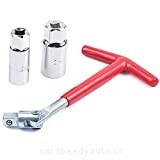
Top | MIKKUPPA Spark Plug Socket Wrench, T-handle Universal Spark Plug Wrench 16mm (5/8") & 21mm (13/16") Remover Installer | Buy Now | |
 Top
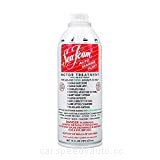
Top | Sea Foam SF-16 Motor Treatment - 16 oz. | Buy Now |
You can repeat the process for all cylinders, but one should be enough. Fully refuel, then mix in at least 2 ounces of SeaFoam per gallon of fuel. Once you start running out of fuel, repeat the process but use 1-2 ounces of SeaFoam. On the third refill, do the standard 1 ounce to the gallon. This will give your engine a full cleanup, but you can also stop after the first or second refill.
Follow the inspection steps again to see the difference in cylinder and piston conditions. If you’d like to swap out spark plugs while you’re there, we’ve got a comprehensive guide on the subject called: How Many Spark Plugs Do I Need?
Sea Foam won’t have any effect on the condition of the spark plugs because it’s a petroleum-based mixture, similar to the petrol used as fuel.
Only if you did it deliberately and had a lot of money to waste. It could potentially have an effect if you add gallons of it, but that’s hundreds of times more than the specified amount.
If you’re asking this question because your hand slipped and you poured too much out of the 16-ounce can – don’t worry, you cannot overdo it with such a small amount.
Yes, adding Seafoam will make even a 4-stroke engine smoke, especially if you add more than one ounce per gallon of fuel. This is a common occurrence and shouldn’t cause concern. However, if the smoke is consistent, stop using SeaFoam and check if you’ve got a head gasket failure or associated coolant leaks.
There hasn’t been any proof that Seafoam affects the O2 sensors or clogs up the catalytic converter.
Sea Foam has been used for decades by thousands of satisfied customers, and with all the feedback and testing conducted, it’s safe to say that Sea Foam actually works as a fuel-based cleaner. I haven’t been selling you on Seafoam as much as I was sold myself. First, my opinion changed on value-brand motor oils through the research for the “Who Makes Supertech Oil For Walmart And Is It Any Good?” article, and now I’ve been convinced that fuel additives can be a very valuable product.
In the near future, I plan on buying a horoscope and conducting my own tests with Seafoam, but I’m confident the results will be positive. When that happens, I’ll make sure to update this article with the results.
Discover new information with these repair tips:
Low Fuel Light Comes On When Tank Is Full: Causes and Fixes
How To Siphon Gas Out Of A Newer Car
How To Open Gas Tank On Nissan Altima?
