
Ask any car owner who’s been driving for a while, and they’re sure to have had this problem. You’re seeing your low tire pressure light, but it stays on even after you fill your tires.
Or perhaps you check the tire pressure and they’re definitely full, but your tire pressure sensor is still on. If your TPMS light is on, but your tires are fine, then this guide will help you.
Whether you own a Japanese-made car like a Honda or a Toyota, European brand like the BMW or Audi, or American car like the Jeep or Ford. This is quite a common issue among all car models, and in this article, we’ll discuss how to get to the bottom of it.
If you’ve never encountered this issue before, you might be asking, what does it mean when my low tire pressure light is on?
Interestingly enough, the problem of your low tire pressure light being on when it doesn’t need to be was never an issue in cars before the ‘90s, when TPMS technology was first introduced.
In 1999, the United States passed a law requiring every passenger car wheel in America to be equipped with a computerized tire pressure sensor, called a TPMS system, that would alert the driver if the tire pressure became too low.
This was because researchers and manufacturers discovered that monitoring tire pressure automatically with a built-in low tire pressure light in the dashboard, rather than relying on drivers to check pressure regularly, had many benefits, including reduced fuel emissions, longer tire life, and less traffic accidents.
Your tire monitoring system can let you know right away if your tires are punctured, for example, which could potentially save you from a fatal accident. On a less intense note, the TPMS might let you know if you’ve forgotten to check your tire pressure for a little bit too long. It’s good to have a reminder!
Given that information, you can see how important it is to make sure that your low tire pressure light is giving an accurate reading.
If your tire pressure light is “the boy who cried wolf,” it will not only be confusing for you as a driver, it could be a serious issue if you actually have deflated tires. So if you ever see your low tire pressure light switch on, do the right thing and check out your tire pressure by hand.
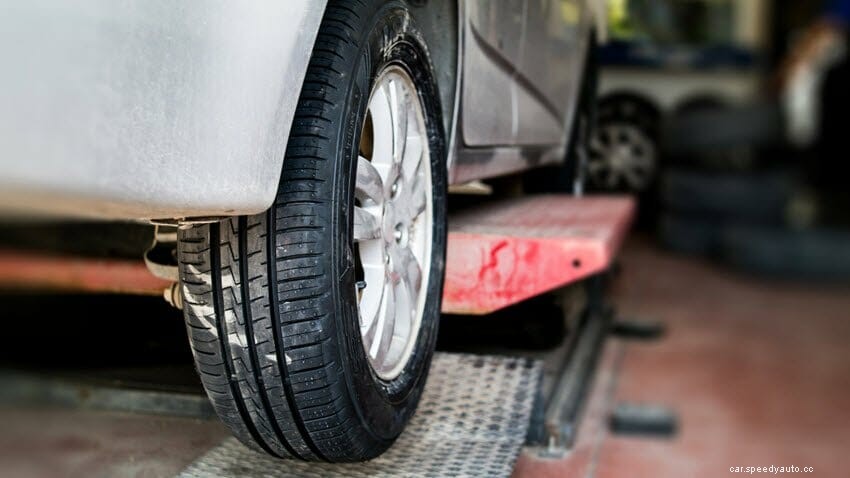
As a car owner, be sure to regularly check your tires to ensure the longevity of your car and the safety and smoothness of your ride. Having the right tire pressure can reduce how bumpy and loud your ride is, and also make sure that your tires last as long as they were designed to.
Tires that are over- or under-inflated can be very dangerous! Over-inflated tires will have less stability and traction and be more likely to blowout. Under-inflated tires, on the other hand, will be loud and bumpy, and cause damage to the treads over time.
Having your tires rotated every 6,000-8,000 miles will also help them stay straight on the road, keeping you headed in the right direction. When you get your tires rotated, that’s also a good time for your mechanic to double check the TPMS sensors on each tire, checking for corrosion or other issues.
Of course, your low tire pressure light will illuminate when your tire pressure drops 25% below the recommended value. Considering that most manufacturers recommend a PSI of between 30 and 35 PSI, 25% is a quite extreme drop!
Your tires lose about 1 PSI (pound per square inch) per month, so it’s a good idea to check your tires with a tire pressure gauge, and then refill them with air if needed, at least every month. Your TPMS is a great help, but it’s important to also take care of your tires manually as well.
Also, it’s a good idea just to have a peek at your tires every time you get in the car. Doing this regular check can ensure that you don’t drive on a completely flat tire that deflated overnight, for example.
Now, with every machine, sometimes there are flaws, or bugs. Often, this can be fixed quite easily. The first thing to do if your car is flashing a low tire pressure light, of course, is to check if you need to add air to your tires using a tire pressure gauge, and adding air if the number you get is lower than your manufacturer’s recommendations, found in your car’s owner’s manual.
If your tire pressure is continually depleted faster than the rate of 1 PSI per month, and your TPMS light is telling you this, it’s probably indicating that you have a small leak in one of your tires that needs repair. Getting your tires checked regularly, and replaced every 25,000 to 50,000 miles, will help prevent issues like this.
But if you’re reading this article, you’ve probably already done that! Read on to figure out why the TPMS might be malfunctioning.

Now, keep in mind that tire pressure is lower in cold tires. So, you may need to just warm your tires up a bit by driving. Also, once you turn your car on, the TPMS always turns on for a few seconds, and that’s nothing to be concerned about.
If, however, your tires are warm, your pressure is normal, and your TPMS light is on and remains on the entire time you’re driving, proceed to the below steps.
There are two sources of a mismatch between your tires’ actual pressure, and what your tire pressure light is telling you.
The first one is that the device on your tires, the TPMS sensor, might be malfunctioning or have a low battery. If this is the case, what usually will happen is that your tire light turns on as soon as you start the car, and remains on the whole time you run the car, despite the fact that the tires are good.
For this problem, you’ll need to buy new devices for each wheel that’s reading incorrectly, which a local auto mechanic can help you out with. Prices for this service vary, but you’ll probably pay about $100 per part, plus labor fees.
If you’ve recently had your tires changed, the mechanic may have damaged one of the sensitive TPMS sensors, so be sure to contact the same body shop to see if they can perform the repair.
The second cause of this issue, which is far more expensive to deal with, is an issue with the tire pressure monitoring system itself, or with the complex computer inside your car. A skilled mechanic can help you figure this out, but be aware it will likely be an expensive fix.
The first thing to do is to get yourself to a gas station, and have an attendant double check your tire pressure readings and ensure there’s enough air in the tires.
Sometimes a second pair of eyes, and someone who does this every day, can help you determine whether or not you’re reading your tire pressure gauge correctly or if one of the TPMS sensors is damaged or broken.
If you get the good-to-go from the gas station attendant, but the low tire pressure light is still beeping at you, try turning your car off and on again. Yes, the classic trick that you tell everyone when electronics go haywire will work on your car too!
The next and final step before seeking professional help is to reset your TPMS. This should be a last resort step, taken only once you have tried everything else–except in cases where you just had your tires replaced or otherwise serviced, in which case you should always reset your TPMS light!
To reset your tire light, check your owner’s manual, but it’s likely that you’ll have to do one of the below things. The usual way to reset your tire pressure sensor system is to turn your key to the “on” position, but don’t start your engine.
Then, press and hold the TPMS reset button for three seconds. This is located underneath the steering wheel. When you see the tire pressure light blink three times, release the button, and the tire pressure monitoring light should turn off.
Another TPMS reset method is driving, believe it or not. Driving at 50 mph for 10 minutes can reset your TPMS, solving this issue.
A third way to reset your TPMS is to inflate your tires to 3 PSI (pounds per square inch) over the manufacturer’s recommendation, deflate them completely, and then re-inflate them again. This should solve the issue of your low tire pressure warning light being on.
Finally, you could also disconnect your car’s positive battery cable when your car is off, then hold down the horn to deplete the car’s energy completely. Reconnect the battery cable, and hopefully, the issue of the tire pressure warning light being on but your tires being fine is solved.
If you’ve tried resetting your TPMS to get the light to turn off, but it’s still staying on, a skilled mechanic can help you figure out what the problem is, and fix it.
If it’s just the TPMS sensors, you’ll likely be set back about $50-220 per sensor, depending on your local mechanic’s prices, labor fees, and the make and model of your car. The batteries in your TPMS sensor are designed to last between 5 and 10 years. Because of technological advances on older cars, it’s more like 5-6 years. So, it’s pretty normal that if you own a car long enough, you will encounter the issue of your tire pressure light being illuminated while your tires are full.
Otherwise, a flashing tire pressure light likely indicates that you need to replace your battery. If you’re buying new tires for your car, it might be a good idea to go ahead and replace your TPMS sensors too, although you don’t have to.
Over time, salt, water, and other corrosion sources can weaken your tire pressure monitors, so you may wind up having to eventually. Either way, getting to a mechanic will get you back on the road safely, with tires full and TPMS safely in tune!
Check some more posts that are worth a read:
Low Tire Pressure Light but Tires Are Fine: Reasons & How to Fix
How To Reset The 2007-2019 Ford Fusion TPMS Light Low Tire Pressure Sensor
How to Reset Tire Pressure Light on the Hyundai Tucson – TPMS Sensor Reset
