
Knowing the curb weight of your truck is important if you want to tow or haul heavy cargo, as going beyond is both illegal and dangerous.
The weight of a truck depends on the chassis layout, trim level, powertrain, and age. For the 2021 Ford F-150, the curb weight ranges between 4,000 and 5,300 pounds.
This article will take you through the weight specifications of the currently relevant F150 models, how to identify the weight of your vehicle, as well as the maximum towing capacity, so continue reading to learn more!
The most accurate way to determine the curb weight of your vehicle is to check the information plate or run a VIN check.
The information plate or sticker is located on the B-column and you need to open the driver’s door to see it. You can find the curb weight, gross vehicle weight, appropriate tire size, and other useful specs on it.
Alternatively, you can run a VIN check – the number is written on the information plate and at the bottom of the windshield on the driver’s side, visible from outside.
The regular cab F-150 layout is the lightest, weighing just a hair over 4,000 pounds with the 3.3L Ti-VCT V6 engine, and up to 4,690 when equipped with the 3.5L EcoBoost V6.
| Regular Cab | Curb Weight (lbs.) |
| 3.3L Ti-VCT V6 | 4,021 – 4,363 |
| 2.7L EcoBoost V6 | 4,171 – 4,546 |
| 5.0L Ti-VCT V8 | 4,300 – 4,650 |
| 3.5L EcoBoost V6 | 4,428 – 4,690 |
In the Supercab layout, the F-150 matched 3.3L Ti-VCT V6 engine is the lightest at 4,345 pounds in its base configuration. The 3.0L PowerStroke V6 weighs 5,208 pounds and is the heaviest.
| Supercab | Curb Weight (lbs.) |
| 3.3L Ti-VCT V6 | 4,345 – 4,598 |
| 2.7L EcoBoost V6 | 4,469 – 4,755 |
| 5.0L Ti-VCT V8 | 4,554 – 4,941 |
| 3.5L EcoBoost V6 | 4,607 – 5,025 |
| 3.0L PowerStroke V6 | 5,208 |
Even in the super-crew layout, the 3.3L Ti-VCT V6 is the lightest option at 4,465 pounds, and it doesn’t surprise that the hybrid V6 is the heaviest at 5,540 pounds when the additional equipment is installed.
| Supercrew | Curb Weight (lbs.) |
| 3.3L Ti-VCT V6 | 4,465 – 4,705 |
| 2.7L EcoBoost V6 | 4,584 – 4,838 |
| 5.0L Ti-VCT V8 | 4,661 – 5,014 |
| 3.5L EcoBoost V6 | 4,696 – 4,995 |
| 3.0L PowerStroke V6 | 5,243 – 5,292 |
| 3.5L PowerBoost Full Hybrid V6 | 5,228 – 5,540 |
The gross vehicle weight rating (GVWR) is affected by the engine and curb weight, which is why the lighter regular cabs hold the lower range. With higher trims, the three layouts even out and come to comparable numbers.
The 3.3L Ti-VCT V6 engine has the lowest GVWR at 6,010 pounds. Interestingly, the 5.0L Ti-VCT V8 has the widest range, from 6,200 to 7,850 pounds depending on trims and packages.
| Engine | GVWR (lbs.) |
| 3.3L Ti-VCT V6 | 6,010 – 6,470 |
| 2.7L EcoBoost V6 | 6,050 – 7,000 |
| 5.0L Ti-VCT V8 | 6,200 – 7,850 |
| 3.5L EcoBoost V6 | 6,750- 7,850 |
| 3.0L PowerStroke V6 | 7,050 – 7,100 |
| 3.5L PowerBoost Full Hybrid V6 | 7,350 |
The gross combined weight rating (GCWR) is based on the fifth-wheel towing and the figures for conventional hitch towing may be lower. Nonetheless, the rating depends primarily on the engine, with the layout making a difference of a few hundred pounds.
The 3,3L Ti-VCT V6 engine is once again the least capable, while all other options but the 2.7L EcoBoost V6 provide similarly high results.
| Engine | GCWR (lbs.) |
| 3.3L Ti-VCT V6 | 9,400 – 13,300 |
| 2.7L EcoBoost V6 | 12,200 – 15,400 |
| 5.0L Ti-VCT V8 | 13,000 – 18,600 |
| 3.5L EcoBoost V6 | 16,100 – 19,500 |
| 3.0L PowerStroke V6 | 16,300 – 18,000 |
| 3.5L PowerBoost Full Hybrid V6 | 16,700 – 18,400 |
The 13th generation regular cab is slightly heavier than the 2021 model, weighing 48 pounds more with the same 3.3L engine. The older models ran a 3.5L engine and has the lightest starting weight of 4,050 pounds. The 5.0L V8 and 3.5L EcoBoost have roughly the same upper curb weight of 4,740 pounds.
| Regular Cab | Curb Weight (lbs.) |
| 3.5L Ti-VCT V6 | 4,050 – 4,385 |
| 3.3L Ti-VCT V6 | 4,069 – 4,506 |
| 2.7L EcoBoost V6 | 4,168 – 4,608 |
| 5.0L Ti-VCT V8 | 4,223 – 4,733 |
| 3.5L EcoBoost V6 | 4,419 – 4,744 |
Supercab layout is 300-400 pounds heavier across the spectrum, with the maximum weights just above 5,000 pounds when paired with the 5.0L Ti-VCT V8 or the 3.5L EcoBoost V6.
| Supercab | Curb Weight (lbs.) |
| 3.5L Ti-VCT V6 | 4,371 – 4,587 |
| 3.3L Ti-VCT V6 | 4,369 – 4,769 |
| 2.7L EcoBoost V6 | 4,463 – 4,703 |
| 5.0L Ti-VCT V8 | 4,554 – 5,024 |
| 3.5L EcoBoost V6 | 4,571 – 5,038 |
In the SuperCrew layout, the 13th generation F150 is the heaviest, from roughly 4,500 with the Ti-VCT V6 engines all the way up to 5,150 with 5,0L V8 and the 3.5L EcoBoost.
| Supercrew | Curb Weight (lbs.) |
| 3.5L Ti-VCT V6 | 4,471 – 4,696 |
| 3.3L Ti-VCT V6 | 4,469 – 4,769 |
| 2.7L EcoBoost V6 | 4,563 – 4,884 |
| 5.0L Ti-VCT V8 | 4,622 – 5,132 |
| 3.5L EcoBoost V6 | 4,679 – 5,142 |
The curb weight correlates to an extension of the gross vehicle weight rating, with the heaviest 4×4 SuperCrew and Supercab models equipped with 5.0L V8 or 3.5L EcoBoost engines offering the best capacity. On the low end, all of the engines provide similar results, between 6,000 and 6,200 pounds.
| Engine | GVWR (lbs.) |
| 3.5L Ti-VCT V6 | 6,010 – 6,350 |
| 3.3L Ti-VCT V6 | 6,100 – 6,500 |
| 2.7L EcoBoost V6 | 6,010 – 7,000 |
| 5.0L Ti-VCT V8 | 6,200 – 7,850 |
| 3.5L EcoBoost V6 | 6,100 – 7,850 |
The gross combined weight rating is limited with the Ti-VCT V6 engines and goes up to 12,600 pounds. The 2.7L EcoBoost has a higher capacity at the low end, but its maximum is just 13,300 pounds. Again, the 5.0L V8 and 3.5L EcoBoost offer the best capabilities, with up to 18,400 GCWR.
| Engine | GCWR (lbs.) |
| 3.5L Ti-VCT V6 | 9,400 – 12,200 |
| 3.3L Ti-VCT V6 | 9,500 – 12,600 |
| 2.7L EcoBoost V6 | 12,200 – 13,300 |
| 5.0L Ti-VCT V8 | 13,000 – 16,900 |
| 3.5L EcoBoost V6 | 15,500 – 18,400 |
The regular cab F150 from this generation had only three engine options available, the lightest being the 3.7L V6 with 4,685 pounds. The other two options are much heavier, ranging between 5,100 and 5,400 pounds.
| Regular Cab | Curb Weight |
| 3.7L V6 | 4,685 – 4,993 |
| 5.0L V8 | 5,083 – 5,368 |
| 3.5L EcoBoost | 4,938 – 5,352 |
Twelfth generation’s Supercabs start at 5,000 and go as high as 5,800 pounds with the 5.0L V8 or the 3.5L EcoBoost engine. When equipped with the 3.7L V6, the maximum weight is roughly 5,300 pounds.
| Supercab | Curb Weight |
| 3.7L V6 | 5,043 – 5,333 |
| 5.0L V8 | 5,169 – 5,777 |
| 3.5L EcoBoost | 5,203 – 5,774 |
The SuperCrew layout is the heaviest, and with the 3.7L V6 engine it comes up to 5,128 pounds. The maximum weight of the 12th generation is achieved with the 6.2L V8, just shy of 6,000 pounds.
| Supercrew | Curb Weight |
| 3.7L V6 | 5,128 |
| 5.0L V8 | 5,254 – 5,716 |
| 6.2L V8 | 5,604 – 5,978 |
| 3.5L EcoBoost | 5,296 – 5,860 |
Gross vehicle weight ratings are based on the cab layout, the engine, wheelbase length and any packages the F150 might have. With the heavy-duty package, the 3.5L EcoBoost is the most capable, while the 3.7L V6 is the least capable at 6,800 maximum GVWR.
| Engine | GVWR (lbs.) |
| 3.7L V6 | 6,450 – 6,800 |
| 5.0L V8 | 6,650 – 8,200 |
| 6.2L V8 | 7,400 – 7,700 |
| 3.5L EcoBoost | 7,050 – 8,200 |
The gross conventional weight rating directly affects the weight limit of the trailer the F150 can tow. The 6.2L V8 has the weakest towing potential without additional towing packages as the trims come with a focus on performance and luxury. The 3.5L EcoBoost is the most capable, with a maximum 17,100-pound GCWR.
| Engine | GCWR (lbs.) |
| 3.7L V6 | 10,400 – 11,100 |
| 5.0L V8 | 12,900 – 15,300 |
| 6.2L V8 | 7,100 – 10,900 |
| 3.5L EcoBoost | 14,000 – 17,100 |
There are several weight ratings you have to consider before loading up the cargo or attaching a trailer. Going beyond the limit is illegal and extremely unsafe, as the load can overcome the brakes and the balance of the truck.
If you put a vehicle on a measuring scale, you’d get its curb weight. From the factory, it only adds the weight of the fuel in the tank, but once you fill it with extra equipment and small items in the cabin, those will also count towards the curb weight.
Dry weight is measured without any fluids, but the exact criteria vary between manufacturers. Some only exclude the fuel, while others measure without oil, fluids, and windshield washer liquid.
Payload weight determines the capacity of the cargo area – trucks bed in case of the Ford F150.
The gross vehicle weight rating has been mentioned in the tables and is an important factor. It combines the curb weight of the vehicle, passengers, and cargo into one. If you only use the curb weight of the vehicle and don’t account for yourself and the passengers, you may go over the limit.
Gross trailer weight is calculated by combining the weight of anything that comes behind the vehicle. This could be an ATV on a trailer, a camping trailer, or farming machinery.
Gross combined weight rating combines every aspect of the GVWR and GTW. This means that the vehicle, passenger, payload, trailer, and trailer cargo all have to be combined into one.
The weight placed on the hitch is only a fraction of the gross trailer weight, but it has to be accounted for, as overloading the hitch can snap it off the vehicle.
Gross axle weight rating represents separate weight limits for the front and rear axle. It’s unlikely that you’ll place any weight on the front axle, as that’s where the engine is located, but the rear axle has to endure the payload and tongue weight.
Ford makes the F-150 truck in three layouts or body configurations: standard cab, Supercab, and SuperCrew.
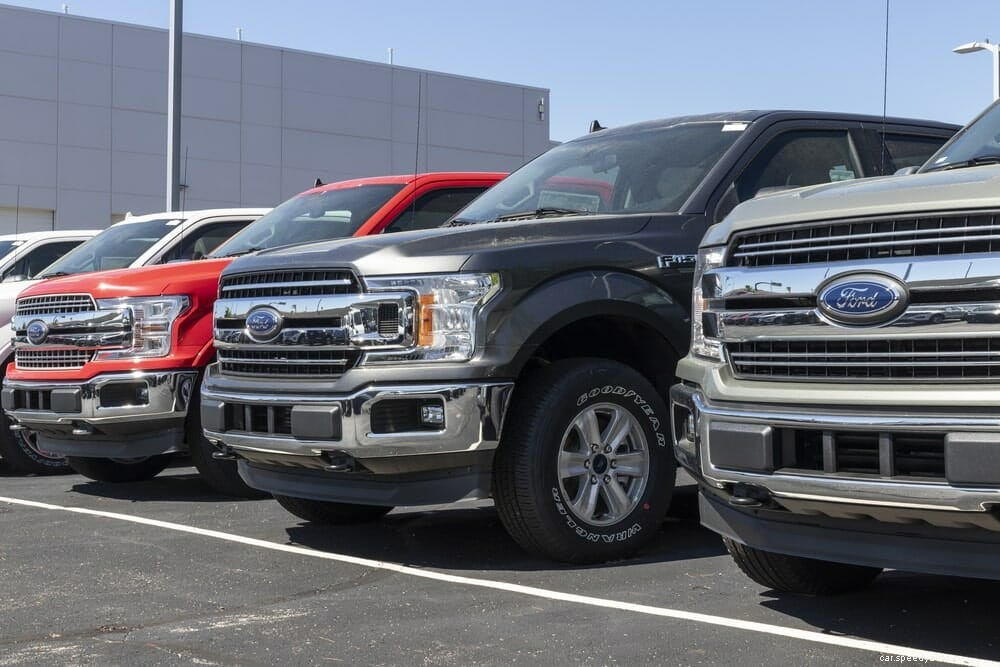
Standard cab represents the classic two-door pickup truck with two or three seats. Because of the inherent design limits, the standard cab can afford to have the longest cargo bed area or have a shorter wheelbase length.
SuperCrew is a standard four-door pickup truck with five or six seats. It balances the passenger number with the cargo bed size. It’s the best option for families or businesses that have to transport more than a couple of workers to the worksite.
Supercab represents the middle ground between the SuperCrew and standard cab and has the characteristic backward-opening rear doors. It has the capacity to transport up to six passengers, but the second-row bench is not as large or as comfortable as the one in the SuperCrew F150.
The lightest F-150 trucks weigh around 4,000 pounds, but when you start adding on equipment, the weight increases by a few hundred pounds. The heaviest 2021 F-150 is the 3.5L hybrid and those equipped with the 3.5L EcoBoost or 3.0L PowerStroke coming close.
Get more tips from these other VehicleFreak articles:
Ford F150 Life Expectancy Miles – How Long Do They Last?
What Size Travel Trailer Can A F-150 Pull?
How To Reset The Battery Light on a Ford F150
