
Steering wheel shake can be very unsettling, especially if you’re moving at high speeds or approaching a series of corners. Whether the issue appears intermittently or is consistent, you should address it or at the very least know what’s causing it.
The most common reasons why the steering wheel might shake are unbalanced tires or misaligned wheels, bad brake rotors or brake calipers, worn suspension, or the steering rack.
The number one reason for the steering wheel shake is unbalanced tires. Those of us that have recently switched to winter tires that were already on wheels may have experienced some shake in the first hundred miles because the tires needed some time to return to their original shape.
Whenever tires are placed on a set of rims, they need to be balanced to run perfectly straight. Think of a wobbly bicycle wheel – car tire has the same issue on a much finer scale, but it’s also rotating much faster so the vibrations travel quickly.
Tire balancing has to be done by a professional as it requires expensive and specialized tools. Luckily, the cost is only $15 to $75 which is affordable.
Staying on the subject of wheels, misalignment is also a potential cause of steering wheel shake. For a wheel to be aligned, it has to be positioned perfectly relative to the ground and parallel to the body of the car.
You’ll experience wheel misalignment with worn suspension or after you’ve just replaced it, so it’s not a job you have to do often, but it’s important nonetheless. Like tire balancing, misalignment can only be corrected by a professional and is not a job fit for a DIY mechanic.

The brake system relies on a metal disc mounted on the axis to endure the friction as the vehicle is slowing down. Over time, it’s normal for the rotor to rust, chip, crack and warp. The imperfections will make the brake pads come in contact with the disc even when the brakes are not applied.
The vibrations and shaking will become even more pronounced when you step on the brakes because the warping causes uneven contact.
Brake rotors should always be replaced in pairs to ensure both sides of the car brake evenly. Rotors cost around $50 each, and it’s a good idea to replace the brake pads while you’re there, which is another $30 for a set of four.
| Title | Price | Buy | |
|---|---|---|---|
 Top
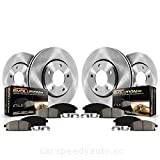
Top | Power Stop KOE6796 Autospecialty Front and Rear Replacement Brake Kit-OE Brake Rotors & Ceramic Brake Pads | Buy Now | |
 Top
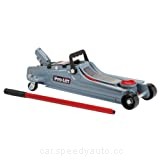
Top | Pro-Lift F-767 Grey Low Profile Floor Jack - 2 Ton Capacity | Buy Now | |
 Top
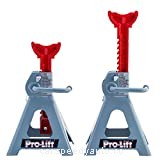
Top | Pro-LifT T-6903D Double Pin Jack Stand - 3 Ton, 1 Pack | Buy Now | |
 Top
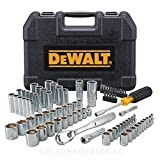
Top | DEWALT Mechanics Tool Set, 84-Piece (DWMT81531) | Buy Now | |
 Top
Top | EPAuto 1/2 Inch Drive by 17.5'' Length Breaker Bar, CR-V Steel | Buy Now | |
 Top
Top | Permatex 24125 Ceramic Extreme Brake Parts Lubricant, 8 oz., Pack of 1 | Buy Now | |
 Top
Top | WD-40 Multi-Use Product, Industrial Size, 16 OZ | Buy Now |
When brake calipers start to fail, the piston will not retract when the brake pedal is released, leaving the brake pedals to grind on the disc and wear each other out. This friction will produce vibrations in the steering wheel but also smell of burning metal and rubber, smoke, and even brake fluid leaks.
Removing a brake caliper is not a difficult task, but it requires you to drain brake fluid and bleed the brakes afterward. Bleeding is a very sensitive task and getting it wrong can cause a loss of braking power, so I strongly suggest that you let a professional take care of this problem.
Suspension is composed of links, joints, suspension arms, coils, and other parts that work together to keep the vehicle on the road, keep it stable, and allow you to maneuver.
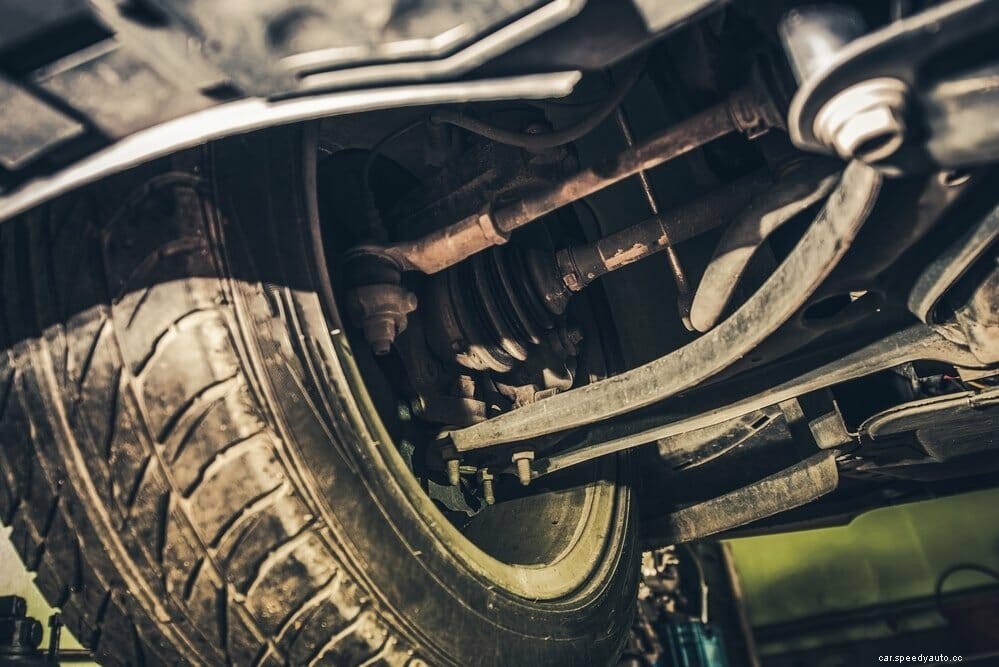
Vehicles with front-wheel drive or all-wheel drive also have constant-velocity (CV) joints. They’re capable of transferring power to the wheel regardless of the angle, which is important as front wheels are used for steering.
Failure of the CV joint is characterized by rumbling noise and vibrations when the steering wheel is turned. The left CV joint rumbles when turning left, while the right CV joint presents symptoms when turning right. However, when the problem is serious, the problem will persist even when driving straight, and neglecting it could cause the wheel to fall off.
Broken control arm, bushings, and worn suspension will also lead to steering wheel shake as the system fails to absorb the imperfections of the asphalt. The bad suspension will cause other components to wear out more quickly, impact control, and is a serious safety risk.
The steering rack is directly connected to the steering wheel, making it an obvious suspect. Failure of the rack leads to steering wheel drift, unresponsiveness, and shaking.
Aside from the steering rack, the power steering system is also worth checking. Recently, I’ve experienced a steering wheel shake and noticed a significant amount of power steering fluid leaking underneath the vehicle. As the pressure drops, the steering wheel becomes increasingly difficult to turn.
Most vehicles use what is called a rack and pinion for the steering system. The rotational force applied to the steering wheel is converted into linear motion that pushes and pulls the front wheels.
Power steering uses hydraulics to assist you in moving the steering wheel left and right, especially when the car is stationary. If you’ve ever tried to turn the steering wheel on an older car or when the engine isn’t running, you know how physically demanding it can be.
Because the steering has a direct connection to the front wheel, vibrations will translate to the steering wheel and impact control.
It’s generally not a good idea to drive a vehicle with a shaking steering wheel. If it’s not the tires, the problem is caused by a serious failure that can lead to a loss of brakes, control over the vehicle, and major engine damage.

In most cases, a simple tire rotation or wheel alignment is enough to sort the problem. If you change the brake rotors, brake pads, and suspension components at regular intervals, you will avoid shaking caused by their failure.
The first symptoms of a bad tie rod are vibrations and shaking in the steering wheel. You may also hear rattling and metallic noise, especially when turning at an intersection.
Older vehicles had some vibrations in the steering wheel because of archaic suspension and lack of power steering. Vehicles made in the last 20-30 years shouldn’t have noticeable shaking or vibrations, except in the case of some diesel-powered vehicles at idle RPM.
Unbalanced tires cause vibrations in the steering wheel and car which increase in intensity with speed. Turn the wheels fully to one side or the other to expose the tire, then take a look at the wear of the tread. When they’re unbalanced or misaligned, tires will wear out unevenly.
The wobbling of the wheel is the final stage of CV joint failure, followed only by the wheel coming off the vehicle. If the joint has been worn to this point, even driving to the mechanic’s shop or a dealership for repairs would be high risk.
Death wobble is a scary failure of the front suspension that causes violent vibrations of the steering wheel and the entire vehicle, sometimes causing a total loss of control and serious accidents. It isn’t clear what’s causing the death wobble, but it’s most likely to happen if maintenance and repairs are neglected.
If symptoms of steering wheel vibrations and shaking emerge, start your inspection with the wheels. Tire balancing and wheel alignment are the most common and easiest problems to fix.
Brake system problems are identifiable by their specific symptoms – the smell, grinding noise, and the lack of power due to brakes sticking. Lastly, we have the suspension and the steering rack which should be inspected and repaired by a professional.
Check out more similar posts here:
Steering Wheel Won’t Lock And Car Won’t Start
Reasons For Noise When Turning Steering Wheel While Stationary
10 Reasons For A Steering Wheel to Make a Rubbing Noise When Turning
