
As you may know, modern cars are incredibly complex with computers and many electrical components that allow your car to perform smoothly. The PCM is a component that makes your drive great.
Understanding what is a PCM on a car, what it does, and why is it important will allow you to know your car inside and out and thus make you a better car owner.
The Powertrain Control Module or the PCM for short is an integrated computer that has several other modules within. As the name suggests the PCM is in charge of controlling your drivetrain which includes the engine, transmission, and other driveline components.
A term you might have heard, ECU or Engine Control Unit which is also sometimes referred to as Engine Control Module or ECM. The Engine Control Module is a separate computer in some vehicles but it is a part of the PCM.
Additionally, you might have heard of the Transmission Control Module or TCM. This is also a component of the PCM. The Engine Control Module and the Transmission Control Module work together to ensure that your car runs smoothly.
What is a PCM on a car? To know that, you should know how it works.
The Engine Control Module takes information from multiple sensors from your car and adjusts the engine settings accordingly so it can drive smoothly. The ECM takes information from the exhaust system, cooling system, air intake, and other components.
Afterward, it will make changes to the engine settings accordingly.
For example, if your engine isn’t getting enough air, the Engine Control Module will reduce the fuel so it gets complete combustion. The ECM can also control other things like the camshaft, throttle position, and ignition timing.
Much like the ECM the Transmission Control Module or TCM controls several components in a car. By using data from the sensors in your car it controls the transmission similar to the way that the Engine Control Module controls the engine.
Only vehicles with an automatic transmission use the TCM, while manual transmission cars only use the ECM.
For example, the rev-matching function in many sports cars is done by the ECM. It matches the clutch and engine speeds during shifts automatically by using data from the ECM. Older TCMs will decide on switching gears by accounting for the speed of the car and the engine.
Modern ones, however, take more input, this includes data from the cruise control, throttle control as well as traction system. Modern TCM not only decides when to shift but also helps reduce wheel spins and gear hunting.
So, what is a PCM in a car do? Does the PCM control the drive train by using the combined help of the TCM and ECM systems? It coordinates the 2 systems in a way to implement better fuel economy and performance.
For example, when the transmission is about to downshift the PCM can ease the throttle a bit for a smoother downshift. But there are some main jobs that the PCM does besides this. Let us look at a few other functions of the PCM.
The PCM is able to control the time at which a spark plug fires. It accordingly adjusts the fuel economy or performance based on your throttle control.
The PCM also controls your engine’s idle RPM, so for example, if you’re parked and you turn on your air conditioning, the engine starts revving to accommodate the energy demand. The PCM controls it so that it does not waste fuel unnecessarily.
By using information from the Engine Control Module the PCM will adjust the air to fuel ratio in your engine. In most conditions, the ideal ratio is 14.7:1 which is 14.7 grams of air for every 1 gram of fuel.
The ratio differs according to the vehicle and the model, but the PCM will do its best to get the optimal fuel ratio set by the manufacturer. However, it won’t always be able to get this ratio. When the PCM detects that the engine isn’t getting the correct ratio, it will try to compensate for it to prevent the engine from stalling.
This is perhaps one of the most important functions of the PCM. The PCM will find errors in your car and do what it can to rectify them. However, if it can’t fix these issues, it will alert the driver by lighting up the check engine light.
For example, if your PCM detects that your engine isn’t getting enough air it will try to take in more air, but if the mass airflow has an issue, the PCM will get the information by the mass airflow sensor and identify the problem and alert it to the driver.
The Check Engine light comes on in one of three ways. steady, intermittent, and high speed. If the Check Engine light stays on, the engine has a minor problem that needs to be checked. On the other hand, intermittent and fast flashing means a more serious problem, often caused by incorrect engine ignition.
In this case, you must immediately stop driving and have your vehicle towed to the nearest service station. Continuing to drive may cause further engine damage.
However as quick and intelligent as PCMs are they can be powerless to function properly when they become faulty. For instance, if a sensor is faulty the PCM might not receive the correct information it needs to function properly or not receive information at all.
During such instances, the PCM will be powerless to fix certain small problems thus larger problems can arise. Here are some common problems that occur with faulty sensors or a faulty PCM.
The PCM, ECM, and TCM are generally designed to extend the life of the vehicle. However, internal components wear out over time, and corrosion can lead to premature wear. Since life usually depends on the manufacturer’s design and build quality, the mileage at which they tend to fail may vary by vehicle make and model.
You are unlikely to experience PCM damage, especially if you are driving a new car. However, there are a few signs to look out for.
A faulty PCM can prevent the car from starting. Turning the key may cause the engine to rotate normally, but it will not start. This is because the faulty PCM is unable to send the correct signals and commands to the machine, causing the machine to crash.
For example, a faulty PCM may not be able to tell the ignition system when to fire the correct cylinder. Without proper ignition, the combustion process in the engine cannot start and the engine will not start.
Of course, there are many reasons why your vehicle isn’t starting. If your vehicle won’t start try troubleshooting using the ways you’d normally do. If none of the fixes work, your PCM might be faulty.
As mentioned earlier, the PCM can control the amount of fuel going into the engine. A faulty PCM can cause incorrect readings of the amount of fuel entering the engine.
For example, an injector is injecting more fuel than needed, but the PCM doesn’t take this into account, so it doesn’t reduce the amount of fuel. The result is low fuel consumption.
Of course, other factors can cause the engine to consume more fuel. Bad tire pressure, faulty oxygen sensor, faulty mass airflow, spark plugs, injectors, etc…
The PCM will register an error code when it finds a problem with the drivetrain or transmission that it possibly can’t fix by itself. When it registers an error code, it will flash the check engine light letting the driver know that there is a problem.
Although, a faulty PCM might display the wrong error codes or register an error code while there are no errors.
When connecting to a car’s computer with an OBD 2 scanner, you can determine the problem code. From there, an OBD 2 scanner will scan your computer and display an error code. For example, code P0301 means there is a misfire problem in the cylinder.
However, if you’re not experiencing any misfire issue, then your PCM has registered a false error code, in which case the PCM might be faulty. Keep in mind that this problem may also stem from a faulty sensor.
However, once you’ve verified that there’s no actual issue with the vehicle, then you can narrow down the problem into either the PCM or a faulty sensor.
Since the PCM controls the engine, it is obvious that a malfunctioning PCM will affect the performance of the machine. It may not turn on while driving, or it may suddenly stop and turn off. However, as with any other symptom on this list, there are many reasons why your engine might not work.
A faulty engine ignition can be caused by a faulty spark plug that does not ignite properly. An engine shutdown can be caused by insufficient air supply to the engine, which is usually caused by a defective mass airflow sensor or a clogged air intake.
You will need to troubleshoot the problem and this can take a long time if you do it yourself. But if you want to save some money, this is a viable option.
Most vehicle malfunctions usually follow a pattern. For example, if the air intake is clogged, the engine may not work only at higher speeds. This is because the higher the RPM, the more air the engine needs to run, and if the intake is clogged, the engine will not get the right amount of air, preventing ignition.
On the other hand, PCM problems are often more unstable and do not have a consistent pattern. If your engine is suddenly behaving strangely, you have good reason to believe that the problem is with your PCM.
We now know that the PCM works closely with the check engine light and serves to alert the user when a problem is detected in the vehicle’s transmission. But what if the check engine light is on?
Well, as mentioned earlier, you should stop driving immediately when the check engine light flashes. This is a serious problem and continued driving can cause severe engine damage.
If the light is not flashing and it is solid, don’t panic and you can keep driving, but it’s best to fix the problem as soon as possible. The first and easiest thing you can do is check the gas cap. This is because the check engine light may come on if the cap is loose. If it is loose, tighten the cover if necessary.
Turn the machine off and on again. If the check engine light is still off, turn the ignition on and off 3 times in succession and remove the check engine light.
However, if the light is still flashing you may have another problem in which case you might need to use an OBD 2 scanner to find what the issue is.
Now that you know what is a PCM on a car, you know how important it is to have a functioning PCM. So when you notice that your PCM is faulty, then you need to invest in a replacement.
The Powertrain Control Module contains software and it needs to be updated from time to time. Much like your smartphone, software updates are necessary so that optimum performance can be maintained.
A faulty PCM can also be caused by buggy old software that hasn’t been updated. Thus your PCM problem might be as simple as a software update or a reboot. But if your PCM has a hardware problem then you will need to replace it.
If you have a faulty PCM, the first thing you should do is check your vehicle’s drivetrain warranty. If the PCM is included you may still be able to claim it, otherwise, it is costly.
The cost of replacing a powertrain control module varies greatly by vehicle make and model. Prices range from $450 to $2,000. This is because cars use different PCMs and have different complexities depending on the make and model.
For example, a Honda Accord PCM might start at $570, add about $80 to labor, and cost about $650. Meanwhile, a Mercedes Benz SL500 has a bigger engine and much more features, therefore, has more complexities.
The PCM for a 2003 Mercedes-Benz SL500 would cost you about $1900, and that’s without labor costs.
Well if your car’s resale value is significantly higher than repair costs then, although the Powertrain Control Module replacement might be very expensive it is recommended that if repair costs aren’t worth it, you might be better off selling the car as it is.
Of course, if you take the decision of continuing with repairs. There are a couple of things to note first, always try to get brand new Powertrain Control Modules because with second-hand PCMs the condition cannot be confirmed unless you install it.
But if the seller agrees that you try it out first and pay then depending upon the condition of the PCM you should be better off getting a second-hand PCM, but the best thing you could do is buy a brand new PCM from the same manufacturer.
Next, if you plan to do the installation by yourself first you should always disconnect the battery from the engine before working on an electrical component of the car. And also if you do the repairs by yourself this will lower the repair costs since you don’t have to pay for labor.
However, the labor cost is relatively cheap compared to the price of the PCM itself. Unless you’re on a really tight budget doing the installation by yourself is really not recommended, you will need to check the owner’s manual if you are installing it yourself because the steps of changing a PCM will vary on model and maker.

Here are some of the most frequently asked questions regarding what is PCM on a car?
There is no standard location for the PCM in a car. It can be located in a few different places. The most common location is the engine bay. But in some models, you will find it covered near the windshield.
If you notice that your PCM is malfunctioning, you could try to reset it. But will this work? If it is an electrical malfunction it could work, so it is worth a try.
The easiest way to reset your PCM is to disconnect the battery. Remove the cables from the battery, and wait for about 5 minutes. Now reconnect your battery and start the car. This should reset your PCM.
It depends on the damage to the PCM. If your PCM is malfunctioning, some features in your car will be affected. So there is a chance that your starting mechanism is unaffected.
If the PCM has completely failed, your car won’t start. The PCM ensures that the camshaft and crankshaft are positioned correctly so that the engine starts properly. It also controls the time at which the spark plugs fire. So a failed PCM could be the reason why your car doesn’t start.
Basically, reflashing a PCM means upgrading the software. PCM is equipped with an electronic chip. These chips can be reprogrammed electronically, without having to remove the PCM from the car.
Reflashing is the process where you send approved files from the manufacturer to the PCM, thus upgrading its software. The process is done using a diagnostic connector.
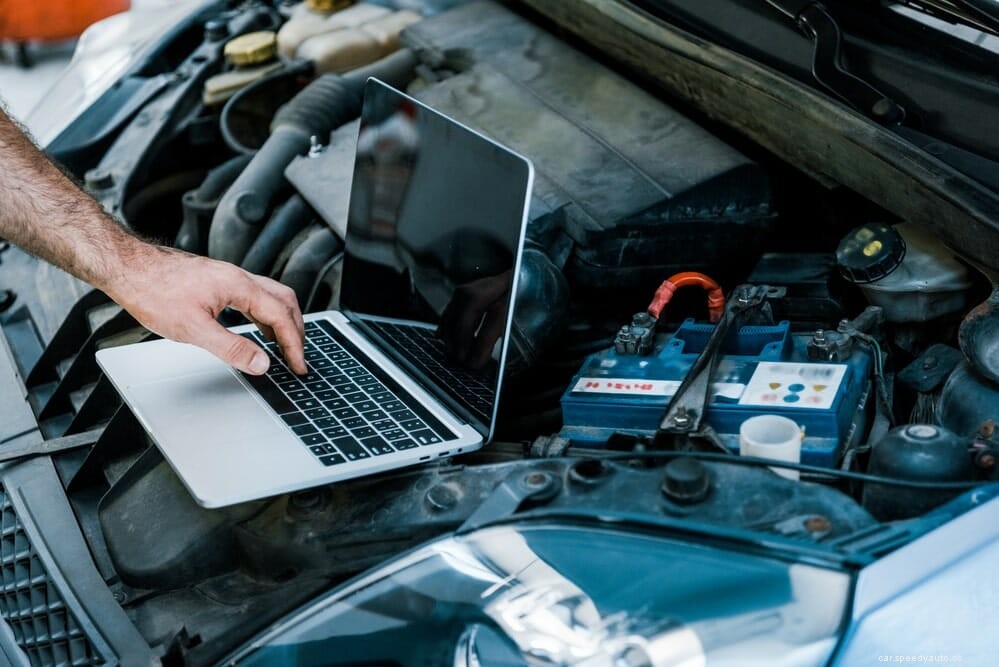
The process takes about half an hour to complete. But most mechanics will charge you for one hour of work. There are no parts associated with the process, so that is not going to cost a lot. But depending on labor charges, you should expect to pay between $80 to $150.
This is one of the rare instances where a dealership might be a cheaper option. So we recommend taking your car to a dealership if you need to reflash your PCM.
if your check engine light is flashing you shouldn’t continue driving. But if it is solid, you can keep on driving. But you should get it checked sooner than later.
The check engine light means that danger is imminent, not immediate.
A Powertrain Control Module is a system that coordinates the Engine Control Module and the Transmission Control Module so that it maximizes fuel efficiency and makes the vehicle run as smoothly as possible. Additionally, it will also give good control and responsive throttle power.
Not only that the Powertrain Control Module can alert you to most technical problems in the car by the information taken to the PCM by sensors, but the PCM can also help drivers adjust engine settings to their preference.
Even though PCMs are made to last a lifetime they can fail because of outdated software or wear and tear. When they do fail your engine may behave erratically and show false error codes. In such a case you may need to troubleshoot and verify the issue.
And if the issue is truly stemming from the PCM, you should replace it. Replacement costs for Powertrain Control Module can go more than $2000 at times based on the complexity of the engine and transmission features of the vehicle but usually, PCM replacement costs an average of $1250.
Driving without a functioning PCM will do more harm than good. So even though a replacement might seem costly, it is the best solution that you have.
