
 The wheel bearings in your car take a lot of abuse and, not surprisingly, why we get a lot of questions about wheel bearing noise and signs of bad bearings. But first thing’s first, what is a wheel bearing? A wheel bearing is a set of small steel balls which are held together in a metal ring called a race and help a wheel spin by reducing friction. Wheel bearings ride on a metal axle shaft and fits tightly inside the hub, a hollow piece of metal at the center of the wheel. The hub holds the lug bolts that you use to bolt the tire onto the wheel. Not only does a wheel bearing have to support the entire weight of your vehicle while it is traveling over rough roads, potholes and maybe the occasional curb, they also have to take the lateral forces of corners you take and have to do all that while allowing your wheel to spin at thousands of revolutions per minute. Unlike your engine bearings, your wheel bearings don’t have a constant supply of oil lubricating and cooling them, they have to be self-sufficient and also be sealed tight enough to keep road dust and water out of them. Bearings are used in all sorts of things we use every day so you might be interested to learn about more uses for bearings!
Since a wheel bearing has to accomplish all this for hundreds of thousands of miles, it’s not surprising that they wear out occasionally. Wheel bearing wear and tear can happen for a variety of reasons we’ll look at in a minute. A bad wheel bearing sound is usually a loud hum coming from that wheel sort of like loud road noise from bad tires. A similar noise can come from worn bearings in your transmission or even a low transmission fluid level. It’s important to regularly check your transmission fluid level find out if you have a leak in your transmission so you can get the problem fixed before any damage occurs.
On classic cars, wheel bearings were a set of tapered roller bearings on a non-drive wheel or a straight bearing supporting an axle of the drive wheel. Today, most vehicles use a unit bearing pressed or bolted onto the hub or knuckle. These unit bearings are sealed units that cannot be serviced. The benefit is that it’s very difficult for contamination to get into the bearing to cause accelerated wear. The downside is that the bearings cannot be serviced, cleaned or re-greased to once they are worn out the whole bearing must be discarded and a new bearing assembly installed.
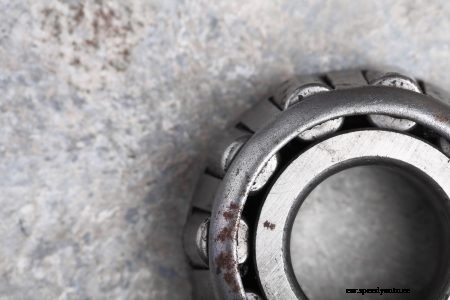 No matter what type of bearing you have, bad wheel bearing symptoms are the same. A wheel bearing will usually fail due to pitting or small damage on the surface of the rollers or the bearing race. Both the surface of the rollers and the race are precision machined to tight tolerances and highly polished to allow the rollers to pass easily over the race with the addition of bearing grease for lubrication and cooling. Over time the bearing will wear slightly, allowing microscopic pieces of metal into the grease. These microscopic pieces of metal, as well as any contamination that gets into the bearing, will wear away at the highly polished surfaces causing pitting and deformation. Since so much weight is riding on your wheel bearings, and so much load is put on them in corners, even the smallest amount of surface damage to your bearing can cause a lot of noise like a growling or humming or in some cases a grinding noise.
Determining if you’ve got a failed wheel bearing in your car can often be a difficult task. Since a failed bearing sounds a lot like excessive road noise, it can be hard to do a wheel bearing noise diagnosis to tell if you’ve simply got worn tires or a bad wheel bearing. Similarly, there are a lot of other noises your suspension can make that make it hard to tell what’s really going on down by your wheels. Often times it can be easier to rule out other problems with your car that can cause noise to help prove you really do have a bad wheel bearing. We recommend starting by rotating your tires to see if the noise changes. If it does, you probably have unevenly worn tires. If it doesn’t, you may have a bad wheel bearing. Here are a few other sounds and symptoms of bad wheel hub bearings:
Many people wonder if vibrations are a common bad wheel bearing symptom. And the answer is that if the race or rollers in your bearing have become pitted due to wear or from water getting inside the bearing, then yes it will cause vibrations when you drive. Interestingly, the vibrations are different depending on your vehicle speed. At very low speeds (less than 5 miles per hour) you may be able to actually feel these vibrations as your creep along. At higher speeds, these vibrations will just sound like humming and feel like you’re driving on a washboard surface. To best way to feel the vibrations is by lifting your wheels off the ground one by one and spinning them to see if one is dragging or rumbling as it spins. You may have to do this with the wheels on or off the car to be able to feel the difference. If your wheel bearing is extremely worn you may also be able to feel the wheel wobble in your hands as you spin it.
The truth is the thing that most often makes a wheel bearing go bad is simply driving. The constant revolutions coupled with the weight of your car will eventually wear out even the best bearings. If moisture gets into the bearing grease it can accelerate wear by decreasing the oil’s ability to lubricate and by allowing rust to form. Driving in the rain isn’t a big deal but driving through standing water may allow moisture into the bearing. Similarly adding load to the bearing can decrease its life and cause it to go bad early. Following the load rating of your vehicle can allow the bearings to live a long and easy life.
Having a wheel bearing replaced is a relatively straightforward procedure so you should be able to get a very accurate quote over the phone by providing your year make and model to a local shop. It can be a good idea to call for a few estimates before choosing a shop to repair your wheel bearing as the prices can vary significantly due to press fees and other incidental labor fees associated with the job. If the steering knuckle needs to be removed to replace the wheel bearing on your car, you may also need to replace some suspension components like a lower ball joint or tie rod end as these can be damaged during removal if they are old or worn. If you have wheel bearing noise it’s important to get it taken care of as soon as possible since you never know how much longer the bearing will support your car!
Pictures provided by:
wheel_bearing.jpg – By pichitstocker – Licensed by Getty Images – Original Link
worn_wheel_bearing.jpg – by Sudok1 – Licensed by Getty Images – Original Link
