
As the role of the alternator is to charge your battery, its health will directly affect your battery’s performance and lifespan. Therefore, although the alternator generally does not require a lot of maintenance, you need to test it regularly to make sure it is in good working condition. You might have heard of the multimeter or voltmeter test, but not many drivers know how to test alternator with screwdriver, which is very simple and useful without the need to buy a voltmeter. Even without the need to turn on your car!
This article will walk you through the steps to test the alternator field current as well as explaining what it is and why you should pay attention to this metric.
The alternator produces electricity from the car’s mechanical energy. It uses this electrical energy to run various electrical parts such as lights, conditioning units, … and to charge the battery. When you hear someone talking about a “charging-system problem”, they are talking about the alternator. If the alternator is working well, the lifespan of your car’s battery is maximized. If it overcharge or undercharge, the battery’s life will be shortened.
READ MORE
A super, super easy way to know how to test alternator with screwdriver at home is to use a screwdriver to check whether the alternator produces a magnetic field. If there is a magnetic field, the alternator is in normal working condition. Then why is the existence of this magnetic field important?
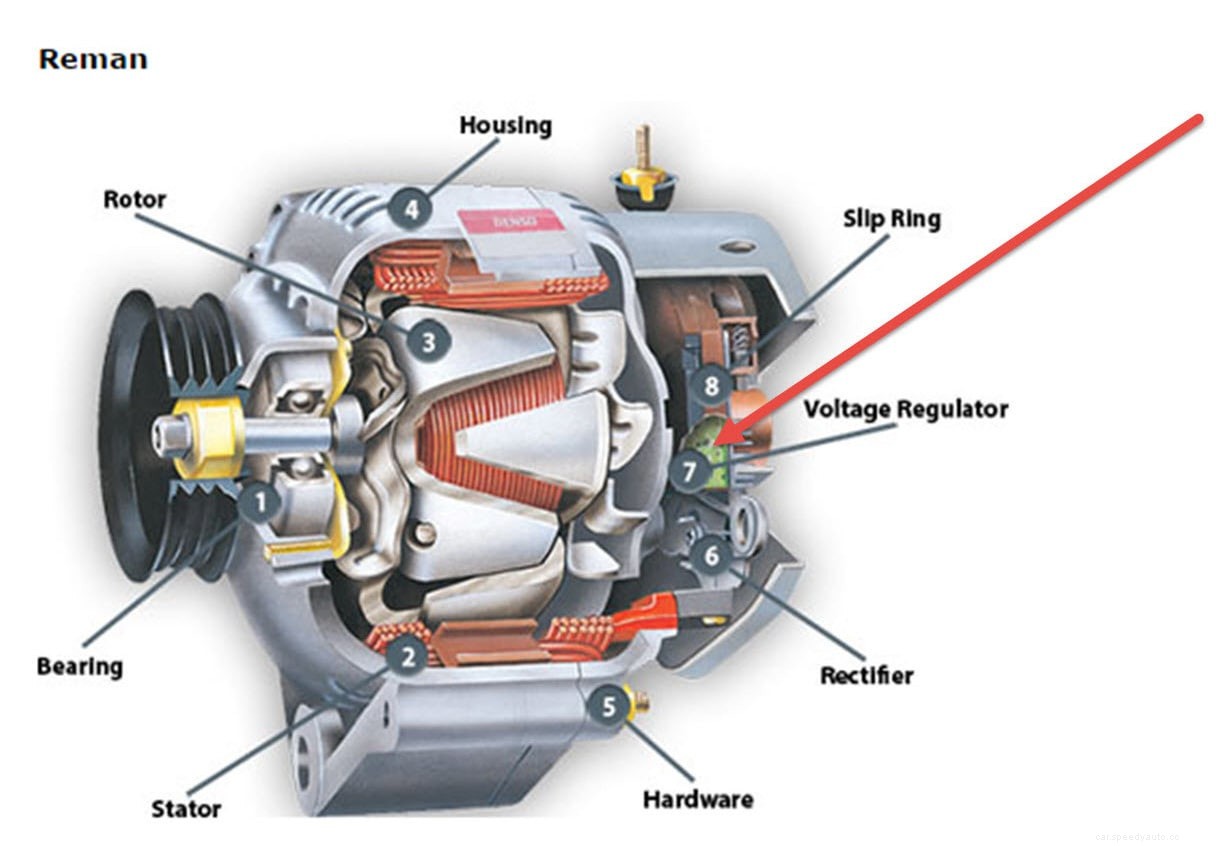
As the engine rotates the alternator pulley, the alternator rotor spins. The rotor consists of a wire coil wrapped around an iron core. Current running through this wire coil is called “field current”, and this field current produces a magnetic field around the core. The stronger the field current, the stronger the magnetic field.
Therefore, as you will see later on, we will check whether there is such a magnetic field and if it’s strong enough. If there is such a magnetic field, this implies the existence of a strong enough field current, thus the alternator should be working fine.
To be able to produce the voltage ready to charge the battery, your car’s alternator requires a voltage regulator. It modulates the small field current to produce a constant voltage at the battery terminals. With the help of a set of rectifiers or diode bridge, the AC voltage produced by the magnetic field is converted into DC voltage, which charges the battery.
The relationship of the whole system here is that the stronger the field current reaching the alternator rotor, the stronger the resulting magnetic field, thus the more DC voltage the alternator produces that can be used to charge the battery.
The voltage regulator is connected to the battery and ensures that the battery gets exactly the amount of voltage it needs, as too high or too low a voltage can damage the battery as well as other electrical components. The voltage regulator gets feedback from the battery and determines the amount of field current allowed to pass through the regulator to the rotor.
If the battery voltage drops, the regulator allows more of the field current to reach the rotor, which makes the resulting magnetic field stronger. This ultimately means the alternator now produces more voltage. Conversely, if the battery voltage increases, less field current reaches the rotor, which reduces the strength of the magnetic field and ultimately reduces the alternator’s voltage output.
A side note is that the alternator field current is substantially lower than the current output of the alternator in operation. For example, an alternator that produces from 40 Amp up to 120 Amp during operation (high-amp alternators can generate from 200 Amp up to 300 Amp) might only need a couple of amperes of field current. A 70 Amp alternator may need only 7 Amp of field current.
Now that you know why we’re trying to test the alternator’s field current, let’s learn how to test alternator with screwdriver in your own garage.
You might have read somewhere that when testing the health of your alternator, you must always test the battery first. This is because the battery gets the car started; when the car runs it spins the alternator and this spinning keeps the battery charged. If the battery is too weak, it will not get the car running and thus any later test to check the alternator will be useless.
However, if we’re testing the alternator’s field current using a screwdriver, the best part is you won’t need to test the battery first and you also won’t need to start your car. It’s a very simple process.
Here’s how to test alternator with screwdriver at home:
If you’re encountering these problems, chances are your car is having a failing battery or alternator:
READ MORE
Technically the car can still run but only for a short while, since it is strictly only using the power stored in the battery. A bunch of other parts of a car consume power as well: headlights, brake lights, interior lights, engine control unit (ECU) …
So in short, the answer is no. Because a car with weak electrical power doesn’t have enough “food” to feed many necessary components to function in order to get it running. If this alternator problem manifests on the road, especially during a long drive, your safety goes out the window. You should test the alternator and the battery at regular intervals, say every 4-6 months.You should familiarize yourself with basic DIY maintenance tools and tips to give your vehicle frequent and proper health check in your own garage.
Alternators generally do not need much maintenance as they are very durable and can last for many years. That said, you should regularly check your alternator along with your scheduled maintenance to ensure your vehicle is always in tip top shape. If at any point your alternator fails or malfunctions, your car will stop after no time.
Protecting your alternator is all about keeping your engine safe, as they are close to each other. This includes making sure your engine’s protective cover is intact and replacing it if there’s any damage to prevent any splashes from the road from reaching your alternator and engine, and dealing with any oil leak as soon as possible as leaks might affect your alternator. Moreover, whenever you decide to wash the engine compartment, the alternator must be well covered to keep it from water and cleaner.
