
An estimated one to two million crashes between a motor vehicle and large animal occur every year in the United States, according to the Department of Transportation. Once thought to be strictly a problem in large, rural states, such crashes are becoming increasingly common in more urban areas as roads and other construction expand into previously undeveloped animal habitats.
Fortunately, there is an effective, well-supported solution to this growing problem: wildlife crossings. Unfamiliar? We don’t blame you. These roadway features are a still rare find, especially in the densely populated Northeast. So, what exactly are wildlife crossings and when can we expect to see more?
Before we get to the solution, let’s define the problem. If you live in an urban area, you may not be fully aware of just how prevalent WVCs are. The scale and scope of the issue, however, quickly comes into focus once you look at the numbers. A study from the Federal Highway Administration found the following:
A wildlife crossing is a manmade structure that allows animals to safely cross over or under a roadway. It is designed to act as an extension of the natural landscape, connecting animals to surrounding areas that are otherwise cut off by the road. In doing so, it prevents habitat loss and fragmentation, as well as reduces the prevalence of VWCs.
There are many different types of wildlife crossings. Some of the most popular include green bridges, overpasses covered in grass and other vegetation, and culverts, tunnels and passageways running underneath a roadway.
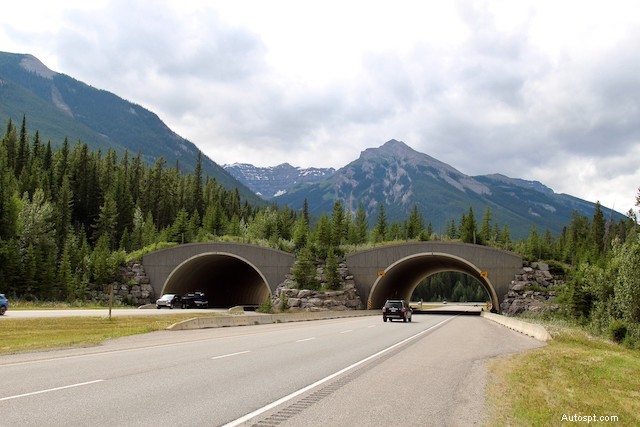 A wildlife bridge in Canada’s Banff National Park (Photo: daveynin)
The answer is a resounding yes. Research by Montana State’s Western Transportation Institute in 2009 found wildlife crossings used in combination with fencing reduced WVCs by 86%. More recently, a 2021 study from the U.S. Forest Service found that wildlife crossings nearly eliminated WVCs completely (a 97% reduction).
There are numerous real-life examples supporting these findings. Animal mortality dropped 93.5% in Florida’s Paynes Prairie State Preserve after a wildlife crossing was constructed. A combination of over- and under-passes along Colorado’s State Highway 9 reduced WVCs by 88%. Since completion of a wildlife underpass across Oregon’s Highway 97 in 2012, the roadway has seen more than a 90% drop in collisions with animals.
Similar success stories have been reported the world over, including Brazil, Mexico, Australia and the United Kingdom. In fact, the most oft-cited wildlife crossing is found just north of the border in Canada’s Banff National Park.
As visitation to the park surged in the 1970s, so too did traffic congestion on the section of Trans-Canada Highway running through the area. More motorists also meant more WVCs. To combat the growing problem, officials constructed several underpasses along the road in the 1980s. In 1996, the first wildlife crossing bridges were constructed.
Today, there are six overpasses and 38 underpasses along this section of the highway. Combined with fencing, they have reduced WVCs by more than 80%, including a 96% drop for deer and elk. As Western Transportation Institute researcher Tony Clevenger told Canadian Geographic, “This is Canada’s biggest conservation success story.”
Although wildlife crossings have proven to be highly effective, they are still underutilized. That should begin to change in the near future.
Included in the massive bipartisan Infrastructure Investment and Jobs Act passed last year is funding for a Wildlife Crossings Pilot Program. The program will allocate $350 million over five years to federal, state and local governments and agencies to construct wildlife crossings in the U.S. that reduce WVCs and improve habitat connectivity for animals.
Learn more about traffic safety.
Last updated on March 9, 2023 by AAA Staff
