
Most people have at least heard of a torque converter, but only serious gear heads actually know what a torque converter does. That lack of knowledge can be pretty problematic because a faulty torque converter can result in some severe (and expensive) damage. But don’t worry, we’re here to help. In this article, we’ll explain what a torque converter actually does, discuss the symptoms of a bad converter, and explain why they go bad in the first place.
Before we can dive into the signs of a bad torque converter and diagnosing specific issues, let’s establish what a torque converter is in the first place.
The short answer is that a torque converter is a kind of clutch.
Let’s dive in a bit deeper.
You’re likely aware that vehicle transmissions come in two types—manual and automatic.
With a manual transmission, drivers must operate a clutch to shift through the gears.
A manual clutch also plays a vital role in stopping the vehicle. If a driver doesn’t depress the clutch when they come to a stop, the engine will die.
To put it another way, a clutch helps to separate the transmission and the engine and allow them to operate independently.
By its very definition, an “automatic” transmission doesn’t have a “manual” clutch.
That’s where the torque converter comes in. The converter is what allows an engine and automatic transmission to function independently.
It applies the necessary power to the vehicle’s rear wheels so that it can accelerate.
In cases where an engine is rotating faster than a transmission, the converter can double or triple the torque output to deliver necessary power.
It also allows the vehicle to come to a stop without killing the engine.
So, it’s not all that hard to understand how important a torque converter is, right?
The truth is that a torque converter is a pretty complex piece of equipment, and before we get into what can go wrong with them, let’s dive a little deeper into how they’re built.
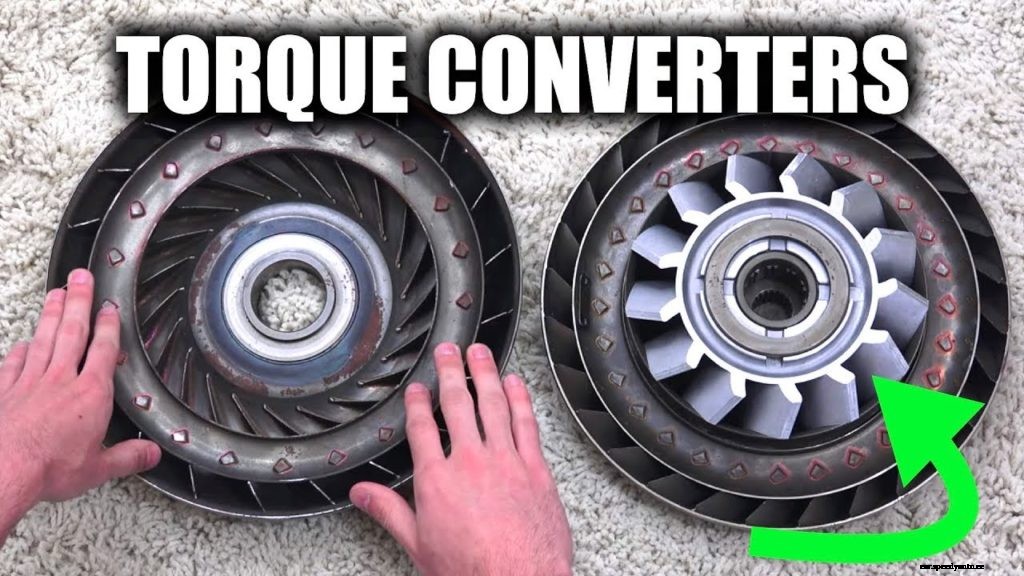
A torque converter has four primary parts: a turbine, pump, stator, and the transmission fluid that keeps everything from burning up.
All of these components are secured in a round housing that sits behind an engine’s flywheel.
As the flywheel turns, so does the converter’s pump. The pump is made up of small fins, which create a vacuum and help move the vital transmission fluid on to the converter’s turbine.
The converter’s turbine is what actually causes the transmission to spin up and move your vehicle forward.
Despite the name though, the converter’s “pump” doesn’t actually pump the transmission fluid.
The stator acts as a kind of shield that prevents any fluid from coming into contact with the pump.
The amount of “torque” that is generated by a converter depends on a couple of different things.
First off, it depends on whether you’re stopping or going. If you’re accelerating, a large amount of torque is generated.
If you’re stopping, the converter only generates a small amount. The second factor has to do with your engine’s horsepower rating.
That’s a topic for a whole other article, but suffice it to say that the more horsepower your vehicle makes, the larger the torque converter you’ll need.
If your torque converter is going bad, there are normally three pieces of evidence that could pop up—transmission slippage, dirty transmission fluid, and shuddering at low speeds.
You may experience just one of these symptoms or all three. No matter how many symptoms manifest themselves, any one of these is enough to warrant a trip to the mechanic.
Here’s a closer look at each symptom.
A slipping transmission is often the first sign that a torque converter is going bad. Luckily, it’s also pretty easy to determine if you have the issue.
As the name implies, a slipping transmission will give off the impression that your tires are “slipping.”
You’ll press down on the accelerator but your vehicle won’t speed up. The engine revs, but nothing happens.
Usually, this slipping will only occur for a second or two before the car jerks into gear. Sometimes, you’ll hear a gut-wrenching crunch of metal on metal when this occurs.
The slipping is caused because the torque converter can’t build up enough pressure to push the transmission fluid through the system.
However, a bad torque converter isn’t always to blame for this particular symptom. If you have too much or too little fluid in your system, it can also cause the transmission to slip.
So, make sure you check your transmission fluid level before assuming it’s the converter (although some transmissions are sealed up, making it impossible for anyone but a dealer mechanic to check the level).
Speaking of transmission fluid, let’s move on to the next symptom…
Assuming your transmission fluid can be checked easily, it’s a part of routine maintenance that you should perform regularly.
Checking your transmission fluid every time you have your oil changed is a good rule of thumb. If you suspect your torque converter is bad, taking a peek at your transmission fluid can tell you a lot.
If you’re able, remove the transmission dipstick and allow some fluid to drip onto a clean, white paper towel.
Clean transmission fluid will have a red or pink color, with no particles of any kind floating around in it.
Burnt transmission fluid will appear brown or even black. If you see shiny particles floating around in the fluid, it’s an indicator that you have metal coming apart somewhere in your transmission.
That’s bad news.
But just like a slipping transmission, burnt fluid doesn’t guarantee that you have a faulty torque converter.
It could just mean you need to have the system flushed and the fluid replaced. While it’s not the cheapest bit of maintenance, it’s a lot cheaper than a torque converter replacement.
You should note that a leaking transmission isn’t usually a sign of a bad torque converter. If your transmission is leaking, it could just be bad gaskets or seals.
A little stop leak might be all you need, and you can read our review on the best products here.
Another very obvious sign that your torque converter might be going bad is shuddering when you’re driving at a relatively low speed (say, between 30 and 40 mph).
If you’re driving on a smooth road and your car suddenly starts to shimmy as if you’re driving over tiny speed bumps, it’s time to get it checked out.
If the above symptoms aren’t quite so obvious, there’s one other course of action you can take to see if you have a bad torque converter.
You can perform what’s called a “stall test.” However, serious damage can occur to your transmission if your vehicle isn’t meant to take such a test.
Specifically, it’s the newer vehicles that usually aren’t compatible with a stall test.
When in doubt, check with your vehicle’s manufacturer to see if a stall test is something you should attempt.
The first step in conducting a stall test is to make sure that your transmission fluid is appropriately topped off.
If you’re able to check the fluid level, make sure that it’s full (but not over-full) and that the fluid is clean and not burnt.
Next, make sure that your parking brake and tachometer are both fully functional. If they’re not, you won’t be able to complete a stall test.
Next, set your parking brake. If you forget this step, instead of performing a stall test you’ll only succeed in smoking your rear tires.
It’s also a good idea to block all of your tires so that your car doesn’t lurch forward should your parking brake fail or your foot slip off your brake pedal.
Start your engine.
Now, place your left foot on the brake pedal and shift your transmission into drive.
Press down on your accelerator and keep an eye on your tachometer.
When your engine speed maxes out, take note of the RPMs on your tach, and record them.
Then, do some research in your owner’s manual or online and determine which torque converter you have.
You should be able to Google the appropriate stall speed for your specific converter. If your recorded RPMs are lower than what they should be, it’s a sign that your torque converter could be going.
If the RPMs are higher than they should be, your transmission is likely slipping (or close to it). While that could also be a sign of a bad torque converter, remember that it’s not a guarantee.
If, however, the RPMs are right where they should be, your torque converter should be in pretty good shape.
By now, you should have a pretty good idea of how to determine if your torque converter is bad.
But the question still remains—what makes them go bad in the first place?
In most cases, the root of all torque converter problems can be traced back to one (or all) of three items.
Bad bearings, leaking seals, and faulty clutches are the most likely culprits.
Tiny needle bearings are what separate a torque converter’s internal parts and keep everything moving smoothly.
If any of these bearings become damaged, it could result in the parts heating up excessively.
That increased heat could damage the internal workings of the converter. Sometimes the increased friction can be so great that it actually causes the parts to break.
A faulty seal can also cause increased friction, with the same results.
Plus, if a seal is bad, it could allow dirty transmission fluid to leak into other parts of your vehicle’s driveline and cause further damage.
Finally, a faulty clutch inside your converter will not evenly distribute the vital fluids among the parts.
That usually means that the torque converter’s stator and/or turbine isn’t functioning properly and damage is likely to occur.
When it comes to fixing a broken torque converter, we’ve got a bit of unpleasant news.
Normally, we’re all about sharing DIY tips for repairing your own vehicle.
However, when it comes to a broken torque converter, we can’t recommend you tackle the repair on your own.
It’s a complex part and going at it in your home garage will likely only result in bigger issues.
It’s best to leave the repair or—more likely—the replacement, to a professional mechanic.
A new torque converter isn’t necessarily an expensive part, but you should expect to fork over a good amount of cash for the labor.
Separating a transmission and engine to get at the torque converter is not a quick task, and in some cases, it will involve pulling the entire drivetrain out of your car.
No one likes to think about dishing out a lot of hard-earned money for auto repairs.
But a bad torque converter can lead to more expensive issues down the road.
Our recommended methods for recognizing and diagnosing the symptoms of a bad torque converter should help you get a jump on the issue.
In turn, you can get your car to a certified mechanic for a repair before the problem gets out of hand.
