
Audi AG, a Bavaria (Germany) based luxury automotive manufacturer is a wholly owned subsidiary of Volkswagen AG (Volkswagen Group), the Germany automotive group. Audi manufacturers across nine production facilities globally. In Germany, the company’s manufacturing facilities are based in Ingolstadt and Neckarsulm. The Audi e-tron family is series of electric and hybrid cars introduced since 2009. The first e-tron concept car was introduced at the 2009 International Motor Show (Germany). The Audi plug-in hybrid electric vehicle (PHEV) portfolio includes:
For those of you new to zero-emission electric driving, we recommend a read of the following articles:

Overview Audi AG, a Bavaria (Germany) based luxury automotive manufacturer is a wholly owned subsidiary of Volkswagen AG (Volkswagen Group), the Germany automotive group. Audi manufacturers across nine production…
Read More
The Audi Q7 is a premium SUV unveiled in 2005 at the Frankfurt Motor Show. The production of the Q7 commenced the same year. The Q7 also uses the Volkswagen Group MLB platform. The Audi Q7 is available as a standard SUV body style. The Q7 is also available as a plug-in hybrid electric vehicle (PHEV).
Let’s face it, in most cases, larger SUVs that are environment-friendly, far and few between. However, plug-in hybrid large-sized SUV’s are a step in the right direction, towards more sustainable driving, and the Q7 PHEV SUV is a good example to consider.
The upmarket Audi Q7 PHEV is a good all-rounder, for those keen to migrate to lower tailpipe-emission electric cars, but need a more spacious vehicle. For a start, driving a conventional SUV is not cheap, let alone, a larger internal combustion engine (ICE) petrol or diesel SUV. The continued increase in petrol and diesel prices, has brought the increased cost of driving large conventional SUVs to the forefront.
One of the many advantages of driving a plug-in hybrid electric SUV, is the lower cost per mile when driven on e-mode, and the overall increase in the fuel economy. Depending on when and where the electric vehicle (EV) is charged, the cost per mile will be between 5 pence and 10 pence.
The Audi PHEV has a claimed fuel economy up to 113 mpg, though not as efficient as some of the more recent plug-in hybrids, still significantly better than the fuel economy of the conventional petrol or diesel Q7 variant (35.3 mpg).
However, the key in leveraging the benefits of the electric mode, is to use it as often as possible. Therefore, adopting a habit of topping up the EV battery on a regular basis, and using the onboard EV battery range to its maximum, is imperative in lowering driving costs. Moreover, topping up on a regular basis is also good for the long-term health and maintenance of the EV battery. Audi offers a 8 years or 100,000 miles warranty.
The financial savings are not limited to improved fuel economy and lower driving cost per mile. For company-car drivers, the obvious advantage is the reduced Benefit-in-Kind (BiK-12%) tax rate, compared to the conventional internal combustion engine (ICE) variant i.e. lower monthly tax bills.
Of course, for all stakeholders, lower air pollution is another benefit. The Audi Q7 EV has a claimed 66g (CO2/km) tailpipe emissions, again much lower than the conventional petrol or diesel variant (209g CO2/km).
The Audi PHEV has a 17.9 kWh onboard EV battery, with a WLTP zero-emission electric range of up to 34 miles. Depending on driving style, weather condition, passenger load, services used in the EV, expect a real-world range closer to 29 miles.
Though the EV range is limited, it is still sufficient for shorter daily commutes: grocery store, high street, school-runs, work etc. Like most electric vehicles (EVs), the Audi PHEV incorporates regenerative braking to increase driving efficiency i.e. EV range.
The Q7 plug-in hybrid does not offer DC charging compatibility. The EV has a 7.2 kW AC onboard charger. Using a dedicated domestic EV charger, the Q7 PHEV can be fully charged in 2.5 hours. Though an EV can be charged using a 3-PIN domestic socket, we at e-zoomed discourage the use of a domestic 3-PIN plug!
The all-wheel drive Audi Q7 PHEV combines a 3.0-litre petrol engine with an electric motor, which is powered by the onboard EV battery. The EV has a maximum output of 381 PS and total system torque up to 600 Nm.
Despite the weight of the vehicle, which has increased due to the placement of the EV battery, the EV can achieve 0-62 mph in 5.9 seconds for the 55 TFSIe quattro tiptronic and 5.4 seconds for the 60 TFSIe quattro tiptronic variant. Top speed is up to 149 mph. Bottom-line, good driving performance and the EV benefits from instant torque, a smoother and quieter drive.
In regards to practicality, the PHEV does not offer a 7-seater option, but the 5 seat PHEV is luxurious and comfortable for rear and front seat passengers. The EV offers 650 L boot space.
The EV interior cabin is completed to a high specification, as is expected from a premium brand, and the EV is technology-filled, to include, the MMI navigation plus, MMI touch response, a 12.3″ Audi virtual cockpit and more. The EV also incorporates a host of driver safety assistance technology, to include, pre sense front and lane assist.
The PHEV does not qualify for the UK government plug-in car grant (PiCG). Bottom-line, electric driving is good for the environment and the wallet. You can lease electric vehicles (EVs) via e-zoomed at very competitive prices!
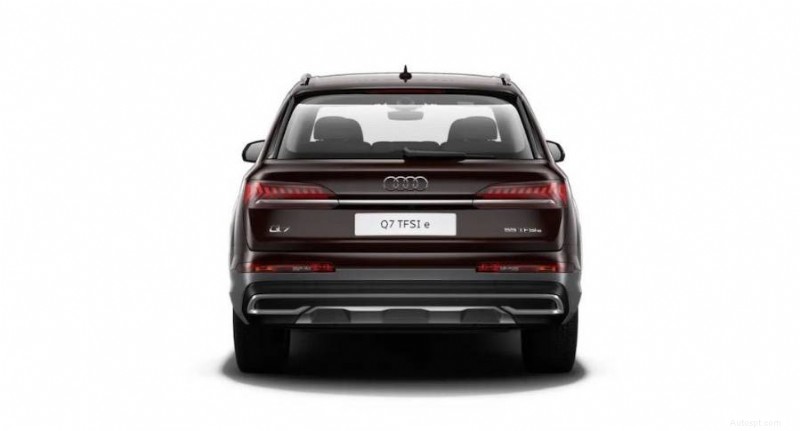
The Audi Q7 TFSIe PHEV SUV (credit: Audi)
While e-zoomed uses reasonable efforts to provide accurate and up-to-date information, some of the information provided is gathered from third parties and has not been independently verified by e-zoomed. While the information from the third party sources is believed to be reliable, no warranty, express or implied, is made by e-zoomed regarding the accuracy, adequacy, completeness, legality, reliability or usefulness of any information. This disclaimer applies to both isolated and aggregate uses of this information.
