
BMW (Bayerische Motoren Werke AG), is a leading global automotive manufacturer headquartered in Munich, Germany. BMW is well known for its portfolio of luxury vehicles, to include the famed Rolls-Royce luxury cars. The group manufacturers a number of cars under its BMW brand, to include battery-electric vehicles (BEVs) and plug-in hybrid electric vehicles (PHEVs). The company currently has the following portfolio of plug-in hybrid electric vehicles (PHEVs):
For those of you new to zero-emission electric driving, we recommend a read of the following articles:
The BMW X3 compact luxury SUV has been on sale since 2003. It is currently in its third generation. The SUV is manufactured in South Africa. The BMW X3 is available a plug-in hybrid electric vehicle (PHEV).
For those private and company-car drivers, keen to take a step towards lower-tailpipe emission electric driving, but still keen on an internal combustion engine (ICE), a plug-in hybrid electric vehicle (PHEV) is a natural next step.
Global automotive manufacturers, like BMW, recognise the important role played by PHEVs for the immediate transition to zero-emission electric driving, and have been hard at work in offering their conventional internal combustion engine (ICE) petrol and diesel range, with plug-in hybrid variants.
The BMW X3 PHEV has much to offer an aspiring electric car driver. First, it is practical: large enough to feel spacious, yet small enough to drive and park in congested town and city centres, with ease. Given the exterior styling of a more traditional SUV roofline, the EV offers ample headroom and legroom for adults seated in the rear. The front seats also offer generous space.
Despite, the addition of an onboard EV battery, the EV boot space is still useful (450 L). The interior is completed to a high quality, as would be expected from a premium-badged BMW SUV. The EV is well specified in terms of technology, to include: driving assistant, steering and lane control assistant, active slide collision protection, BMW intelligent personal assistant, BMW Digital Key and a lot more.
The X3 plug-in SUV has an average size onboard EV battery (11.15 kWh). The claimed emission-free electric range up to 30 miles (WLTP certified) is also very similar to other plug-in electric cars available today.
Real-world range will be closer to 25 miles, impacted by a number of factors, to include: driving profile, road conditions, passenger load, regenerative braking, speed, wheel size, weather conditions, etc. For shorter distances, in particular, in towns and cities, a pure electric range over 25 miles is more than sufficient. In fact, 2/3rds of motorist drive only 30 miles per day.
We recommend charging the EV overnight at the convenience of your home, when the electricity tariff rates are lower. It is worth noting that the onboard charger for the X3 PHEV is limited to 3.7 kW. Given the upmarket badge, a 7.4 kW onboard charger should have been incorporated as standard.
Charging the EV from 0% to 100% SoC (state-of-charge) using a dedicated EV charger like Easee will take up to 3.7 hours. We encourage EV charging via a dedicated residential EV charger, and discourage the use of a domestic 3-PIN plug. An EV charging station is safer and achieves a faster charging speed. The EV does not offer DC charging. BMW offers a 8 years or 100,000 miles warranty.
The X3 EV delivers a decent driving performance. The X3 hybrid incorporates a number of driving modes, to include: hybrid, hybrid eco pro, electric or sport/XTRA boost. The all-wheel drive X3 plug-in hybrid has a 2.0-litre (four-cylinder) petrol engine paired with an electric motor (80 kW).
The top speed on electric mode is 83 mph, which is more than sufficient for driving around in congested urban centres. When the EV is being propelled by the internal combustion engine (ICE) the top speed is 130 mph. The electric SUV can achieve 0-62 mph in 6.1 seconds (maximum power: 292 hp).
By leveraging the hybrid technology i.e. an internal combustion engine (ICE) paired with an electric motor, this family hybrid SUV achieves, both, lower tailpipe emissions and financial savings. The X3 plug-in hybrid has claimed tailpipe emissions up to 48g (CO2/km), much lower than the conventional petrol engine X3 SUV (177 CO2/km).
Lower tailpipe emissions help improve local air quality. Moreover, due to the lower tailpipe emissions, company car drivers can take advantage of the reduced Benefit-in-Kind (BiK-12%) tax rate, resulting in lower monthly bills.
The claimed fuel economy is 134.5 mpg, but this will depend on a number of factors to include, the amount the EV is driven on the pure electric mode. The longer the duration driven on emission-free electric mode, the better the fuel economy. So best to take full advantage of the electric motor and EV battery!
The PHEV does not qualify for the UK government plug-in car grant (PiCG). Bottom-line, electric driving is good for the environment and the wallet. You can lease electric vehicles (EVs) via e-zoomed at very competitive prices!
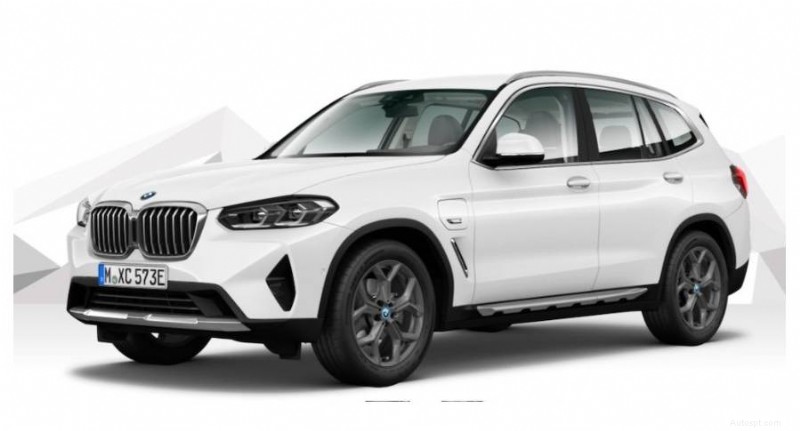

The BMW X3 Plug-In Hybrid SUV (credit: BMW)
While e-zoomed uses reasonable efforts to provide accurate and up-to-date information, some of the information provided is gathered from third parties and has not been independently verified by e-zoomed. While the information from the third party sources is believed to be reliable, no warranty, express or implied, is made by e-zoomed regarding the accuracy, adequacy, completeness, legality, reliability or usefulness of any information. This disclaimer applies to both isolated and aggregate uses of this information.
