
Next year, SK innovation and LG Chem will produce the first generation of NCM 811 battery cells to be used in electric cars. However, this is just the beginning of the end for the ICE (Internal Combustion Engine).
The next step will be to replace the graphite anode with lithium, this is what some companies such as Solid Power or SolidEnergy Systems promise to deliver soon. Both of these companies have ties with A123 Systems and I consider them reliable. Nevertheless, this doesn’t mean that they are the only ones working on this technology, it just means that they can talk about it openly – without undermining current sales. Why would LG Chem or SK innovation talk about future improved NCM 811 battery cells and osborning themselves, when they are about to start selling the first generation?!
The next generation NCM 811 battery cells – to arrive by 2020 -, will not only have thin lithium anodes, but also semi-solid state electrolytes (such as demonstrated by SolidEnergy Systems) or even solid state electrolytes (such as demonstrated by Solid Power), this will help to increase safety and lifespan. A battery pack made with solid state battery cells will also be lighter and simpler, since it won’t require a TMS (Thermal Management System).
SolidEnergy Systems is confident that it’ll start producing this new battery technology for consumer products as soon as next year. As for electric cars, we’ll need to wait for 2020 to see it implemented. I expect that some big battery cell maker will buy the production rights of this technology for further improvements, like LG Chem did with Sion Power.
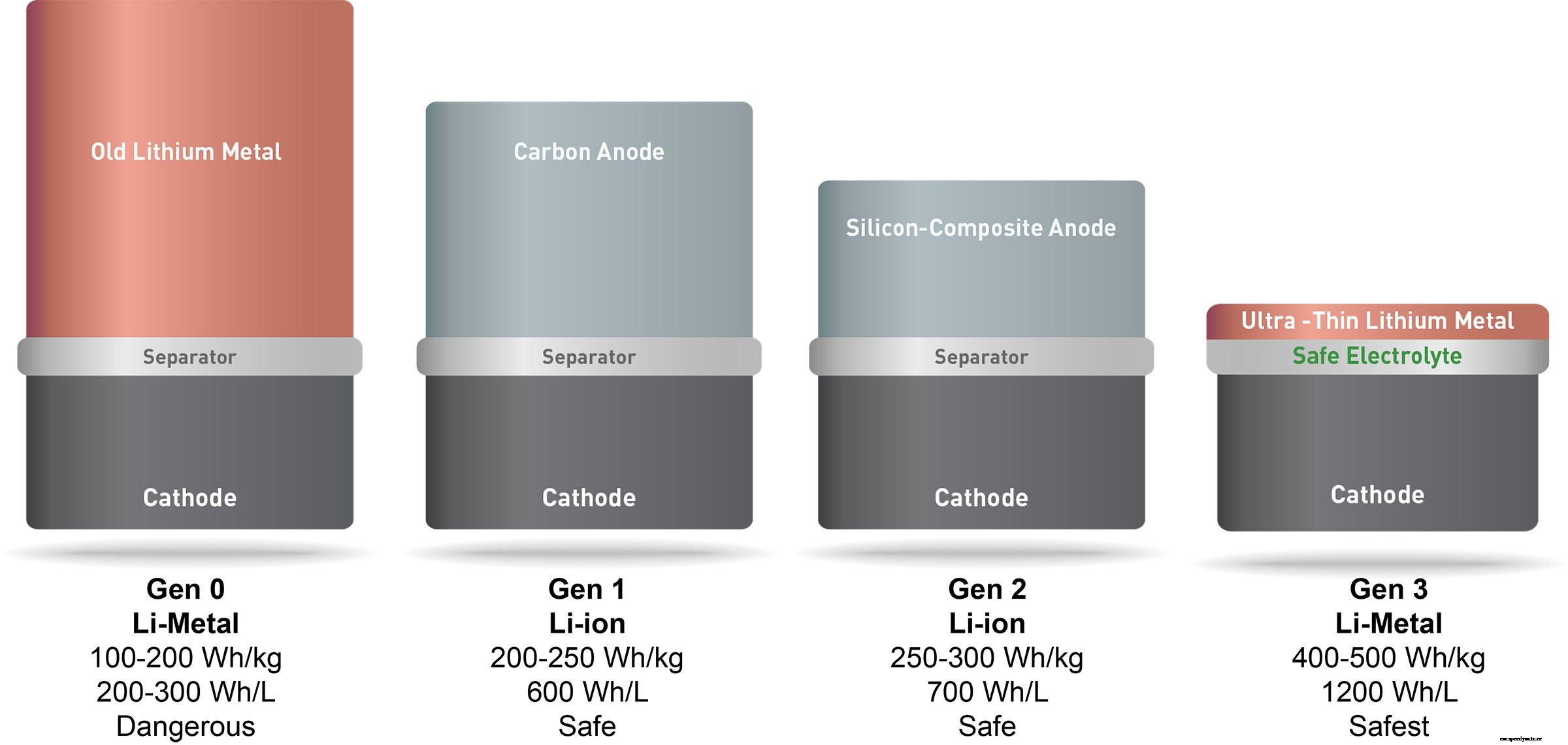
SolidEnergy Systems battery comparison
Let’s see what this kind of energy density (1.200 Wh/L) means for electric cars.
For example, the best selling electric car in Europe, the Renault Zoe could get a 113 kWh battery, enough for roughly a 1.047 km range in NEDC, or 700 km in the real world. While the Nissan Leaf could get a 90 kWh battery and an EPA range of 318 miles (512 km).
To sum up, solid state electrolytes and lithium anodes are the battery enhancements you can expect to see implemented real soon and will help to further make ICE obsolete. Lithium-sulfur battery is also promising, especially in areas where weight is more important than volume, such as Aeronautics (electric planes).
