
It’s no surprise that Volkswagen won’t make a serious effort to sell electric cars before 2020. The automaker has been saying it for a long time in its numerous press releases about e-mobility. Nevertheless, Volkswagen wants to be the global e-mobility leader by 2025.
Anyway, this year, Volkswagen will only have 3 BEV (Battery Electric Vehicle) models for sale. They are the e-Golf, e-up and the upcoming electric van e-Crafter. However, Volkswagen expects to add another 50 new BEVs by 2025, as you can see in the roadmap below.
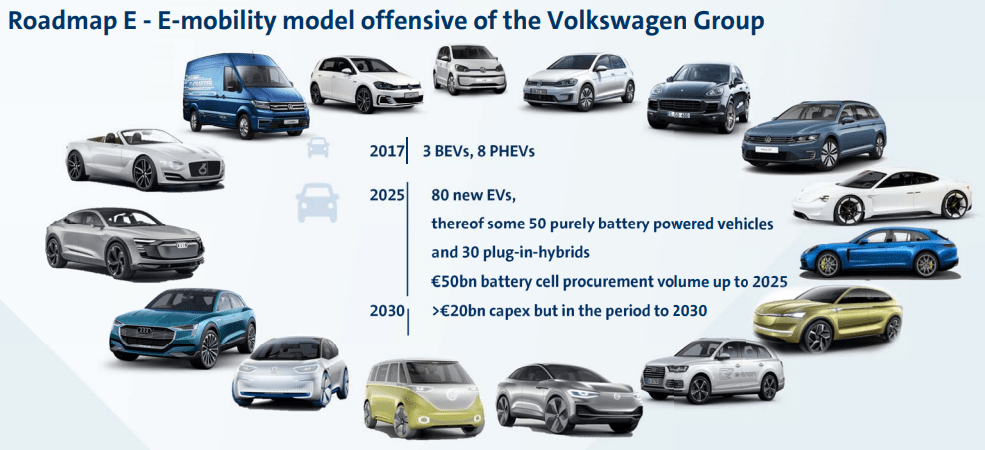
E-mobility model offensive of the Volkswagen Group
In this roadmap we see the obvious, BEVs will outnumber PHEVs real soon, since PHEV is just a bridge technology.
One reason why Volkswagen is delaying BEVs until 2020 is battery costs. While at the battery cell level the cost will be already below 100 € per kWh next year, it won’t be until 2020 that we can say the same about the complete battery pack, as you can see in the chart below.
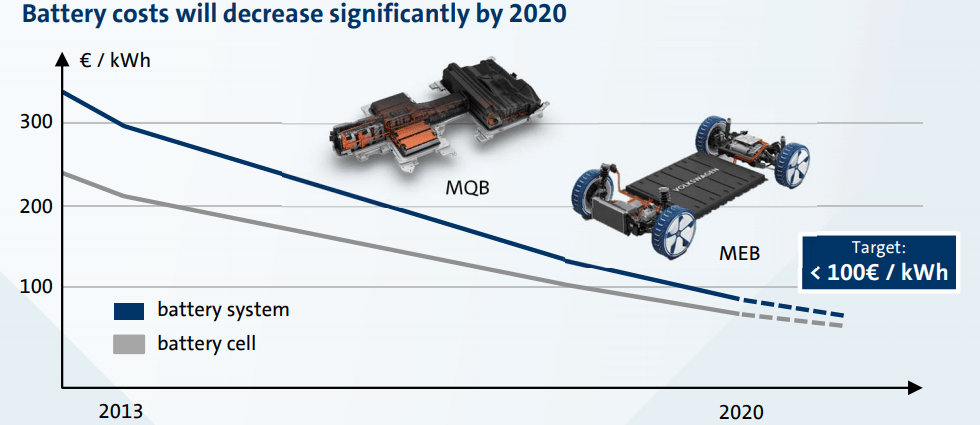
Battery costs roadmap by Volkswagen
With the kWh cost below 100 € at the battery pack level, BEVs will be cheaper to produce than diesel cars – and not much more expensive than the petrol counterparts.
Another reason why Volkswagen is delaying BEVs until 2020 is range. Nevertheless, already next year with NCM 811 battery cells, cost and range won’t be problems anymore.
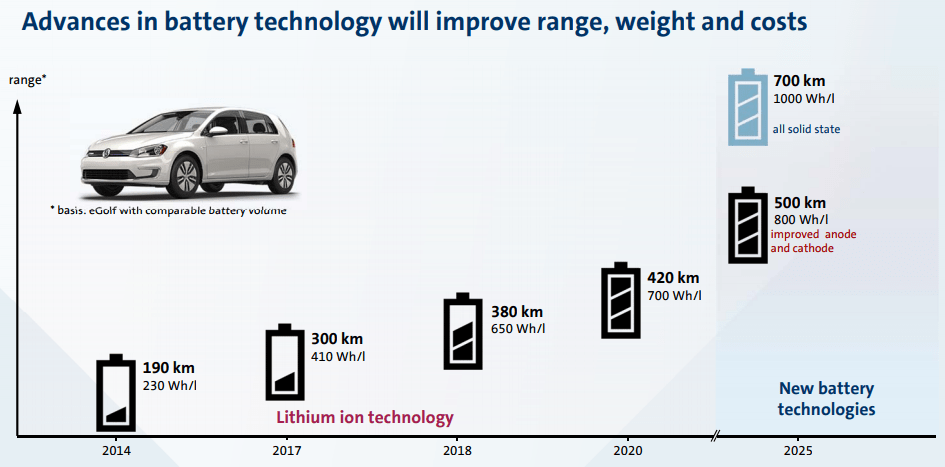
Advances in battery technology will improve range, weight and costs by Volkswagen
In the chart above you can see a nice increase in the volumetric energy density, which from 2018 onwards isn’t accompanied by a similar evolution in the homologated range, because the more realistic test cycle WLTP (similar to EPA) is already gradually replacing NEDC.
It will be interesting to see the Renault-Nissan-Mitsubishi Alliance and the Volkswagen Group battling for the e-mobility leadership in the coming years. The Hyundai Kia Automotive Group will also be in the race by selling electric cars with great value for the money.
