
Today Hyundai announced a series of updates made to the popular electric car Kona Electric. Most of them are just small incremental improvements, but under the surface an important upgrade might have happened…
Let’s see some highlights.
In order to make the new Kona Electric an even better product for its customers, the upgrades revolve around design, technology, and practicality.
- The new Hyundai Kona Electric has a new purer exterior design, signifying clean electric mobility
- Additional safety, connectivity and convenience features ensure an even better driving experience
- Kona Electric continues to deliver one of the best all-electric driving ranges of any electric car, with up to 484 kilometres (WLTP)
Nothing major, only incremental improvements on one of the best electric cars out there.
Pure and stylish design signifying clean electric mobility
The new Kona Electric has undergone a series of bold exterior design updates. By combining a clean and sleek appearance with the protective and bold B-SUV body type of the Kona, it expresses its exceptional electric technology while being even more recognisable on the road.
The front with the new-look closed grille features a pure and clean design. This modern look is further enhanced by the new LED Daytime Running Lights, which emphasise the car’s wide stance. The front is complemented by an asymmetric charging port, a feature unique to the Kona Electric which makes a strong statement about driving electric.
New, sharper headlamps stretch around the side of the car. The high-tech headlamp inner bezel now incorporates multifaceted reflector (MFR) technology. The headlamps are connected to the painted wheel arch claddings, giving the new Kona Electric a distinctive and sophisticated look. Vertical air inlets in front of the wheel arch claddings enhance its aerodynamics, substantially reducing turbulence in the front wheelhouse area. Meanwhile, a functional air intake in the lower bumper is visually enhanced by horizontal satin accent bars, which give it a pronounced stance.
The rear bumper retains the accent bars to add value to the overall look of the car, while new horizontally-stretched rear lamps complement the pure appearance of the front.
The new Kona Electric is 25 millimetres longer than the previous version. This ensures it has a dynamic appearance combined with a strong visual stance.
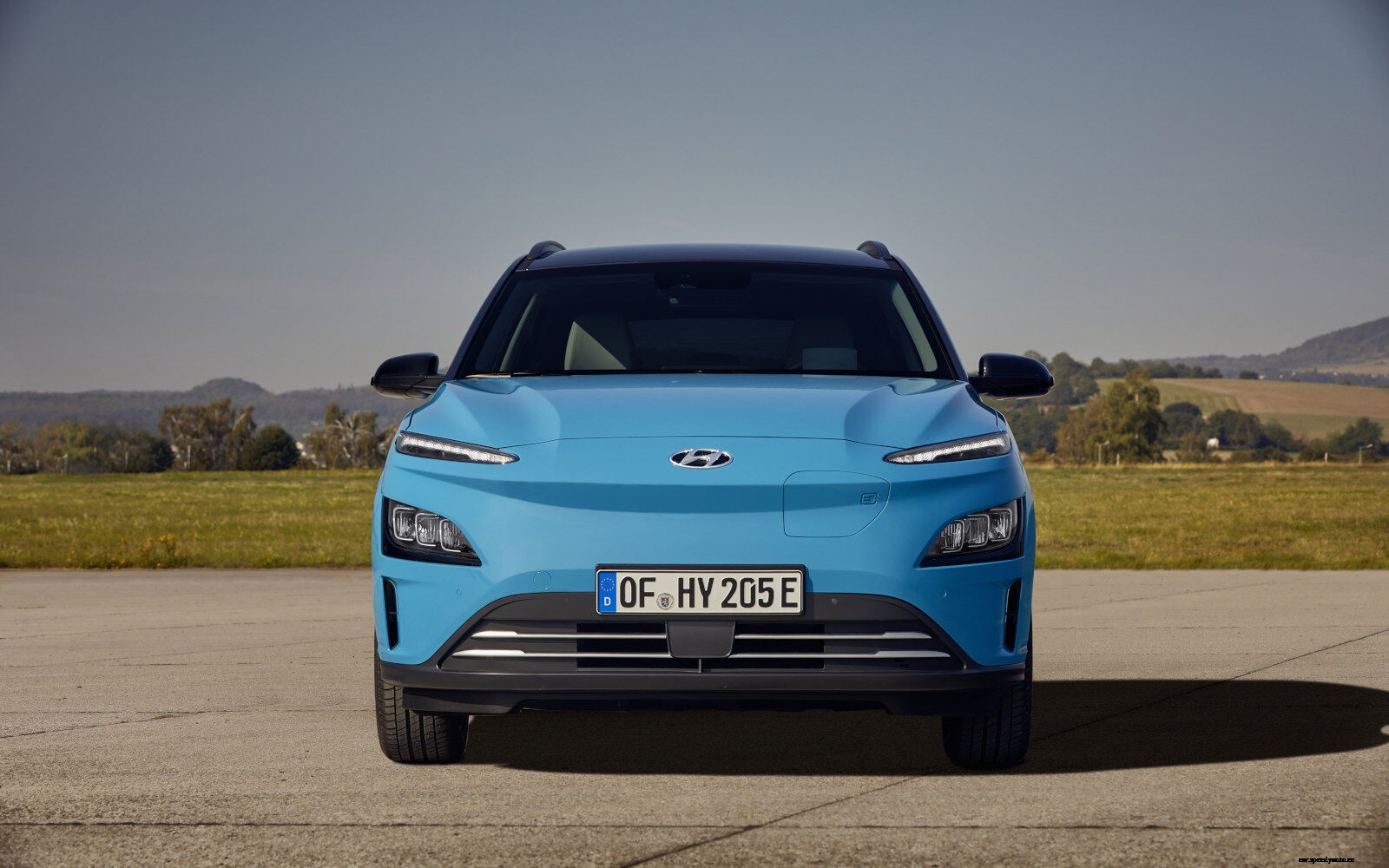
New Hyundai Kona Electric front
An updated interior with progressive technology
For the first time, the new Kona Electric is equipped with a 10.25-inch digital cluster, while an optional 10.25-inch AVN screen is carried over from the last update. The AVN unit incorporates multimedia and convenience features including Bluelink®, Hyundai LIVE Services and Apple CarPlay and Android Auto, further democratising advanced connectivity for Hyundai drivers. Customers who select the eight-inch Display Audio system can wirelessly connect their smartphones to Apple CarPlay and Android Auto.
New Kona Electric customers can enjoy the new Bluelink® upgrade, which allows them to control their car with their smartphone or voice to make their drive more convenient and enjoyable. The app displays the vehicle’s range and battery state, as well as charging times, when plugged into different public or private charging points. Users can access an advanced battery management system in order to select charging times that best fit their schedule or their budget by making the most of off-peak electricity rates.
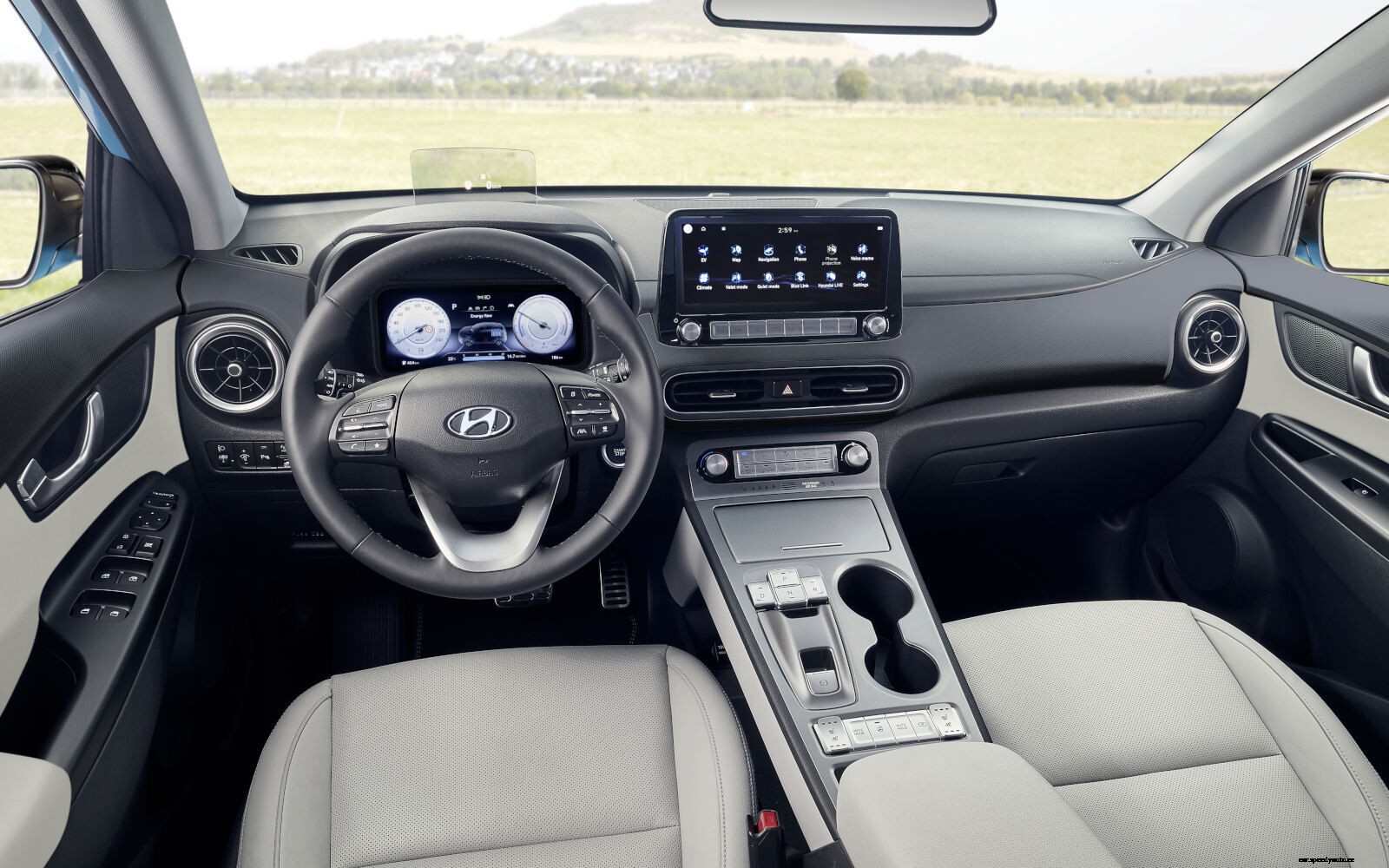
New Hyundai Kona Electric interior
Segment-leading driving range
Like its predecessor, the new Kona Electric offers two different zero-emissions battery electric powertrains, with no compromises on performance.
The long-range version with a 64 kWh battery features an electric motor which delivers maximum power of 204 PS (150 kW), accelerating the Kona Electric to 100 km/h in 7.9 seconds. The basic version has a battery capacity of 39.2 kWh, with the motor delivering 136 PS (100 kW), accelerating to 100 km/h in 9.9 seconds. The long-range battery version provides a maximum speed of 167 km/h, with the standard-range battery version offering 155 km/h.
Charging the lithium-ion polymer battery from 10 to 80 per cent only takes about 47 minutes using a 100 kW direct current (DC) fast charger. The Kona Electric features an optional 10.5-kW three-phase on-board charger, allowing for significantly shorter charging times using public three-phase AC charging stations or with a private compatible wall box at home. Drivers also have the option of charging their car at a compatible regular household power socket using the ICCB-cable (in-cable control box).
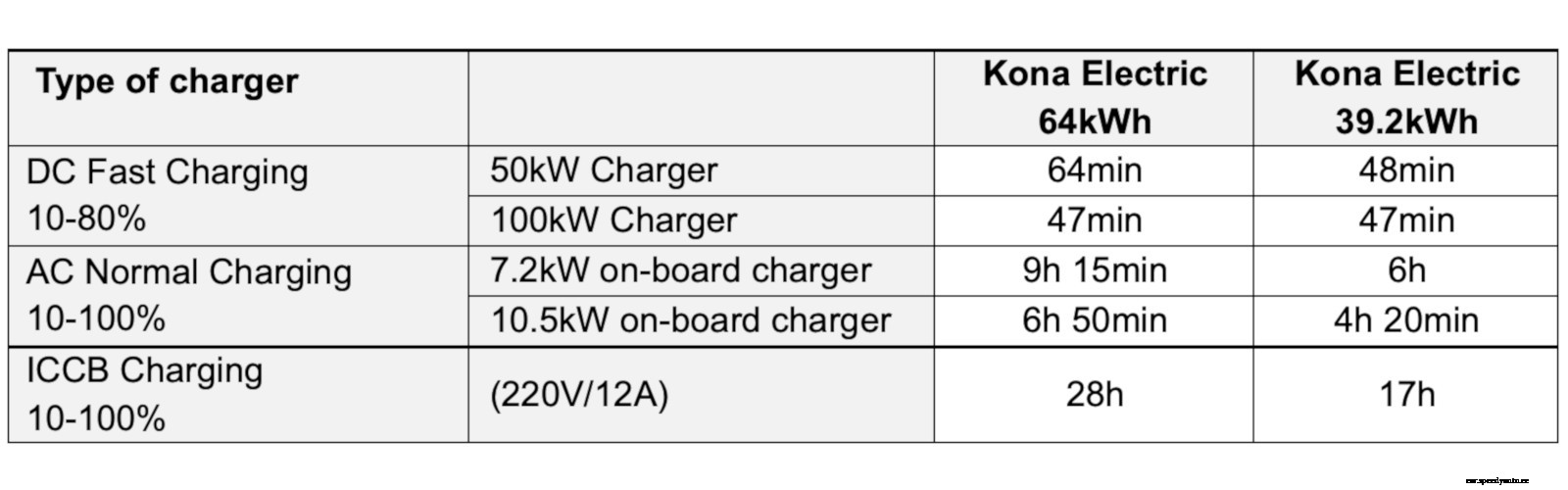
New Hyundai Kona Electric charging times
Even more best-in-class safety features
The new Kona Electric features a state-of-the-art Hyundai safety package for peace of mind. Hyundai SmartSense provides comprehensive, best-in-class active safety and driving assistance systems, and the new Kona Electric is now equipped with even more functions than its predecessor.
Hyundai SmartSense safety features:
- [NEW] Blind-Spot Collision-Avoidance Assist (BCA)
- [NEW] Rear Cross-Traffic Collision-Avoidance Assist (RCCA)
- [NEW] Leading Vehicle Departure Alert (LVDA)
- [NEW] Safe Exit Warning (SEW)
- [NEW] Rear Seat Alert (RSA)
- Forward Collision-Avoidance Assist with pedestrian and cyclist detection (FCA-Ped)
- Smart Cruise Control with Stop & Go (SCC w/ S&G)
- Lane Following Assist (LFA)
- Lane Keeping Assist (LKA)
- Intelligent Speed Limit Warning (ISLW)
- Driver Attention Warning (DAW)
It seems that the new Hyundai Kona Electric doesn’t change much, but this is a good thing since it was already a great electric car.
However, under the surface some interesting changes might have happened. It seems that the Hyundai Kona Electric made in Europe not only gets its battery cells from LG Chem, but also from SK Innovation. At least it’s what was reported by some Korean media outlets when this model suffered from some battery fires.
Both LG Chem and SK Innovation have supplied batteries for the Kona Electrics. According to industry officials, the 77,000 Kona Electrics under recall were made in Korea from 2018 to March this year.
SK Innovation is thought to have supplied batteries for 12,000 Kona Electric vehicles built at Hyundai Motor’s plant in the Czech Republic. These are not subject to the recall.
This makes me think that currently the Hyundai Kona Electric no longer uses NCM 622 battery cells, instead it gets NCM 712 cells from LG Chem and NCM 811 cells from SK Innovation.
However, since the battery capacity doesn’t seem to have increased, the battery should be lighter with the new more energy density chemistries. I would like to know if there was a battery weight reduction to back this possibility.
Publicly Hyundai still says that it managed to increase the WLTP range of the Kona Electric from 449 to 484 km from tyre improvements alone…
Thanks for the heads up Giora.
