
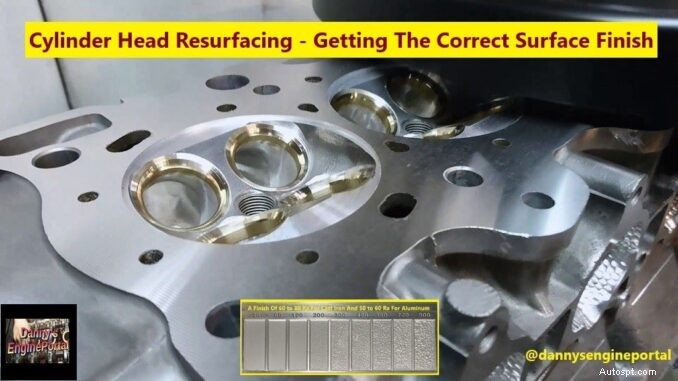
 Cylinder Head Resurfacing - Getting The Correct Surface Finish
So, there are many other reasons for cylinder head resurfacing, besides a head gasket leak:
To seal properly, a head gasket requires a surface finish, that is within a suggested range.
The specs vary, depending on the type of head gasket. And, if the surface is too rough, or in some cases too smooth, the gasket may not seal properly. So, look up the suggested specs, for a particular engine and/or a particular type of head gasket.
(CBN) or (PCD) Tool Bits, Can Give The Best Ra Numbers, But:
Today, you need smoother finishes required by many of today’s, aluminum heads and gaskets. Consequently, you need to use the right combination of table feed, and (RPM) when cylinder head resurfacing. This requires a variable speed table and/or multi speed or variable speed milling head.
Increasing the (RPM) of the cutting head and/or slowing down the feed rate, makes a smoother finish. We suggest a feed rate of two inches per minute, at 1,000 (RPM), on a milling machine.
And, with a two bladed cutter ( harder to index, but better ), to achieve a surface finish of 12 RA. Carbide or (PCD) tooling, is usually suggested, for milling aluminum. While, carbide or (CBN) is suggested, for milling cast iron.
So, very smooth surfaces are required for (MLS) head gaskets. And, smoother is generally better (up to a point) for most gaskets. Because, it improves cold sealing, but there is a limit. Most gasket manufacturers say, the surface should not be smoother than 30 RA for, non-asbestos or graphite head gaskets.
This is because of the gaskets’ lateral support from the head and block. And is another very important fact, when doing any cylinder head resurfacing. When the head is bolted to the block, the metal on both sides bites into the gasket. And, this is what helps hold it in place.
But, you don’t want too much bite when the head is aluminum, and the block is cast iron. Due to, the sideways shearing forces that result, from the expansion and contraction of the aluminum head. Yet, support is necessary, to keep the combustion gases in the cylinders, from distorting the gasket. As a result, blowing the head gasket.
Clean, flat and smooth. These three words describe the surface in any machining job, not just the head and block. But, how clean, how flat and how smooth, do the surfaces really have to be? It depends on the application.
One thing to watch out for here is, the use of cleaning solvents or gasket remover chemicals. Mostly because, they leave residue on the surface. The residue may interact with the coating on or materials in a head gasket. As a result, leading to premature gasket failure.
Some shops and rebuilders use, an abrasive pad in an air drill or buffer, to buff off residual gasket material. It’s a quick and easy way, to remove old gaskets. It is also risky, because there’s a risk of removing to much metal. And, leaving a depression that will be, hard to seal. Causing leaks and possible engine overheating.
As for belt sanding, it can be a real time saver. Because, heads and other parts, do not have to be mounted in a fixture. But, cylinder head resurfacing, with a belt has dropped off. Because, it is not as precise as milling or grinding and relies too much on the individual operator.
So, belt sanding is better for, clean up work and resurfacing hard to fixture parts, like manifolds and timing covers.
So, when doing any cylinder head resurfacing, it needs to be perfect. Because, you can’t expect to get high quality surface finishes, if you’ve ignored your equipment. And, dry milling does not require any coolant, so there’s no coolant to maintain.
