
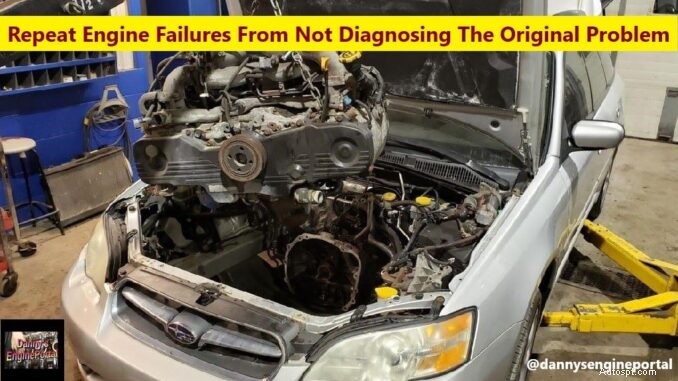
 Repeat Engine Failures From Not Diagnosing The Original Problem
Repeat engine failures often occur because the original underlying cause of the initial problem was never correctly diagnosed. That’s why fixing only the symptoms allows the true problem to persist.
And, inevitably causes the new part to fail in the same way. Another common mistake in diagnostics is falsely condemning a part that is really just out of adjustment.
1. Fixing The Damage, Not The Cause
Replacing a blown head gasket without identifying and fixing the overheating issue. (faulty water pump, clogged rad, or leak) means the new gasket will also fail.
2. Not Fixing The Root Cause Of Lubrication Problems
An engine fails due to oil starvation. Just installing a new engine will not fix the root cause of the problem. As a result, you will have repeat engine failures.
3. Failing To Flush Contaminants
A catastrophic failure can create metallic debris and other contaminants that circulate throughout the system. If the related systems are not thoroughly cleaned or replaced, the debris can damage the new engine. Engine bearings are usually the first to fail. As a result, you will have repeat engine failures.
4. Incorrect Installation Or Incompatible Parts
Never use an incompatible replacement engine, wrong parts or make installation errors. Because, this will put immediate undue stress on the system. As a result, you will have repeat engine failures.
5. Neglecting Supporting Systems
Problems in related systems, such as a faulty fuel injector or a weak ignition system leading to misfires. Also, affecting idle quality. This can place excessive stress on internal engine parts. It can cause them to break down repeatedly if the original fault is ignored.
1. Significant Financial Loss
So, repeat engine failures or replacements are costly. It is a burden that is often avoidable with a complete initial diagnosis.
2. Extended Downtime
The car is out of commission multiple times leading to inconvenience and potential additional costs for alternative transportation. All because of repeat engine failures.
3. Safety Hazards
So, an engine failure can occur at any time. Including while driving, which poses a serious safety risk.
4. Accelerated Wear And Tear
Undiagnosed minor issues force the engine to work harder. As a result, accelerating wear and tear on all parts until another major failure occurs.
The key to help prevent repeat engine failures is a comprehensive diagnostic process. One that identifies the original underlying cause of the failure, rather than just fixing the resulting damage.
1. This Involves, Thorough Inspection
Beyond the immediate site of damage, a full inspection of all related systems (cooling, lubrication, fuel, electrical) is crucial.
2. Professional Expertise
Relying on qualified technicians who follow correct diagnostic procedures is essential.
3. Quality Parts
Using high quality, compatible replacement parts.
4. Scheduled Maintenance
Always following the car makers suggested maintenance schedule. As it helps identify and resolve minor issues before they escalate.
(ECU)s and sensors control, almost all of today’s cars. And, any one of them failing can cause repeat engine failures.
So, the engine, piston, or cylinder head is replaced. But, shortly after the customer returns with the same or a new problem. Because finding and fixing the original problem never did happen. Quite often it’s a leaking or blown head gasket.
Before one minute of time is spent on diagnosis, be certain that a problem actually exists. Because, if the problem does not exist it cannot be solved or tested to verify that the fix was done.
So, a visual inspection is the most important part of a diagnosis. Most experts agree that most engine problems can be found, simply by performing a visual inspection.
If a (DTC) is present in the (ECU)s memory, it should turn on a warning light. Either a (CEL) or a (SES) light.
Check for corrections in bulletins, that match the symptoms. NOTE: (DTC)s must be known, before searching for service bulletins. Bulletins often include info on solving problems that involve a stored (DTC). And, some can cause repeat engine failures.
The best way to look at scan data, is in a sequence. Because, that can tell you the most about the operation of the engine.
Consequently, narrowing the focus down to a system or individual cylinder is the hardest part of the entire diagnostic process.
Always follow the car maker’s suggestions when you fix or replace any part. And, their suggested procedures and methods.
(ECU)s and sensors control most of today’s cars. So, there may be as many as 20 sensors, feeding info to the cars (ECU). And, there are also other sensors, while not directly attached to the (ECU), that do affect the info as well.
Furthermore, these sensors are part of other systems that allow the car to operate correctly. So, all of these systems must be in correct operating order for the engine to function correctly. As a result, you risk repeat engine failures.
Some Of The Systems That Play An Important Role, In The Correct Running Of Today’s Engines Are:
These systems are all controlled by the (ECU). And, the (ECU) gets all its info from all the sensors. So, the end result of this info is a good or bad running engine.
Consequently, failure of any of the sensors, or failure of the system itself, can cause an engine failure. So, just as with the original engine, it is reasonable to expect the same mileage from a rebuilt engine. And now you have to add labor and any additional parts as well.
So, there are sensors that provide info to the (ECU) that allows the engine to run correctly. But, these parts also have 100,000 miles on them. So, always remember that the same mileage applies to other parts as well.
Then, if you have not found the original problem, keep searching. Otherwise, you could end up with the installer’s worst nightmare. “Repeat Engine Failures”.
Thank You!
