
Certain models of Toyota, such as the Toyota Camry, Toyota Prius, Toyota Corolla, and other vehicles include an “OBD relearn” option on your TPMS tool. Most Toyota vehicles from the manufacturer have a TPMS system installed in them directly.
When certain services are performed on your Toyota, such as a replacement of the TPMS sensor, a TPMS relearn is highly recommended to transmit the sensor information to your Toyota’s ECU.
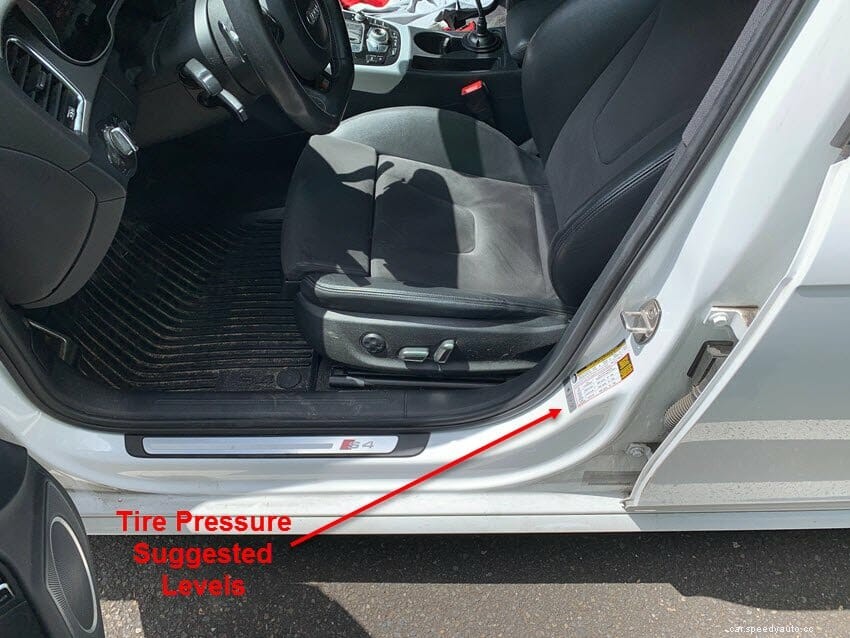
Before you begin, make sure that all the vehicle’s tires are inflated to the level that is listed on the placard.
Beginning with the passenger’s side rear tire, use the scanning tool to scan each of the sensors located near the tires. Make sure you do them in this order. LF (on Passenger Side Rear), RF (on Driver’s Side Rear). RR (on Driver’s Side Front), and LR (on Passenger Side Front).
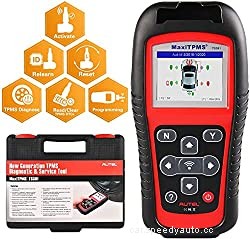

After you scan all the tires, turn the position of the ignition to where it is on with the engine turned off. Make sure the engine is not positioned to ACC. Now that you’ve switched some gears, connect the scanning tool to the port that is made for the OBDII and begin uploading the sensor Identifications.
After this is completed, turn off the ignition and scan each of the sensors again.
To test if everything is how it should be, drive your Toyota a little over thirty-miles-per-hour for a minimum of 10 minutes. While you are driving, monitor the low tire pressure monitor to make sure that it doesn’t blink or light up.
Ensure all tires are inflated to the pressure listed on the tire placard.
Just like when you replaced the sensors, make sure that all tires are inflated as listed on the tire placard.
To begin, make sure you turn on your parking brake and turn on the ignition with the engine turned off. As before, make sure it is not in a position to the ACC.
Locate the pressure warning switch. It should be located under the steering wheel or in the glove box. Press the pressure warning reset switch down until the TPMS light begins to blink. It should blink 3 times.
After the TPMS telltale light blinks three times, it may take up to several minutes for the ECU to accept the signals from the sensors and finish the boot.
Here is a video guide to resetting and reinitializing the low tire pressure warning light:
If you see errors E1, E2, E3, or E6 these are reading communication errors. The best thing to do is to make sure your vehicle is on and not on ACC. Since this is a communication error between device and vehicle, make sure the connection is secure.
Error E5 is an error you receive if you did not upload the sensor id for the spare tire. Make sure you upload all tire IDs in the ECU. If you happened to upload a spare but still receive this message, then your vehicle does not store identification information for a spare tire in the ECU.
Find other Toyota articles you may enjoy:
Is the Toyota Yaris Good for Long Drives? (Good Car & Reliable?)
Toyota Camry Won’t Start? Here’s What You Can Do
How Long Does a Toyota Corolla Last?
