
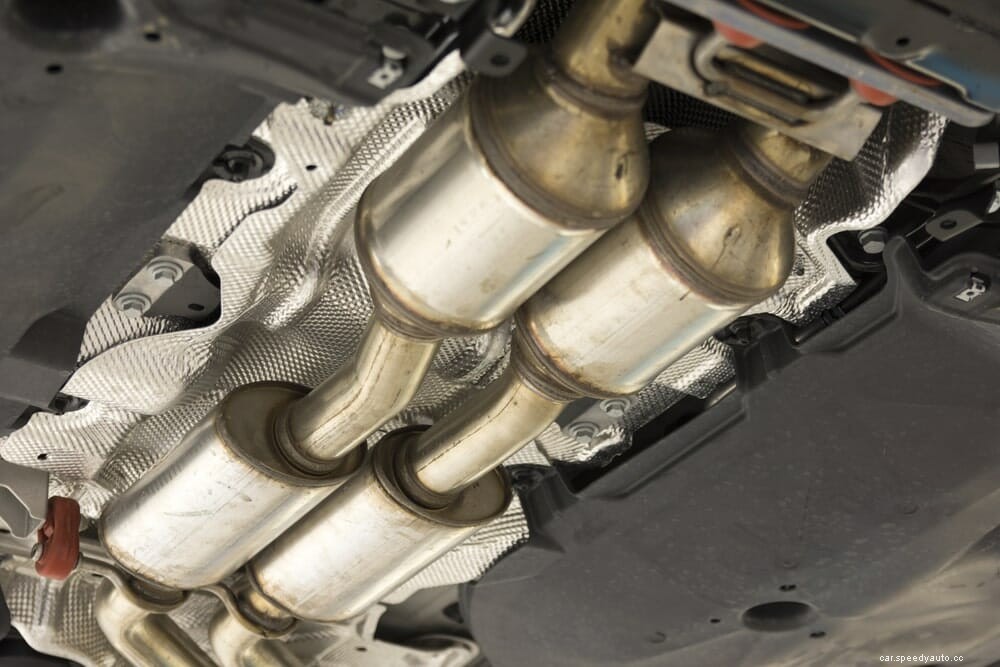
The catalytic converters or cats are a part of the exhaust system responsible for filtering out harmful emissions. The main downside is the negative effect on performance once the cat clogs up.
From a mechanical standpoint, the catalytic converter is a completely unnecessary component. In fact, straight piping the exhaust could even have a positive effect on performance.
The conclusion is that you can drive without the catalytic converter for as long as you’d like. The problem with that is the federal law, which dictates that the removal of the catalytic converter is illegal in every US state.
The internal combustion engine uses oxygen and petrol or diesel to create a mixture that releases a lot of energy when detonated. The system is brilliant in a mechanical sense as the power output is significant from such a small amount of propellant.
But, there’s one problem – the emissions. The US environmental protection agency claims that a typical passenger vehicle emits 4.6 metric tons of carbon dioxide annually.
The figure is based on a vehicle that does 22 miles to the gallon and is driven for 11,500 miles during the year. Two metric tons is a more realistic figure, but it is still a significant amount of pollution.
To combat the problem, especially with the massive V8 gas guzzlers of the ’60s and ’70s, the installation of catalytic converters was made mandatory since 1975. Studies claim that a catalytic converter makes a significant difference, reducing 75-90% of gaseous emissions.
The goal of a catalytic converter is to reduce the output of nitrogen oxide, carbon monoxide, and unburnt fuel through a heat-induced chemical reaction.
The catalytic converter is contained in a thick metal housing and has two components:
The reduction catalyst breaks down the nitrogen oxides into nitrogen and oxygen, while the oxidation catalyst turns the unburnt fuel into carbon dioxide and water.
This is a very simple explanation but the point is that catalytic converters can eliminate up to 90% of the harmful gases by breaking down their chemical composition into a harmless or at least less harmful matter.
The engine is perfectly capable of running without the catalytic converter and would arguably be better off without it. There’s absolutely no risk of damage to the engine, turbocharger, spark plugs, fuel injectors, or any other component in the system.
The only reason why the removal of the catalytic converter could cause a problem is because of the O2 sensors.
The upstream sensor is located in front of the cat, at the end of the exhaust manifold, and measures the emissions coming straight from the engine. It sends a signal to the ECU which uses the data to adjust the air-fuel mixture to ensure a cleaner burn.
The downstream sensor is located behind the cat and measures the emissions that come out of the converter. If the emissions exceed a specified limit, it will warn you that the catalytic converter is wearing out.
I cannot rule out the possibility that a change in the flow of exhaust gases could have an effect on the upstream O2 sensor and therefore mess with the performance, but it’s extremely unlikely.
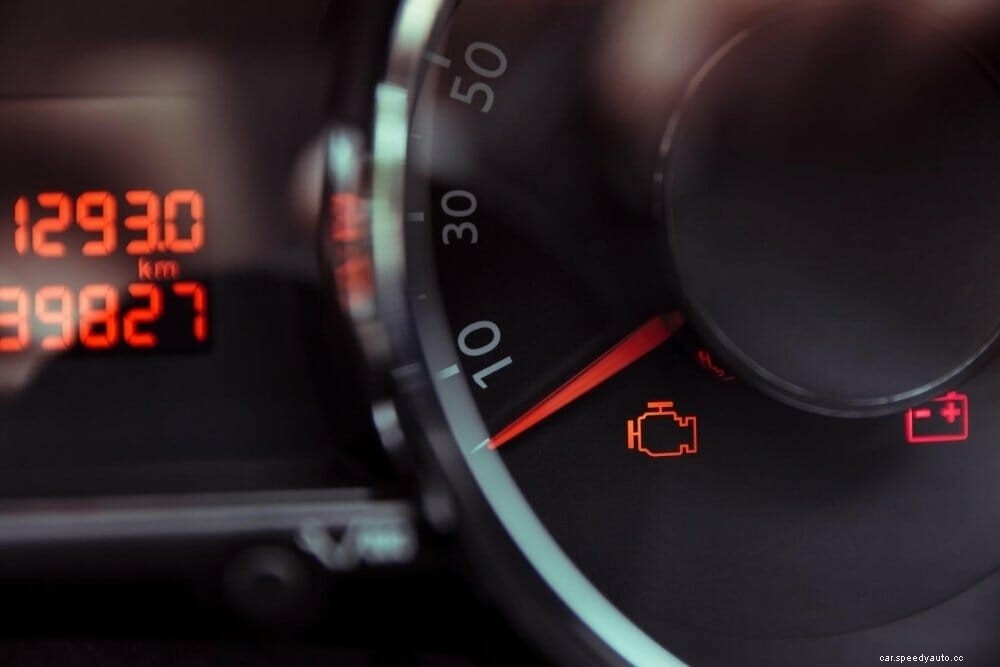
The downstream sensor will notice a problem and turn the check engine light on, but it has no effect on the performance and won’t push the vehicle in some sort of safe mode. In almost all cases, removing the cat is consequence-free from a mechanical standpoint.
Let’s make one thing clear – a brand new catalytic converter will not affect the performance and reliability of the vehicle in any way. The benefits of removing the catalytic converter are the same as if you’d clean it, or replace it.
The problems with the catalytic converter emerge when it clogs up, which is less likely in gasoline-powered vehicles but frequent in diesel.
After every combustion, the exhaust valve opens to let the gases escape into the exhaust manifold and towards the tailpipe. A clogged catalytic converter gets in the way, and the gas pressurizes in the piping between the cat and the engine block.
The engine doesn’t know what to do with these gases and goes into a safe (limp) mode which significantly reduces power and allows them to find their way out through the clogged converter.
The performance issue can be annoying, but on turbo-charged diesel engines, it can lead to turbo failure as well.
We all know the basics of turbo – exhaust gases are used to power the turbo which in turn forces more air into the engine and results in a significant power boost. When they’re not needed, those gases are released back into the exhaust system.
When the catalytic converter clogs, the pressure buildup can destroy the turbocharger. I can’t tell you exactly how it happens, but I have seen what it did to a friend’s BMW.
When my Audi’s converter clogged up, thankfully there was a system that automatically shut off the turbo, which saved it from damage and allowed me to address the problem.
No matter how we look at it, the answer is always going to be no. You should never remove the catalytic converter. I’m no eco-warrior, but even I’m sensible enough to leave a part that reduces the emissions by 75-90% and is also completely illegal to remove.
If your catalytic converter clogs, you don’t necessarily have to replace it – we’ve already discussed how to clean the catalytic converter on VehicleFreak. It’s hard labor as you have to get underneath the vehicle and take the converter off, but once it’s off it’s fairly easy to clean.
Replacement catalytic converters can be found for $200-300, but that’s still a lot cheaper than a fine you’d get for driving without one. And once you get caught, you’ll have to install the converter anyway before getting back on the road.
It’s not OK because it’s neither legal nor is it environment-friendly. If your cat got stolen, check with the insurance on how to proceed – you can get away with driving the vehicle to the mechanic or the parts store to get a new one.
There’s next to no chance of damaging the engine by removing the catalytic converter. Apart from a check engine light warning, there’s no other issue with removing the converter.
Legally, you’re not allowed to straight pipe the catalytic converter, but it would work.
Catalytic converters are generally placed under the feet of the front passenger or the driver. Replacing them with a straight pipe or even just drilling a hole through it will make the car louder when idling, but won’t be noticeable when driving.
Catalytic converters are either resold on the online marketplace or sold to the scrapyard for the precious metals contained within them – rhodium and palladium.
Removing a well-functioning catalytic converter will not have any effect on the gas mileage, but removing a clogged one can. However, the same effect can be achieved by replacing the converter with a new one or simply cleaning the current catalytic converter.
The check engine light depends on the downstream O2 sensor. If your vehicle has one, it will detect a problem with the effectiveness of the converter and turn the check engine light on.
The comprehensive package should cover the theft of the catalytic converter by reimbursing you for the cost of a replacement and labor required to install it.
Unless there’s a problem with the O2 sensor, you can drive without a catalytic converter indefinitely. However, this drastically increases your emissions output and is neither legal nor responsible.
By some logic, the bigger the catalytic converter is, the more valuable it is. That’s why small-engined cars (excluding Toyota) are generally not as frequent of a target. American-made cars are also somewhat safer than expensive imports like Audi or Mercedes-Benz.
The SUVs and trucks are prime targets because of the dual catalytic converter configuration and ease of access to the undercarriage. Toyotas are also a high-priority target, as are other premium imports.
The catalytic converter is an integral part of the exhaust system so to steal it, the thieves will cut it at the front and back, leaving a 1-2 feet long gap in the exhaust.
It’s hard not to notice the extremely loud and unpleasant engine noise coming from beneath your feet. If your catalytic converter gets stolen, trust me, you’ll know.
Replacing the catalytic converter can be very expensive, but ultimately, it has to be done to keep the vehicle road-worthy. The environmental benefits of the converter far outweigh any benefits you might have from a cat delete.
If you can’t afford to buy a replacement, do your best to clean the current one and you’ll likely get it back into working shape!
Learn more tips about catalytic converters here:
How Much Platinum Is In A Catalytic Converter?
Cleaning A Catalytic Converter With Lacquer Thinner
Can An Exhaust Leak Cause A Misfire?
