
The most fundamental automotive problem is the engine not starting. After all, if the car’s not running, nothing else really matters in so far as that transportation is concerned. And an engine not starting can lead to feelings of helplessness, as if being totally stuck. When your vehicle isn’t running it can’t be driven to the shop or anywhere else to repair it; it’ll have to be towed if it ultimately can’t be started where it’s parked. Plus, you may not be able to get to work or anywhere else outside of walking distance if you don’t have an alternate vehicle.
It’s nice to be able to understand the basics of how a car starts up and some of the reasons for it to fail to start on demand. This kind of knowledge might put you in a better position to figure out and fix simple issues that may be preventing the engine from starting, and to know which issues require professional attention.
How an Engine Starts
Before getting into some of the reasons why an engine may not start, it’s a good idea to cover the basics of how an engine starts. This will give a foundation from which we can take a look at some of the reasons why the process breaks down.
There’s a specific part designed to provide the cranking power for the engine to start up. That part is known as the starter, though it’s also called the starter motor, or sometimes the cranking motor. When you turn the ignition key or press an ignition button, an electrical signal instructs the starter to crank, or rotate. This begins the process of starting up the engine.
Once the starter is cranking, there are three additional things needed for the engine to start running: A spark, a supply of fuel, and compression. The spark starts the combustion process that supplies power to the engine; and the fuel is the source of that energy. Compression means that the mix of fuel and air is confined within the engine’s cylinder at a volume needed for the whole process to work.
Obviously, if the starter doesn’t work or the battery that supplies electricity to the starter is dead your engine won’t start. If the starter is working but your engine isn’t starting, it’s almost certainly an issue either with the spark, the fuel supply, or a compression problem. Depending on which it is, the engine reacts differently when attempting to start. More details on this below…
Engine Does Not Crank
First of all, let’s look at a situation where the engine doesn’t crank. What this means is that for whatever reason, when you attempt to turn the key in the ignition you don’t hear the sound of the starter cranking to attempt to crank and start the engine. Please note that it’s definitely possible for the starter to crank but for the engine to not start up. So this section is covering only situations where you can’t even get the starter to crank at all.
Battery Issues
Today’s automobiles operate with an electric starter system. The battery gives power to that system; so one of the most common reasons an engine won’t crank is that the battery isn’t supplying any power (or isn’t supplying enough power) to the starter system. You turn the key (or push the start button), but the electrical signal doesn’t get sent.
This happens to be the most common reason for an engine not to start – We’ve probably all left the lights or another accessory on or had a door not fully closed causing the battery to drain down. Fortunately, it’s pretty easy to determine if it’s a battery issue.
The first sure sign of a battery problem is when the engine cranks slowly but doesn’t start. But, let’s say you turn your key and the engine doesn’t crank at all. Are your lights and dashboard lighting up? If not, it’s very likely that your battery is dead. If the battery is totally dead, you won’t be able to roll down windows, turn on the windshield wipers or anything electrical-related.
But it’s possible that you’re getting some power, though not enough for the starter. If the lights are on but your engine isn’t cranking, do a couple of tests to see if your battery is low on power. Turn on the windshield wipers. If they operate more sluggishly than normally, your battery is probably too weak. Also, observe the interior dome light. When you switch on the windshield wipers, does the light flicker or grow dimmer? Again, that’s an indicator that your battery is weak.
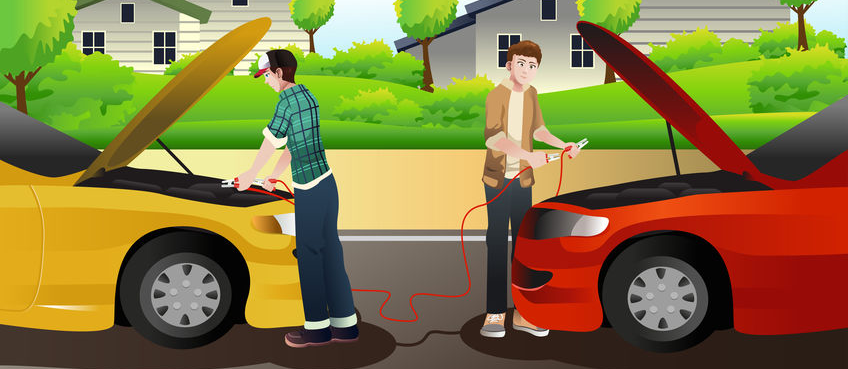
If your battery is dead due to a light being left on, you’ll probably be able to get back in action by jumping the battery. You can use jumper cables and another vehicle’s battery, or even certain specialty devices that can be charged via a wall outlet and jump the battery without the need for another vehicle’s battery. Once the car is running, you can run the engine for a while to re-charge your battery. For safety’s sake, take a look at your owner’s manual for instruction on how exactly to jump-start your battery. Certain vehicles may have precautions from the manufacturer, especially hybrids.
However, some batteries are simply too weak or completely drained, and jumping the battery won’t do the trick. Note that this is especially possible if you’ve let a car sit for a prolonged period of time without running. Any battery over the age of 4 to 5 years may possibly have lost its charge and needs to be replaced. As a sidebar, if you do have a vehicle that is regularly parked for prolonged periods, you may want to consider installing a deep-cycle battery that’s designed to survive such a condition.
Key Won’t Turn
Another somewhat common issue is that you attempt to turn the key in the ignition but can’t physically turn it. There are a couple of reasons this may happen. The most likely, and the easiest to fix, is that the steering is locked by the ignition lock. Often times, the cause of this is that the wheels are turned to the side, which is frequently the case when parking on hills, or else when the front wheels press against something, like a curb or parking curb.
All you need to do in this case is jiggle the wheel back and forth gently, and you’ll be able to turn the ignition key.
If that doesn’t work, it’s possible that there’s an issue with the ignition system, or with the key itself. If you have a spare key, try that one in the place of the key you just tried. If it turns without a problem, your key may have worn out of shape. If all your keys aren’t turning, it’s possible that the issue lies with the ignition lock itself, and you’ll probably need to have your vehicle serviced by a professional.
Problems with the Starter Motor
There are a few areas within the starter motor component that can go bad, any of which can cause the engine not to crank. The starter solenoid is a frequent culprit when the starter motor goes bad. The starter solenoid transfers a sizeable electrical current to the starter motor when the ignition switch sends it the signal.
The starter solenoid itself can completely fail or go bad, as can the connection with the starter motor apparatus. Either of these will prevent the engine from cranking. And additionally, problems with the starter motor device responsible for rotating can break down or go bad.
With problems related to anything from the ignition lock, the ignition switch, wiring and fuses related to the car’s computer and starter motor down to the starter motor itself, if you have extensive automotive knowledge and experience, you can try to fix it yourself. However, if you haven’t had experience trying to diagnose and fix such issues, you’re probably better off having your vehicle serviced by a trained professional.
Ignition System Issues
There are a number of failure points within the ignition system, any of which can cause your engine not to crank. If you can freely turn the key but the engine doesn’t crank and you’ve also checked out and confirmed that your battery is functioning properly, it’s probably an issue somewhere in the ignition system.
One possibility is that the electrical ignition switch has become faulty. The ignition switch is a switch at the back of the ignition lock, and it sends the signal to the starter. One way to determine that you have an issue with the ignition switch is if you can get the starter to crank by jiggling the key. This indicates that the ignition switch isn’t aligned properly and needs to be fixed or replaced.
Another related issue would be problems with the wiring leading from the ignition switch to the car’s computer and/or the starter motor, or fuses connected with those systems. If the wiring has gone bad in either of those areas, the electrical signal isn’t getting passed and the starter won’t crank.
If when you attempt to start the engine the ‘Check Engine’ light doesn’t briefly flash, you have an issue with the wiring, relays and fuses associated with the computer. The ‘Check Engine’ light flashing indicates that the computer is online and functioning. Not seeing that light when you turn the key means for some reason the computer isn’t getting power.
On the other hand, the problem is with the wiring leading to the starter motor, you’ll turn the key and the starter won’t crank. There isn’t a telltale sign like with the ‘Check Engine’ light, other than the fact that the battery is fine, the ignition lock is fine and the starter won’t crank. In this case, it could be an issue with the wiring or another issue connected with the starter motor.
Engine Cranks but Won’t Start
All of the preceding discussion has been about a situation where the engine doesn’t even crank. However, in some cases you’ll hear the engine turning over and yet the engine won’t start running. This situation means that you have one of a number of different problems preventing your engine from running.
One point worth emphasizing is that if your engine is cranking but not starting, don’t continue to crank the engine over and over. Continually cranking the engine without it starting is a significant drain on the battery, and this repeated cranking will drain the battery and can also do damage to the starter motor.
Here’s where we come back to those three elements needed for an engine to run: A spark, fuel, and compression. If your engine is cranking but doesn’t start running, you’re looking at a deficiency in one of those three areas. Before we get into those issues, though, it’s worth mentioning a scenario that is in-between the two.
Engine Cranks, But Weakly
It’s possible that you’ll hear the engine crank, but the sound is much weaker than it normally is, and the engine doesn’t start. Like with when the engine doesn’t crank, your first check should be the battery. A weak battery can be the reason for this. Another related possibility is that the connections from the battery to the starter motor are loosened, corroded or damaged in some other way. Tightening or replacing these connections or cable(s) can solve the problem.
Finally, a weakly cranking starter motor might indicate that there’s a problem with the starter motor itself, and you may have to replace the starter motor.
Now, we’ll move on to the situation where the engine cranks properly but doesn’t start running.
Engine Becomes Flooded
This is an issue seen most commonly in older, high-mileage cars. What you’ll typically observe in this case is that the engine cranks, the engine briefly starts up, but stalls and doesn’t start again. What’s happening here is that gasoline saturates the spark plugs and washes oil from the piston rings inside the engine itself, which reduces compression.
Lack of Fuel
This one is as simple as it gets, but it should be mentioned for the sake of completeness. Make sure that there’s sufficient fuel in the gas tank.
Fuel Pump Problems
Another fuel-related issue that’s a little bit trickier is problems with the fuel pump. This can take the form of an issue with the fuel pump itself, engine computer, or the fuel pump relay. In the case of the fuel pump going bad, this is something older cars are especially prone to. If the fuel pump dies, you won’t be able to start the engine. The same would be true if the main relay fails.
You’ll need to have a new fuel pump installed or fuel pump relay in order to get back on the road. This is a job that’s particularly well-suited to a trained technician, as it requires some testing to determine where the breakdown has happened, and fuel pumps on most cars today are installed within the fuel tank.
Mass Airflow Sensor Problem
If the mass airflow sensor breaks down, the engine will often start very briefly and then immediately stall. Fortunately, this isn’t usually a very expensive part to replace once the problem has been diagnosed.
Engine Computer Problem
A malfunctioning engine computer can lead to the engine cranking but not starting. While this issue is fairly rare, there are some situations that can leave a car vulnerable to it. One such scenario is improperly jump-starting a dead battery, which can cause damage the engine’s computer.
Like with the previous discussion about problems with the wiring from the ignition switch to the computer, a tell tale sign is that the ‘Check Engine’ light doesn’t light up during ignition. The bad news is that the engine computer is typically an expensive repair.
Engine Compression Problems
One of the most unfortunate issues that can cause the engine to crank but not start are general compression issues within the engine. This can result from the engine overheating, or from a timing belt or chain skipping. If the engine loses compression, it’s a serious problem even beyond the fact that the engine may not start.
In this case, you’re likely going to have to rebuild or replace the engine, which is a major repair with a significant cost attached to it.
To sum it all up, there are quite a few reasons why an engine won’t start, though it’s possible to make a rough diagnosis in many cases based on observing the details described above. While you can’t always pinpoint the cause, for a number of problems the symptoms can be clear.
If the engine doesn’t crank, start the investigation with the battery, as that’s the most likely cause and also the easiest to deal with yourself. In cases where the engine cranks but doesn’t start, make sure not to drain the battery by excessively cranking the engine. Crank no start situations tend to be a little tougher to diagnose than when the engine doesn’t crank at all.
In all cases, if you can diagnose and fix it yourself, that’s wonderful. For some of the simpler problems, that’s possible. However, for a number of the more difficult or hard-to-diagnose issues, it’ll be necessary to tow the vehicle to our shop for one of our Automotive Experts to pinpoint the problem.
You may also be interested in reading…
Battery Check
Check Engine Light
Electrical Diagnosis and Repair
The Importance of Routine Car Service
