
We’re getting closer to the official new Leaf’s presentation and today Nissan released another teaser, this time promising better aerodynamics for more range and efficiency.
Let’s see the press release:
“The new Nissan LEAF will feature improved aerodynamic design that makes it even more efficient, allowing drivers to travel farther on a single charge. Aerodynamics is key to how efficiently an electric car moves. Less drag and better stability enable the vehicle to drive longer distances before having to recharge.
The redesigned next-generation Nissan LEAF is lower to the ground, helping it realize zero lift for better stability at high speeds. Other new design features significantly stabilize the car when hit by strong crosswinds.
Inspired by airplane wings, Nissan engineers recreated the ideal shape for the new LEAF, enabling a symmetric air flow that helps it slice through the air for a smoother, more efficient journey.
Nissan established itself as a pioneer in the EV movement by launching the LEAF, the world’s first mass-market electric vehicle*. Today, the Nissan LEAF is the world’s best-selling electric vehicle with more than 277,000 units sold.”
Probably the thing I dislike the most when I look to some electric cars is when it’s clear that improving aerodynamics wasn’t a priority when they were designed. Some of those electric cars could easily get 10-20 % more free range from simple aerodynamic tweaks. Since not everyone would like some of these tweaks, they could at least be optional. As I see it, every electric car should have a special trim dedicated for maximum efficiency with moon discs, wheel skirts and cameras replacing side view mirrors for example.
Last year, the Hyundai IONIQ Electric proved that aerodynamics matters and more battery capacity isn’t the only way to considerably increase range. The Tesla Model 3 is also very impressive, efficiency wise. It’s great to see Nissan getting the message and following the same path.
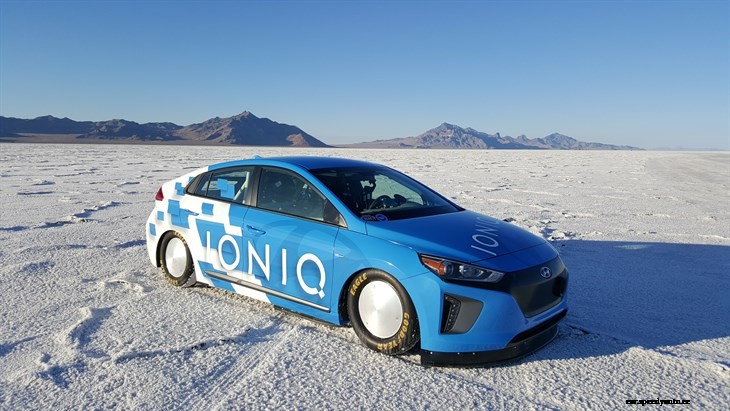
Hyundai IONIQ Hybrid land speed record car
Definitely the new Nissan Leaf will not please everybody. However, I do like the strategy of fighting range anxiety the smart way. Nissan increases the battery capacity just enough to not represent higher costs, increases efficiency to better use the battery and increases the charging rate. When Carlos Ghosn was Nissan’s CEO, he said multiple times that this would be his strategy.
Just putting a bigger and heavier battery would make the car more expensive to buy and run (less efficient).
I do wonder if the long range version powered by LG Chem batteries will charge faster at DC fast chargers than the standard version powered by AESC, just like what happens with the two battery versions of the Tesla Model 3.
Ultimately the battery capacity doesn’t matter, only range and efficiency. Unless your electric car supports vehicle-to-grid (V2G) and you plan to use it, then the battery capacity does matter.
What will the next teaser be? Weight reduction from using aluminium in moving parts such as the hood and doors?
