
Last year, I wrote an article about the new generation Nissan Leaf and the role it will play in the car market. In the article I explained why I think that the 2019 Nissan Leaf will be the real deal and why BMW should be worried.
Unfortunately, the same thinking doesn’t apply to the current model year. The 2018 Nissan Leaf is just a stopgap until the no-compromise 2019 model year arrives.
I’ll proceed to explain why…
Nowadays, we get higher energy density battery cells mostly by adding more nickel to the cathodes and the NCM 622/811 cathodes are clear examples of this. However, nickel-rich cathodes have a downside, they have less thermal stability.
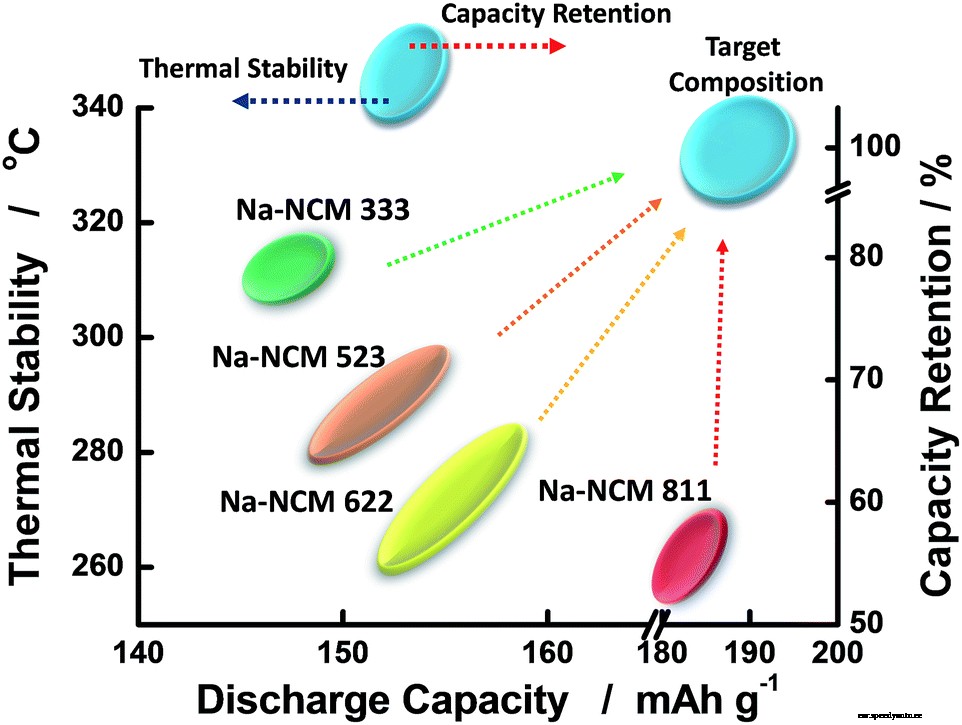
Thermal stability vs discharge capacity in NCM cathodes
With less thermal stability, thermal runaway occurs at lower temperatures and it becomes more important to have a TMS (Thermal Management System) to protect the battery and assure that it operates at a comfortable temperature. However, as you already know, the Nissan Leaf still lacks a TMS and this is a problem, specially now that it has NCM 622 battery cells.
Remember that Nissan no longer owns the battery cell maker AESC and can no longer push its battery packs to the limits and expect free replacements under warranty when things get bad. Now to be eligible for warranty Nissan has to comply with more demanding requirements from the – now independent – battery cell maker.
Since the Leaf’s battery pack isn’t protected by a TMS, now the newly independent battery cell maker AESC demands – for warranty purposes – that the BMS (Battery Management System) becomes “overprotective” and has to step in frequently and protect the battery when temperatures get high – by limiting the charge/discharge rate. Therefore we can expect frequent very low DC charging rates in the 2018 Nissan Leaf…
Imagine the battery as a CPU and the TMS as a cooler, if you’re not using a cooler you can’t overclock the CPU to get its best performance. You might even have to underclock the CPU to prevent it from burning…
James from the Electrified Journeys Japan YouTube channel is a Nissan Leaf fan and was one of the first persons to test the 2018 Nissan Leaf in Japan. He already shared his concerns about this topic multiple times in some of his videos such as the one below.
Initially, before its launch, the 2018 Nissan Leaf was advertised as being able to fast charge from 0 to 80 % in just 40 minutes. Then, more recently, Nissan started advertising the charging time as something between 40 and 60 minutes.
I think that by summertime, we’ll see Nissan saying that it’ll “fast” charge in roughly 2 hours at 23 kW like we see in the video below shared on Twitter by Ecocars.
Not happy @NissanEV_UK ! pic.twitter.com/YhTU7ifklE
— eco-cars.net (@ecocars1) March 18, 2018
Anyway, if you have any interest in this topic there is an ongoing discussion at SpeakEV forum that you’ll probably find interesting.
Finally, to make things clear, I’m not saying that the 2018 Nissan Leaf is a bad electric car, it isn’t. It has more range, looks nice (like a bigger Nissan Micra that I like so much) and is much safer than the outgoing model.
However, Nissan should be honest about what they’re selling. Some buyers are expecting to use fast charging regularly and it’ll be a problem in this particular electric car. Nissan should under-promise and over-deliver by saying that the Leaf can “fast” charge at 22 kW or more, so that buyers can have nice surprises instead of disappointments. The Renault Zoe was the best selling electric car in Europe for many years and it wasn’t the lack of super fast charging that undermined it – unlike many other things like mandatory battery rental or bad customer service…
Summing up, if you don’t plan to fast charge regularly nor you live in a hot region, the 2018 Nissan Leaf is a good electric car to buy – although a bit expensive for a stopgap car -, otherwise, wait a bit more for the next model year. The 2019 Nissan Leaf will be almost perfect. Trust me 😉
What do you think? Are you worried? Or are you just waiting to get the 2018 Nissan Leaf at a lower price, when summer discounts become available?
