
Kazuo Yajima is the Alliance Global Director of EV and HEV Engineering Division of Nissan and recently gave Nikkei Automotive an interesting interview. Unfortunately, only the first part of the article is available without subscription.
From this interview I conclude that:
For Nissan, it doesn’t make much sense to bet in plug-in hybrids (PHEVs) now that electric cars are starting to have higher ranges. It seems that Nissan is going for full electric cars and hybrids – such as the Note e-Power -, while not seeing much future in something in between (PHEVs). I tend to agree with this approach since PHEVs are very complex and expensive machines, it’s best to have either an efficient ICE (Internal Combustion Engine) car such as a hybrid, or go for a fully electric car (BEV).
As for the approach of gradual range increase, while maintaining or even dropping the price, I also find it reasonable. While we all were excited to see the arrival of the Chevrolet Bolt EV, let’s face it, it’s not a mass market electric car, at least not until it gets a considerable price cut. As much as we try to convince ourselves, the 40.000 € price-tag for the Opel Ampera-e doesn’t make it an affordable car, not even 30.000 €… at these price-tags electric cars will never compete with ICEs, and the ICE car to beat in Europe it’s the Volkswagen Golf which has a starting price below 18.000 €.
As a side note, the press release World champion (Volkswagen), does say that its electric car to be released in 2020 based on the ID concept will have a similar price to the Volkswagen Golf. When it happens, we’ll have a truly mass market electric car.
Finally, 350-400 km range in the Japanese JC08 Cycle might seem very little – now that every automaker is announcing electric cars with higher range -, but the upcoming Nissan Leaf can shine in other fields such as affordability, build quality or safety features.
In September we’ll see if the upcoming 2018 Nissan Leaf is a step in the right direction of delivering zero-emissions and zero-fatality mobility, which should be the objective of every automaker and was the moto of Carlos Ghosn. A simple and cheap thing like a heads-up display helps to keep the eyes on the road when driving and greatly reduce fatalities, its presence in a modern car tell us a lot if the automaker is determined or not to reduce road deaths.
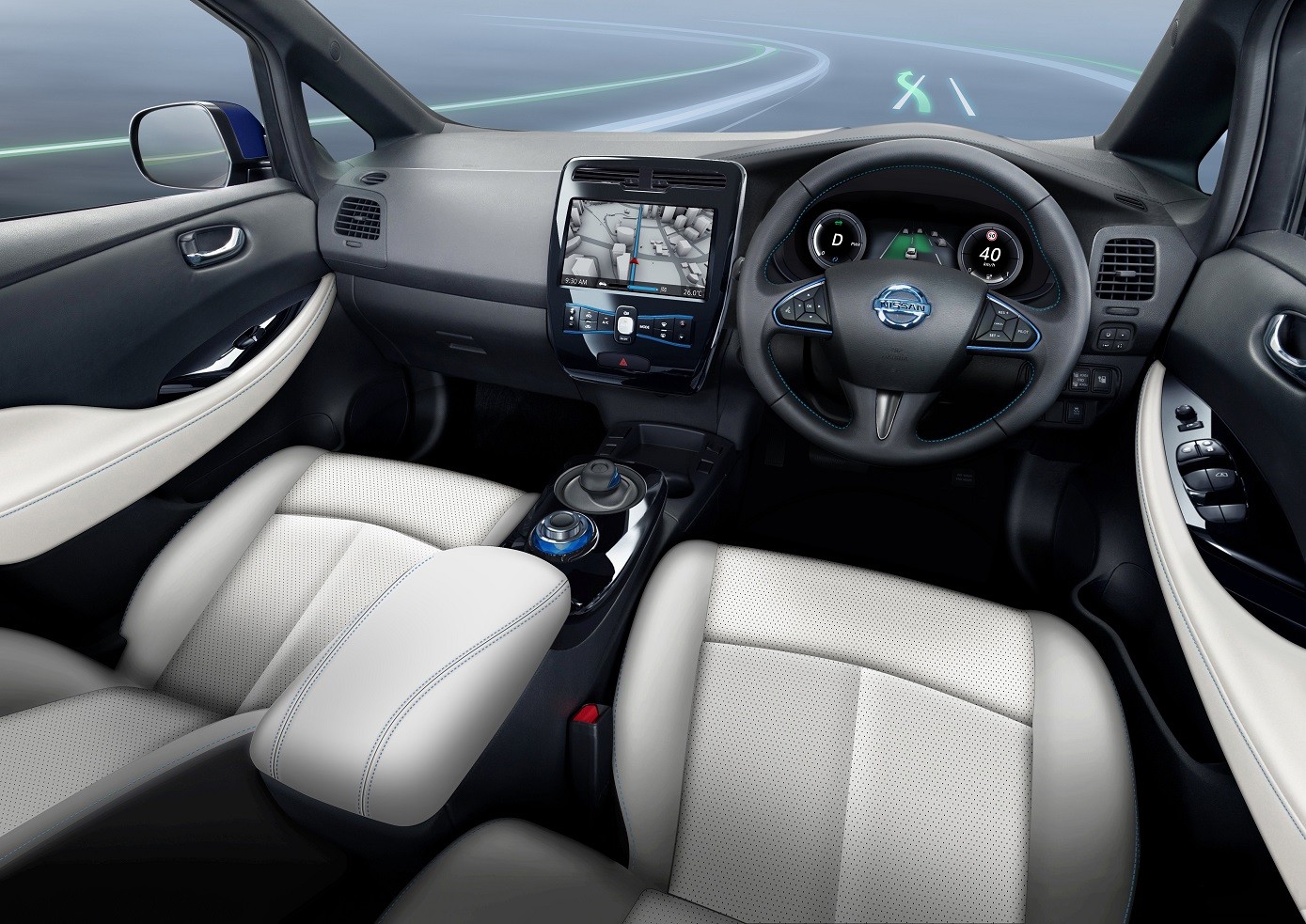
Possible 2018 Nissan Leaf interior with heads-up display
To sum up, it seems that Nissan will continually increase electric cars range while trying to keep them affordable, which is a honorable thing to do. Electric cars with great range that few people can afford won’t do much to reduce emissions, this was what the former Nissan CEO, Carlos Ghosn said and I completely agree. This being said, I’m not yet convinced that the 60 kWh battery will only be available in 2020, but I do understand this assumption is required to keep the current Leaf’s sales going…
What do you think about Nissan strategy? What is the best trade-off between range and price?
Thanks Adrian for the heads up!
