
The 2018 Nissan Leaf battery – like all previous versions – uses a 96s2p cell configuration, this means that in total there are 192 cells in the battery pack. However, the battery cells now have a much higher energy density.
In the Nissan Leaf, each battery pack has 24 modules and each module has 8 cells. Originally, the Nissan Leaf was launched with double the modules. The 24 kWh battery in the 2011 Nissan Leaf had 48 modules, each module with 4 cells. However, when Nissan released the 30 kWh battery, the number of modules was reduced to half – to further increase the energy density of the battery pack. If you look at the new battery module below you’ll see that it seems 2 old modules stuck together…
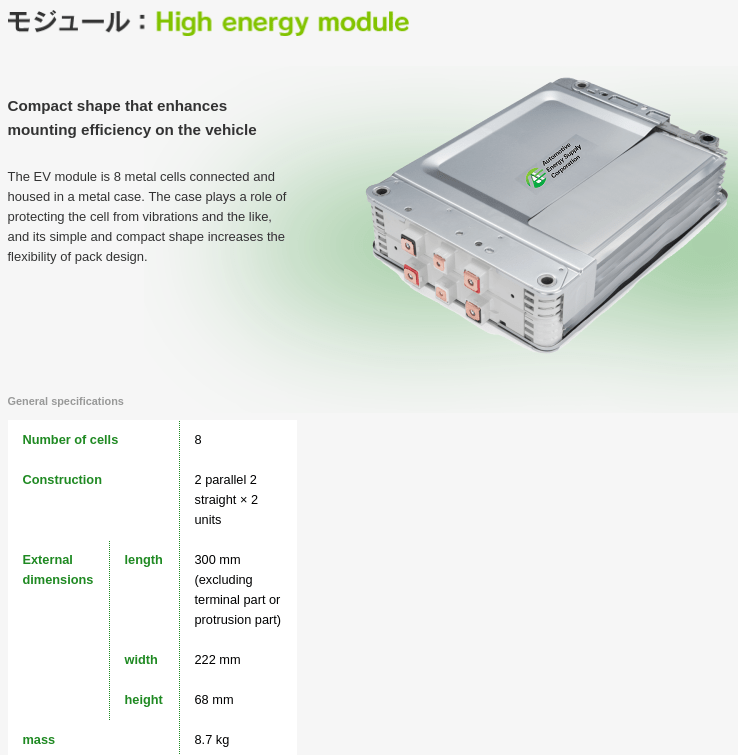
AESC new battery module specs
Moving on…
Now we can calculate the new battery real capacity:
And compare it to the original battery pack in the 2011 Nissan Leaf.
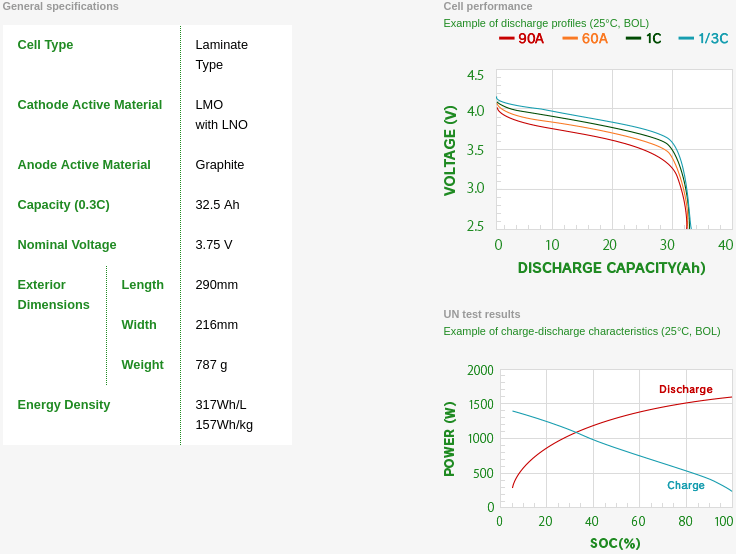
Specs of the AESC battery cells used in the first generation Nissan Leaf 24 kWh battery
The energy density of 460 Wh/L (volumetric) and 224 Wh/kg (gravimetric) is pretty impressive for a NCM 523 battery cell. It would be great to see AESC develop NCM 811 cells to compete with SK innovation and LG Chem.
Anyway, I’m a bit disappointed with the battery real capacity, because for a while now the inside information was that Nissan – with the new battery – would start advertising the usable capacity, as others have been doing. In fact, that’s what Nissan says that is now doing – as we can see in the video below -, but the numbers don’t add up…
Now you know that the 2018 Nissan Leaf has a battery with a rated capacity of 39,46 kWh. This is under normal conditions and can be affected by temperature or C-rate.
