
Last night, the 2018 Nissan Leaf was officially unveiled, without any major surprises, since the most important specification – battery capacity -, was already known for more than a year, but then Nissan decided to take more time for further tweaking and I learned that sometimes I should keep some information for myself…
Anyways, first deliveries will start in early October in Japan, while the rest of the world has to wait for January next year.
Below we have the part of the press release where Nissan highlights this new Leaf’s improvements.
“The focal point of Nissan Intelligent Power in the new LEAF is the e-powertrain, which offers improved energy efficiency and increased torque and power output.
The new e-powertrain delivers an exhilarating, linear driving performance with a power output of 110 kW, 38% more than the previous-generation Nissan LEAF. Torque has been increased 26% to 320 Nm, resulting in improved acceleration.
Existing Nissan LEAF drivers already love the instant response and linearity of performance as they navigate the city. The new Nissan LEAF’s improved acceleration will boost enjoyment even further.
Even with the additional power output, the new Nissan LEAF’s driving range has been increased. The car’s new lithium-ion battery pack delivers an estimated range of 400 km by Japan standards, which should satisfy the daily driving needs of the majority of our customers.
The new battery design adds energy-storage capacity without increasing the size. The battery pack occupies the same dimensions as that of the previous-generation Nissan LEAF. It’s the individual cell structure of the laminated lithium-ion battery cells that’s been improved, representing an impressive 67% increase in energy density versus the 2010 model. Another key engineering improvement for the lithium-ion battery pack is enhanced electrode materials with revised chemistry, resulting in higher power density while contributing to greater battery durability on charge and discharge.
For customers who want more excitement and performance, Nissan will also offer a version with more power and longer range at a higher price in 2018 (launch timing may vary by market).”
Notice that Nissan expects to sell the mid level trim the most, by limiting the availability of the entry level.
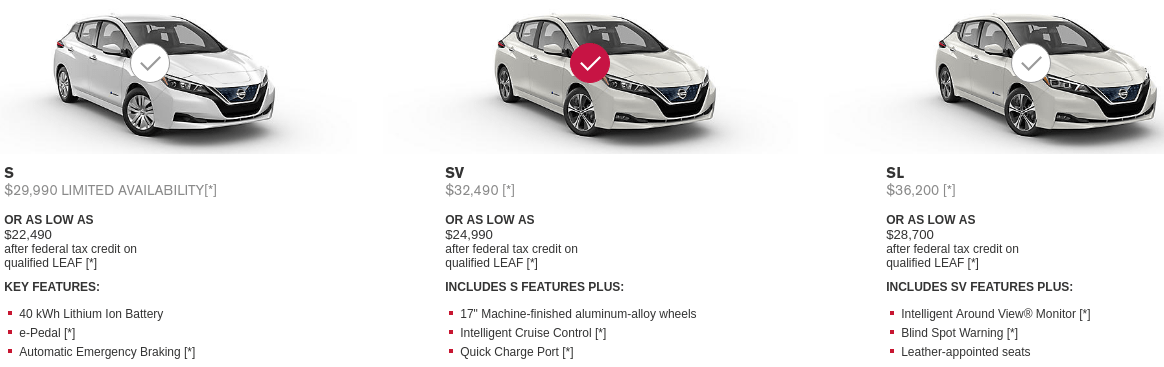
2018 Nissan Leaf different versions in the USA
And now the European specifications…
2017 Nissan LEAF specifications (European model)
Specifications pending final homologation
|
Exterior |
(mm) |
|
Overall length |
4,480 |
|
Overall width |
1,790 |
|
Overall height |
1,535/1545 |
|
Wheelbase |
2,700 |
|
Track width front/rear |
1,540/1,555 |
|
Minimum ground clearance |
150 |
|
Coefficient of drag (Cd) |
0.28 |
|
Tires |
205/55R16 or 215/50R17 |
|
Weights/capacity |
(kg) |
|
Curb weight (min) |
1,535 |
|
Capacity |
5 passenger |
|
Gross vehicle weight |
1,765-1,795 |
|
Battery |
|
|
Type |
Li-ion battery |
|
Capacity |
40kWh |
|
Electric motor |
|
|
Name |
EM57 |
|
Maximum output |
110kw(150ps)/3283~9795rpm |
|
Maximum torque |
320N・m(32.6kgf・m)/0~3283rpm |
|
Performance |
|
|
Cruising range |
378 km(NEDC) |
|
Charging time (normal charging) |
16 hours(3kW) |
|
Charging time up to 80% (Quick Charging) |
40 minutes |
|
Maximum speed |
144 km/h |
It’s in the homologated range, where the specs for the various regions differ the most. The 2018 Nissan Leaf in Japan has an estimated 400 km range in the JC08 cycle, in Europe it’ll be 378 km in NEDC, while in the USA the range will be 150 miles (241 km) with the more realistic EPA test cycle.
When compared to the outgoing model, the 2018 Nissan Leaf is a clear improvement. It has better range, better acceleration, better efficiency, it’s better looking and safer, overall it’s better in every single aspect we can think of. However, as much as I like it, this isn’t a revolutionary electric car.
In my opinion the improved Nissan Leaf needed to achieve even better efficiency and allow faster charging to finally convince more people to go electric.
Let’s take a look to the Hyundai IONIQ Electric. This electric car can be charged in 23 minutes from 0 to 80 %, this means that a 23 minutes charge can give you a range of 99,2 miles (160 km). While the 2018 Nissan Leaf takes 40 minutes to charge from 0 to 80 %, this means that this electric car is expected to only get 69 miles (111 km) of range from the same 23 minutes fast charge…
If you’re trying to convince somebody to switch to electric cars, the psychological part plays a very important role. While 23 minutes of waiting is considered acceptable, since it’s less than half an hour, 40 minutes is not. In people’s minds, that’s very close to one hour.
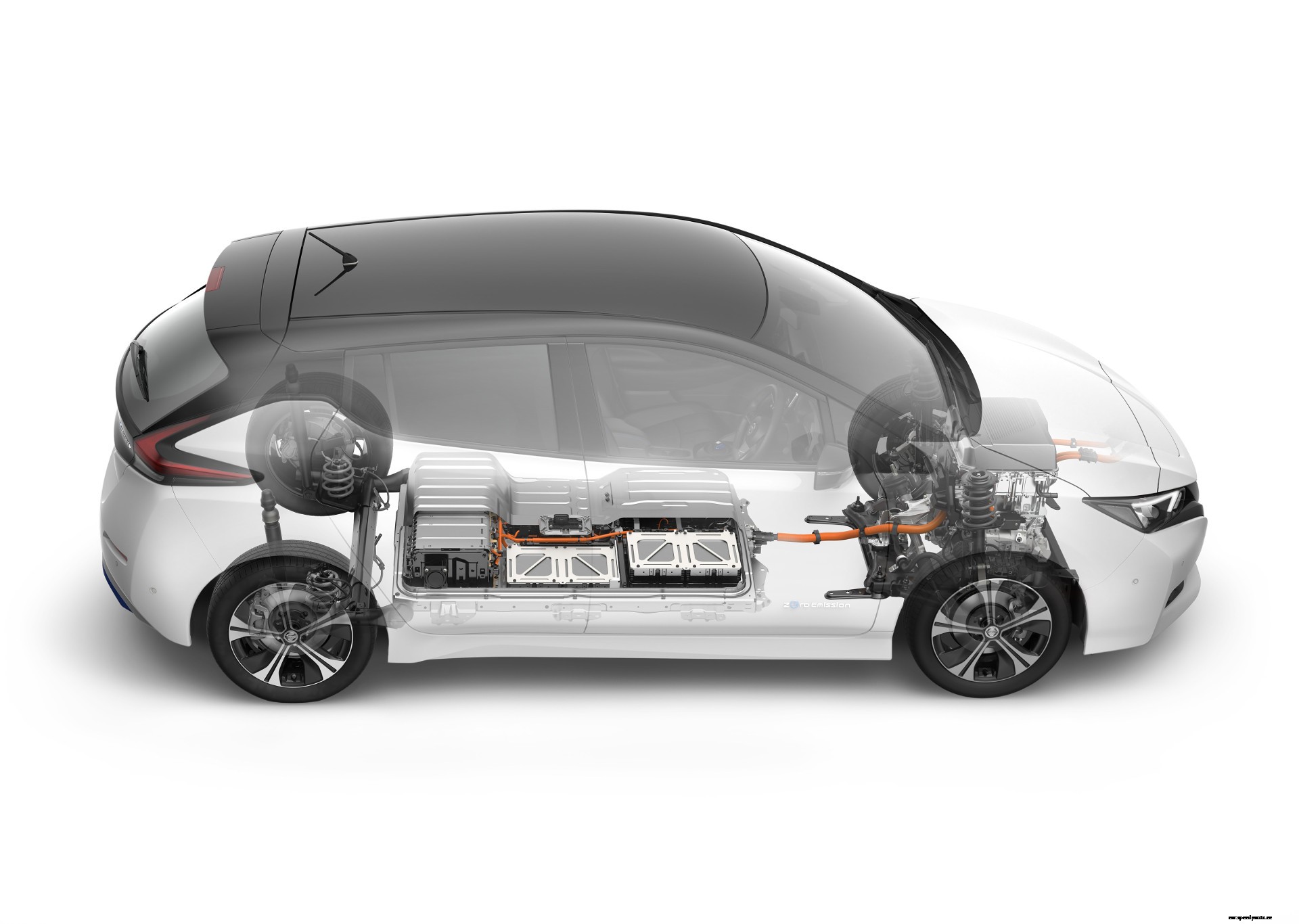
2018 Nissan Leaf powertrain
The much awaited revolution is postponed to the next year, with the introduction of a LG Chem battery with more capacity, which will not only give us more range, its TMS (Thermal Management System) will also enable faster charging – without increasing capacity degradation.
Nevertheless, the now available 40 kWh battery made with AESC cells is not bad at all. This battery is the same size as the old 24 kWh version, this was possible due to a 67 % energy density increase.
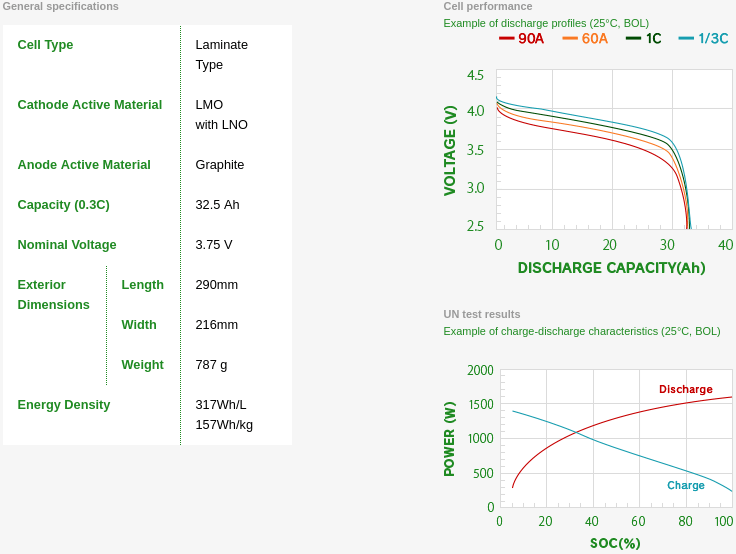
Specs of the AESC battery cells used in the first generation Nissan Leaf 24 kWh battery
Considering that the old AESC battery cells had an energy density of 317 Wh/L, the new ones reach 529 Wh/L. These cells are actually more energy dense than the LG Chem battery cells (435-484 Wh/L) used in the new ZE 40 battery of the Renault Zoe. Furthermore, the new AESC battery cells are not only more energy dense, they also have better power density. This makes possible higher charge and discharge rates without increasing the capacity degradation.
To sum up, while I don’t see this as a revolutionary electric car, I see it as a good bridge technology to the real new generation Leaf coming in 2020. I won’t be surprised if Nissan manages to sell 10.000 monthly units in the USA, another 10.000 in Europe and 5.000 in Japan. Far from Tesla Model 3 territory, yet I don’t see any other electric car coming close.
What do you think about the 2018 Nissan Leaf? Besides the Tesla Model 3, do you see any other electric car to be as successful in sales next year?
