
Just a few days before the 88th Geneva International Motor Show, Hyundai shows us the details of one of the most awaited electric cars in 2018.
Hyundai made my job easier and summed up the details in this infographic:
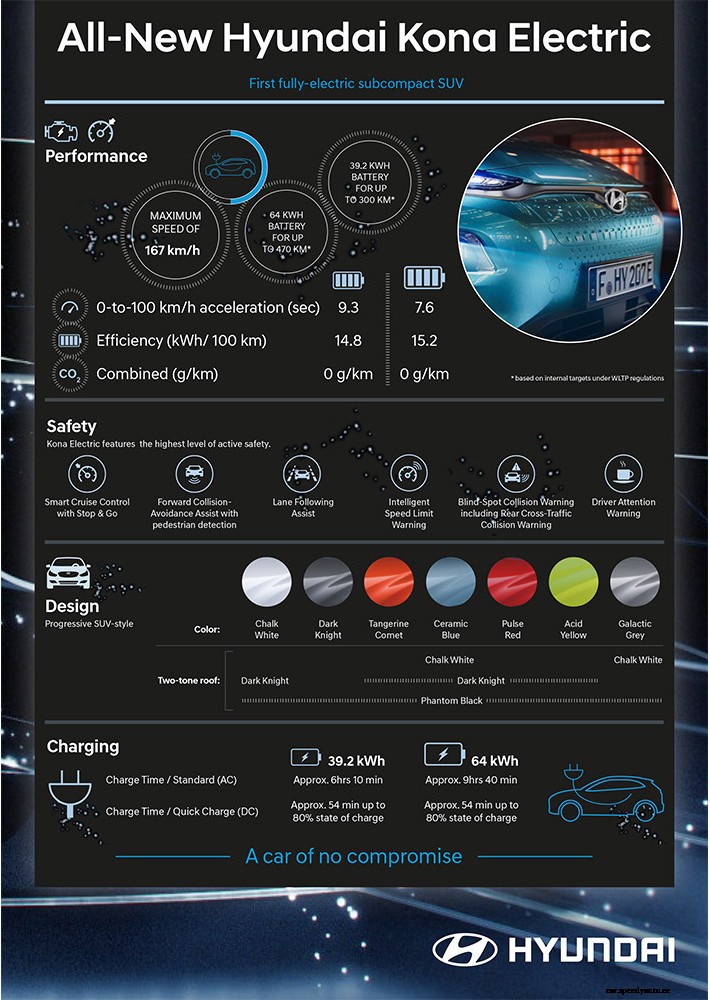
Hyundai Kona Electric infographic
However, if you prefer to look at information displayed in a comparison table I made one for you:
|
Version |
Short-range |
Long-range |
|
Maximum Power |
99 kW / 135 PS |
150 kW / 204 PS |
|
Maximum Torque |
395 Nm |
395 Nm |
|
Maximum speed |
167 kph |
167 kph |
|
Battery Capacity |
39,2 kWh |
64 kWh |
|
On-board Charger |
7,2 kW (1-phase) |
7,2 kW (1-phase) |
|
AC Charge Time |
Approx. 6 hrs 10 min |
Approx. 9 hrs 40 min |
|
DC Charge Time (100 kW DC fast charger) |
Approx. 54 min up to 80 % state of charge |
Approx. 54 min up to 80 % state of charge |
|
Range (WLTP) |
Up to 300 km (186 miles) |
Up to 470 km (292 miles) |
|
0-to-100 km/h acceleration (sec) |
9,3 |
7,6 |
|
Efficiency (kWh/100 km) |
14,8 |
15,2 |
|
CO2 combined (g/km) |
0 |
0 |
|
Overall length |
4.180 mm |
4.180 mm |
|
Overall width |
1.800 mm |
1.800 mm |
|
Overall height |
1.570 mm |
1.570 mm |
|
Wheelbase |
2.600 mm |
2.600 mm |
|
Front overhang |
855 mm |
855 mm |
|
Rear overhang |
720 mm |
720 mm |
|
Head room (1st/2nd row) |
1.006 / 948 mm |
1.006 / 948 mm |
|
Leg room (1st/2nd row) |
1.054 / 850 mm |
1.054 / 850 mm |
|
Shoulder room (1st/2nd row) |
1.410 / 1.380 mm |
1.410 / 1.380 mm |
|
Luggage including charging cable storage (VDA) |
332 litres |
332 litres |
|
Luggage without charging cable storage (VDA) |
373 litres |
373 litres |
What doesn’t seem right is that according to the information provided by Hyundai, the two motors deliver the same top speed and torque. Moreover, the DC fast charging time is the same for the two batteries. It must be a typo.
Moving on…
The Hyundai Kona Electric is the first next-generation electric car from the Hyundai Kia Automotive Group to use the revolutionary NCM 811 battery cells. However, other electric cars such as the Kia Niro EV, new-generation Kia Soul EV and Hyundai IONIQ Electric will follow. Imagine the super-efficient Hyundai IONIQ Electric with these new powertrains…
Not only the electric powertrains are very impressive, this electric car is also packed with the latest active safety and driving assistance technologies from Hyundai, called SmartSense:
Furthermore, it has a HUD (Heads Up Display), which “projects the relevant driving information directly to the driver’s line of sight. This allows faster processing of information while keeping attention on the road ahead.” This will probably be the safest car (electric or not) to drive in 2018.
Unfortunately, Hyundai’s electric car production goals for this year are still very shy.
Anyway, Hyundai Kona Electric will have its first deliveries to South Korean customers in April, while in Europe they’ll happen during the summer. Regarding electric cars North America is not a priority for Hyundai.
What do you think about the Hyundai Kona Electric? And what’s your favorite upcoming electric car?
Update: it seems that the battery cells will be NCM 622 and not NCM 811.
