
A car that is working fine isn’t supposed to make any weird noises. Usually, if you hear noises when slowing down, the brakes are the culprits. Brakes are a crucial part of your car that ensures the safety of a driver. Slowing down is just as important as driving off.
So what does it mean if your brakes are making noise? Let us look at 9 reasons for a grinding noise when driving slow or slowing down.
You need to know how to deal with the symptoms that faulty components throw at you. Usually, when a component fails, it emits an unusual noise. This is an audible indicator, that your car has a failed component and it needs to be repaired or replaced.
What if you hear grinding noises when you slow down or drive slowly? There are many possible reasons why this phenomenon might be occurring. So, just using the audio signals, you won’t be able to identify the failing component.
You need to take all the possible causes and cross-reference them with other symptoms that you see. This way you should be able to pinpoint the reason for a grinding noise when driving slow or slowing down.
Usually, if you hear this sort of noise, it is often connected to the brakes. But that doesn’t narrow it down enough.
There are 2 reasons why you need to understand the cause before it is too late.
First, if the sound is coming from the brakes, there is a good chance that it might fail. The brakes are the only way of slowing once you start driving. You won’t be able to control your car without brakes.
Driving a car with no brakes is an accident waiting to happen. So to protect yourself from an accident, you need to figure out the cause of the problem and solve it.
Secondly, the longer the problem lingers, the more damage it does. This is true with almost every car-related malfunction. So by solving the issue at its early stage, you would be able to save thousands of dollars in the long run.
Therefore you need to know exactly how to diagnose grinding noises when driving slow or slowing down. You should also know how to troubleshoot this issue.
Analyzing the audible cues your car provides is an important skill to develop as a car owner. Here we shall discuss, how to analyze the cues and the possible solutions.
There are dozens of reasons why this might happen. But let’s just look at the 9 most common reasons for a grinding noise when driving slow or slowing down.
As the name suggests, wheel bearings are the bearings that keep the wheel in place. It is located in the front wheel hub assembly. This bearing plays important role in keeping your wheels rolling. It makes sure that there is little to no friction during the motion of the wheels.
Friction causes wear. If the bearings aren’t functioning properly, there will be friction between the components. This will cause a grinding noise when slowing down or driving slow. Worst of all it will result in excess wear in those components.
There is nothing fancy behind the technology that goes into making wheel bearings. If you do not know, they are basically steel balls. They are installed in the housing and lubricated with grease. The grease greatly reduces the friction and reduces the wear that these steel balls suffer.
Generally, with proper lubrication, these wheel bearings can last hundreds of thousands of miles.
But sometimes, if you are really unlucky, these bearings tend to wear out. A worn-out bearing will cause a lot of potential problems including grinding noises when slowing down. Noises are often heard when there is a change in speed.
So, you might hear a squealing noise when you accelerate as well. This also makes a grinding noise when turning.
If you notice the issue early on, there might not be a lot of wear on the bearings. Since the cause of this issue is often the lack of grease, you can add grease to lubricate the bearings and your car should run fine.
But if you’ve been hearing these grinding noises for a while now, chances are your wheel bearings are worn out. If this happens, you might have to replace these bearings.
Worn brake rotors will also result in grinding noises when slowing down or when you slam on the brakes. Brake rotors wear out with time. There is not a lot you can do to stop it. But when your brake rotor is worn or warped, it will start to reduce the braking of your car.
A good brake rotor will have a smooth surface on it. When it wears out, you will notice fine lines running horizontally. These lines clearly indicate that your brake rotors are worn. Some people think that replacing the brake pads will solve the issue. Actually, the only solution is to replace the rotors.
The grinding noise that you hear due to a worn rotor is quite different from the causes. A bad rotor creates intense grinding or squealing noise, which is quite unbearable.
You might have noticed that we talked about rotor warping. Not a lot of people that brake rotors can warp. Brake rotors can warp if you drive through water. Another reason why it warps is due to hard braking.
Are you wondering, why do brake rotors warp when braking hard or driving through water? It all comes down to the change in temperature. When you brake hard, the temperature of the rotors rapidly increases. This results in a warped brake.
A similar explanation can be given to the warping of brake rotors while driving through water. Only this time it is caused due to the temperature rapidly decreasing. Rotors tend to heat up a lot when you drive. When you drive through water, the sudden drop in temperature will warp the brake rotors.
Worn or warped brake rotors cannot be repaired. So replacing the brake rotor is your only solution. Replacing the rotors will set you back anywhere between $300 to $600.
This is one of the most common reasons why you hear grinding noise when you slow down or when you are driving slow. Worn brake pads can seriously reduce the braking of your car.
Different types of brakes are made out of different materials. Often multiple materials are combined to make up your brake pad. Sometimes, a new braking pad could also make noises when slowing down. This indicates that your brake pad is not made out of quality material.
So, you need to buy brakes from certified manufacturers to avoid this from happening.
If you hear these noises after a recent replacement, you might need to replace the pads again. A good quality brake pad which not worn out should make any grinding noises when slowing down.
Brakes pads work using friction. Therefore wear is inevitable. Unlike many other components in your car, lubrication is not an option to stop the wear of brake pads. When the brake pads wear off, there is no more material left on them.
So the plate starts to rub with the rotor. If this continues, the rotor will also be damaged due to the metal-on-metal contact. So, you need to get your brake pads replaced when necessary.
You should regularly check the state of your brake pads. And if they seem worn off you need to get them replaced. If they completely wear out and rub on the rotor, then the rotor will also need to be replaced. This could get costly.
The brake calipers work with the help of the master cylinder. Bad brake calipers will also result in grinding noises when driving slow or slowing down.
When you press the brake pedal, it creates a vacuum in the master cylinder. This vacuum is what moves the piston in and out of the brake calipers. These are not the same as the engine pistons. The piston on the calipers are small and move in and out when you press the brakes.
Occasionally, these brake calipers get stuck. This could get at either position, open or close. If they are stuck in an open position, then they will make a grinding noise when driving slow. If the piston is stuck in an open position, it will cause havoc on other components as well. The brake pads and rotors will fail prematurely.
There are 2 options for you if you are in this situation. The first is to use a caliper rebuilding kit. Rebuilding your caliper is not that complicated. You can do it yourself or you could hire a mechanic to do this for you.
The second option is to replace the brake caliper. Replacing the caliper is a much better option as it will be more durable and dependable than a repair kit.
The brake stops your car through friction. So, you might be wondering, why does it need to be lubricated. Actually, there are much more components to the braking system other than your rotors and pads. Some of these components need to be lubricated.
The backside of your brake pads needs to be lubricated. A lubricant called brake caliper lube is used for this. This component comes into contact with the caliper piston. Without lubrication, these components will grind against each other generating a grinding noise.
Apart from this, the caliper pins also need to be lubricated. The caliper pins are the part that connects the 2 sides of the brake calipers together.
A loose engine belt might be the reason you are hearing a grinding noise when driving slow. If the sound is erupted by a loose engine belt, then you might hear the notice when driving slower than 20 mph.
The reason why you hear the grinding noise is because of an untightened pulley or a bad tensioner pulley. Crankshaft pulleys tend to wear and wobble with time. This results in a loose engine belt. The only solution for this problem is to replace the engine belt and the pulley.
The reason for a loose belt might also be a bad tensioner pulley. The small known as the tensioner pully applies pressure on the engine belt. Without pressure on the belt, it might get dislodged.
The tensioner pulley can be tightened easily with a ratchet. Even if it is damaged, it is a fairly cheap repair to do. So either one of these pulleys could loosen the engine belt. A loose engine belt will result in a grinding noise when driving slow.
This is one of the worst things that you could encounter. Though most car owners consider the transmission as a culprit when they encounter shaking, vibrations, or rough gear changes, a bad transmission will also cause grinding noises.
The reason might be the lack of transmission fluid or maybe the gears themselves are failing. If one of the lower gears is damaged, it could be the reason why you are hearing grinding noises when driving slow.
Whatever the reason is, you need to get your transmission evaluated by a professional. The transmission is a crucial component to keep your car running. Repairs related to the transmission could be costly. So, you should not leave the problem unattended.
The tensioner inside your engine is in charge of keeping the timing chain held tight. So when the tensioner fails and the transmission chain becomes loose, it will create a grinding noise at slow speeds.
When the timing chain is loose, then the camshaft and the crankshaft of your engine will not work in sync. This could damage your engine. If you hear grinding, speaking, or rattling noises from your engine, you need to inspect your timing chain.
Replacing the timing chain could cost $1000 or more. But if your timing chain jumps out of its position, then it could get stuck among the moving parts of the engine. This will seriously damage your engine. And if this happens, you would have to completely replace your engine.
The sound that you hear is actually more of a rattle than a grind. But it is good to know as it could be easily mistaken as a grinding noise.
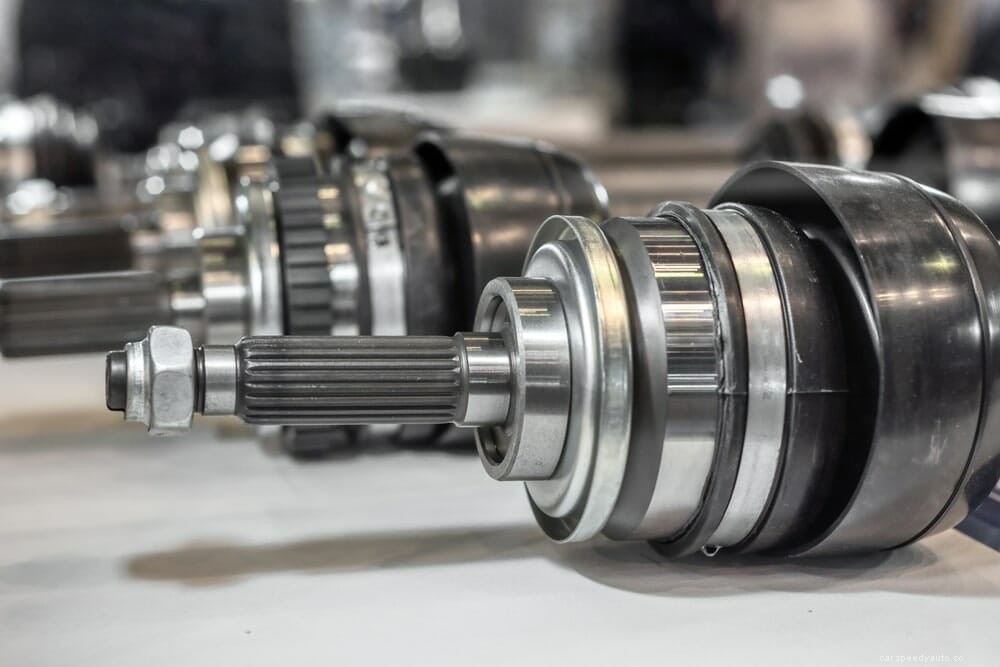
If you only hear the grinding noise when making turns at low speeds, then the likely suspect is the CV joint. It is a pretty common issue as the car gets older.
The CV joints are key components in keeping your car stable and comfortable. Unlike an ordinary axle, the CV axle works with bearings. This allows the CV joint to freely move vertically.
Almost every car with front-wheel drive has a CV joint. Some rear-wheel-drive cars have CV joints as well. This is a huge step up from the older solid axles. Cars with CV axles are more comfortable and they handle better.
CV axles tend to brake. If you drive through rough terrain, or if you drive through a big pothole, it can break the CV axle. A broken CV joint will result in a different set of problems. Let us look at why CV joints cause a grinding noise when driving slow.
The bearings in the CV joint are lubricated with grease. This loses its lubricating properties as it ages. Or it could leak out as well. Without lubrication, the CV joint will produce a grinding noise when it is engaged. This will be audible when making turns at slow speeds or if you are slowing down through a turn.
Without lubrication, the CV joint will take a lot of damage. So you need to get your CV joint checked and you might need to replace it.
Here are some of the common questions regarding the reasons for a grinding noise when driving slow or slowing down.
It is never a good idea to drive with bad brakes. Grinding brakes are definitely an indicator that your brakes are failing. When you hear grinding noises from your brakes, it often indicates that you either have bad brake pads or rotors. Both of these are serious issues and will mess with your braking.
Your braking will be drastically reduced. The stopping distance would increase greatly. Without proper braking, the chances of being in an accident significantly increase.
The exact life span of brake pads varies according to the materials used to manufacture the pads.
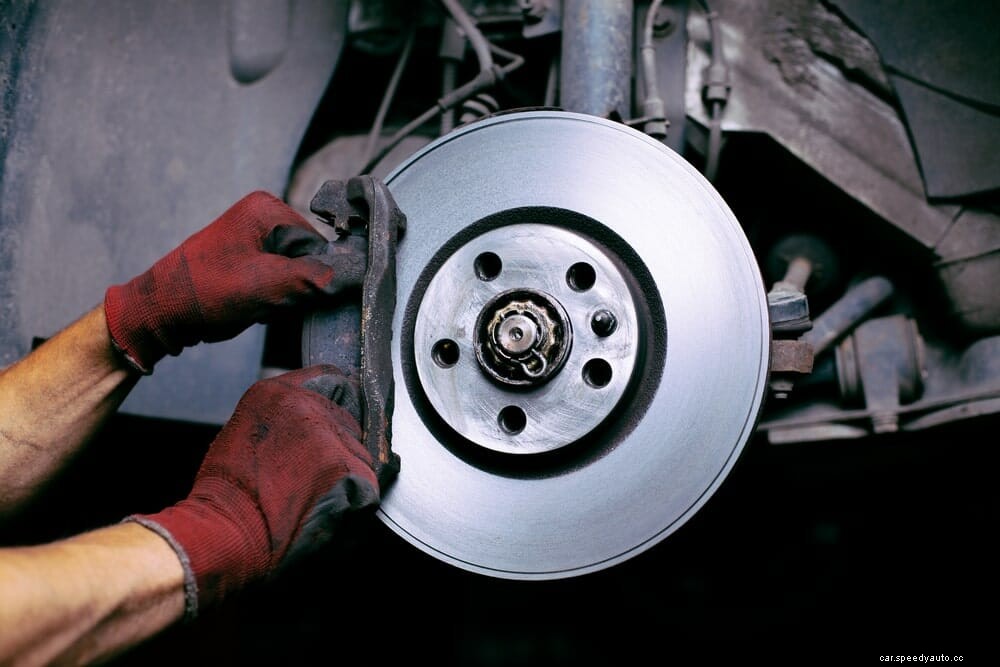
Ceramic pads are one of the hardest materials used to make brake pads. These tend to last around 70,000 miles. Metallic pads last around 50,000 miles. The life expectancy of organic pads varies according to their composition.
Any part that moves in your braking system will require lubrication.
Disc brakes need to be lubricated at the caliper slides, pins, and bushings, the contact points where the pads slide within the caliper housing, self-adjuster mechanisms on rear disc brakes with locking calipers, and the parking brake cables and linkage.
Brake lubricants are silicone-based or synthetic lubricants that do not contain petroleum. Before applying the lubricant, you need to thoroughly clean the surface of the component.
If you are hearing grinding noises that are originating at the CV joint, you might be too late to think about repairs. The grinding could have caused premature wear to the joint, you are going to have to replace it.
The procedure is quite costly. The parts themselves cost $100 to $200 or more. You would have to pay for labor as well. The labor time taken to access and replace CV joints varies from car to car. Usually, CV joint replacement costs between $300 to $800.
There is no specific time interval for replacing brake rotors. If you are careful enough, brake rotors will last a lifetime. You need to consider replacing your brake rotors when necessary.
If you hear grinding noises when braking, inspect your brake rotors. If you notice a crack, warp, wear, or any other physical damage, get it replaced.
The exact cost to replace wheel bearings varies according to the make and model, the garage’s labor rate, and the cost for parts. The national average cost is $350. The price will increase for luxury cars and sports cars.
There can be many reasons why you might be hearing grinding noises when driving slow or slowing down. We discussed the 9 most common reasons why this might be happening to you.
Should you continue driving if you hear grinding noises? You can drive, but it is not at all recommended. Without knowing the exact reason your car is making this noise, you should not drive.
Whenever your car is making a weird noise, you need to get the source identified. This is especially true in the case of grinding noises when driving slow or slowing down. This is because often this sound is connected to your brakes.
When your brakes are affected driving is not a good option. If you cannot stop your car on command, you won’t be able to control your car. This is exactly what would happen if your rotors are worn or warped.
You will be putting yourself and everyone else with you on the road in danger if you choose to drive with bad brakes.
As we looked at above, there are a few tips and tricks which you can use to diagnose the reason for a grinding noise when driving slow or slowing down. Once you figure out the problem, you can either do the repairs yourself or hire a problem. Until you find out the problem, it is best to avoid driving.
