
February was the debut month of the new-generation in the USA, but Nissan only managed to sell and deliver 895 Leafs. This is surprisingly low since the production of the new-generation Nissan Leaf in the USA plant began in December 4th, two weeks earlier than the European plant.
Nonetheless, it’s okay to start slow and steady. We should see deliveries increase during this month.
I’m curious to see how many Leafs Nissan actually plans to produce and sell this year, since I see the MY-2018 as a stopgap until the no-compromise MY-2019 arrives.
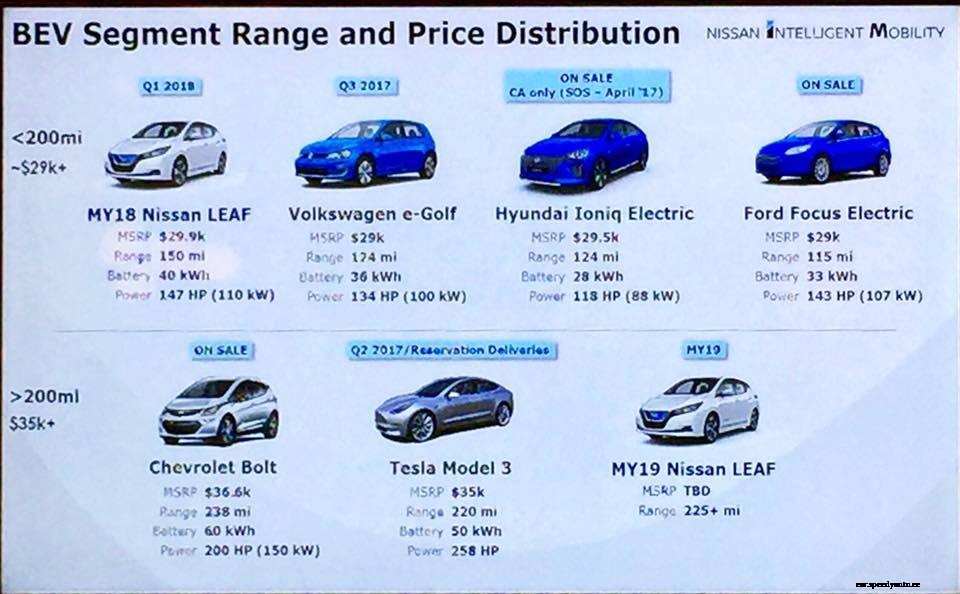
BEV Segment Range and Price Distribution by Nissan
Now that Nissan no longer owns the battery cell maker AESC, it can no longer push its batteries to the limits and expect free replacements under warranty when things get bad. Now to be eligible for warranty Nissan has to comply with more demanding requirements from the – now independent – battery cell maker.
Since the Leaf’s battery pack isn’t protected by a TMS (Thermal Management System), now the newly independent AESC demands – for warranty purposes – that the BMS (Battery Management System) becomes “overprotective” and has to step in frequently and protect the battery when temperatures get high – by limiting the charge/discharge rate. You can expect frequent very low DC charging rates in the 2018 Nissan Leaf…
Imagine the battery as a CPU and the TMS as a cooler, if you’re not using a cooler you can’t overclock the CPU to get its best performance. You might even have to underclock the CPU to prevent it from burning…
And that’s why I see the 2018 Nissan Leaf as a good, but underclocked electric car.
What do you think? Will Nissan push the sales of the MY-2018 Leaf as much as it can, or will it wait for the next model year for the big push?
