
Yesterday at the New York Auto Show Hyundai unveiled the US-market version of the Kona Electric. It has an estimated EPA range of 250 miles (402 km) and a combined efficiency of 117 MPGe (17,9 kWh/100 km).
Below we have the highlights from the press release.
2019 Kona Electric Highlights
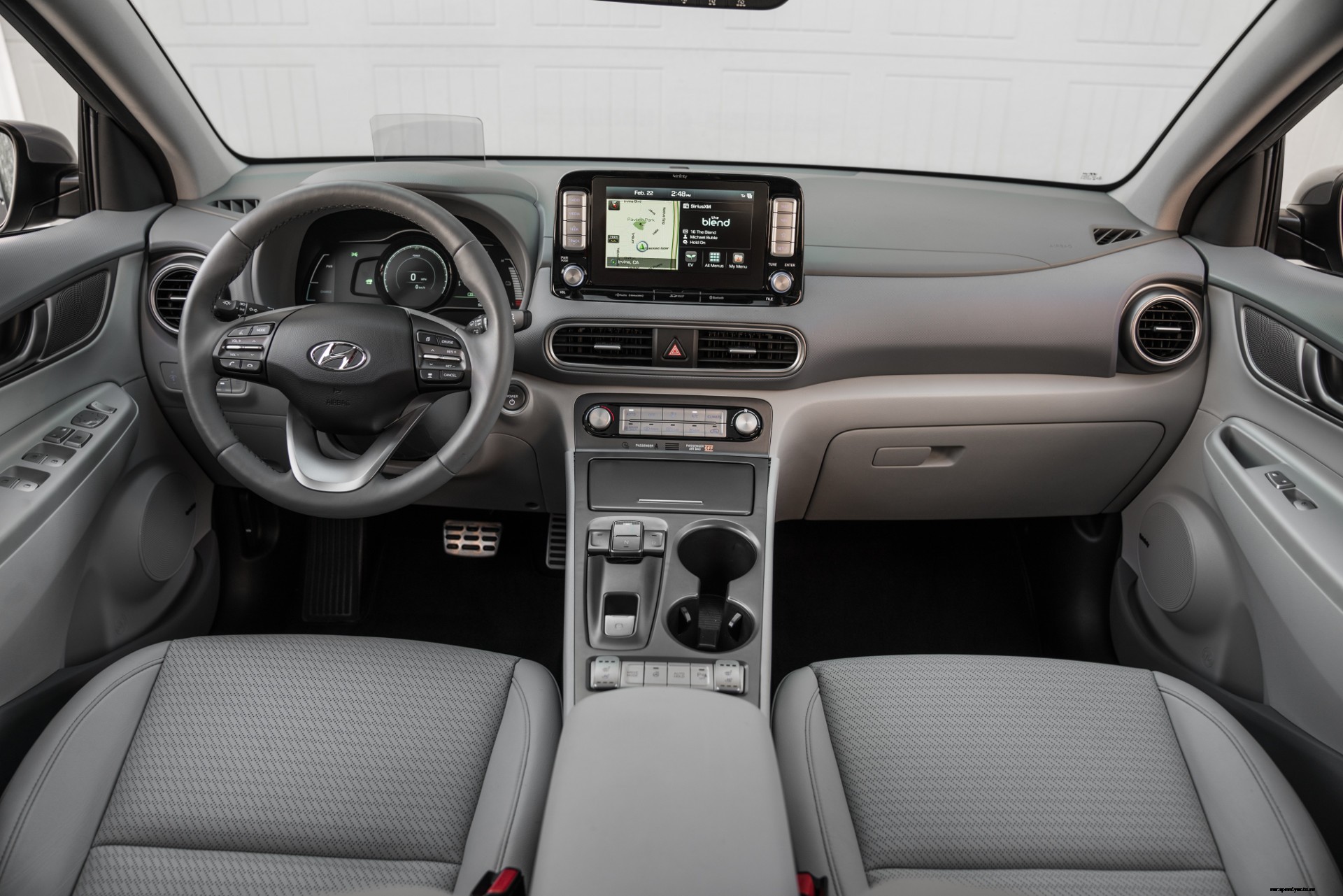
2019 Hyundai Kona Electric interior
Hyundai toke the opportunity to compare the Kona Electric with other popular electric cars.
POWERFUL ELECTRIC PROPULSION WITH 250-MILE RANGE
The Kona Electric powertrain employs a high-efficiency 150 kW (201 horsepower) permanent-magnet synchronous electric motor supplied by a high-voltage 64 kWh lithium-ion battery. The motor develops 291 lb.-ft. of torque distributed to the front wheels through a 7.981 axle ratio. The powertrain inverter has a power density of 25.4 kVA per liter. The battery system is liquid-cooled and operates at 356 volts. Battery pack energy density is 141.3 Wh/kg (greater than Chevy Bolt), with a total battery system weight under 1,000 lbs. In addition, Kona Electric energy efficiency is internally-estimated at 117 MPGe, superior to Nissan Leaf (112 MPGe), Tesla Model S (104 MPGe), and Tesla Model X (93 MPGe).
In this part Hyundai forgot to say that the Tesla Model 3 gets 130 MPGe and the Chevrolet Bolt EV gets 119 MPGe.
Anyway, let’s go to the interesting subject, the battery pack…
The whole 64 kWh battery pack weighs 452,94 kg, while the Chevrolet Bolt EV’s battery pack at 453,59 kg weighs basically the same.
If we consider that LG Chem rates (labels) the Bolt EV battery capacity at 57 kWh and assume that by using the same procedure the Kona Electric gets 64 kWh, we can do some calculations.
At the battery pack level, the gravimetric energy density is 12,44 % higher in the Hyundai Kona Electric. I’ve to say that I was expecting something better for the NCM 811 battery cells, even if this is only the first generation of the new cathode chemistry and the improved second-generation with lithium metal anodes will arrive around 2020.
Nonetheless, with higher nickel content in the cathodes, batteries require better and more complex TMS (Thermal Management System) to keep them at safe temperature, this can contribute to add some weight and reduce the overall battery pack energy density.
As a curiosity, the Tesla Model 3 battery pack energy density is rated at 150 Wh/kg.
Anyway, we still don’t know the most important energy density (volumetric) because Hyundai didn’t disclose the battery volume. However, since Hyundai says that “Kona Electric offers a generous 19.2 cubic feet of rear cargo volume, exactly the same volume as the Kona with an internal combustion engine” the battery shouldn’t take much space. Considering that’s easier to decrease the battery volume than its weight, I’m convinced that Kona Electric’s battery takes less space than the one in the Chevrolet Bolt EV.
Moving on…
It seems that in the USA only the bigger battery capacity (64 kWh) version will be available, since the 39,2 kWh isn’t mentioned. Considering that the USA is a big country and the Tesla Model 3 is already on the roads there, it makes sense to focus on the long range version.
According to Hyundai, this electric car will be “available in the fourth quarter of 2018, with initial availability in California and subsequently in the ZEV-focused states in the western and northeastern regions of the U.S. market.” Seems like a compliance electric car…
Sadly, the Hyundai Kona Electric is a great electric car that will be produced in very low quantities. Until an electric car like the Tesla Model 3 starts selling 500.000 units per year and “stealing” sales from ICE (Internal Combustion Engine) cars, legacy automakers won’t be serious about electric cars.
Update: it seems that the battery cells will be NCM 622 and not NCM 811.
