
Politicians often use the TINA (There Is No Alternative) narrative when they need to push unpopular agenda. Corporations do the same, whether we’re talking about cutting wages, while giving big bonus to CEOs, or when they want to keep using profitable, yet polluting and already obsolete technology.
This article is all about TINA. I really hate TINA, it’s a coward excuse to ignore reality and alternatives, while feeling comfortable with the ruling paradigms. For this reason, in this article we’ll see where the current battery technology is at and what it makes possible today, not in a distant future.
Let’s begin!
In 2014, Volkswagen planned to continuously upgrade their plug-in cars with Sanyo battery cells as we can see below.
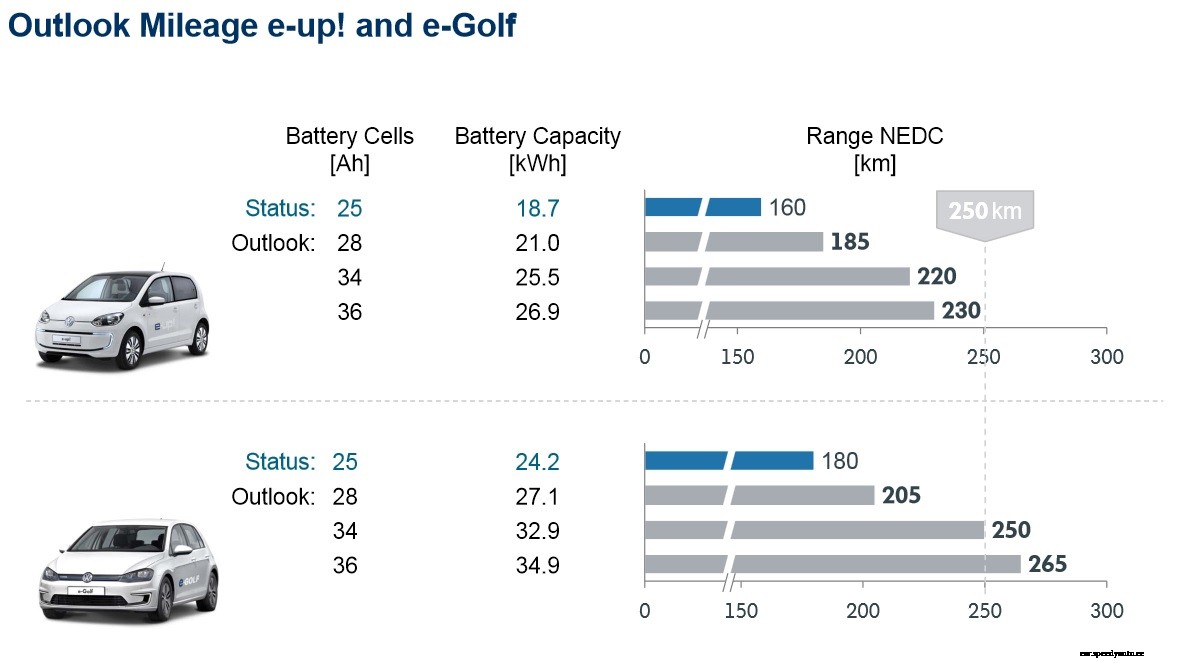
Volkswagen’s plan in 2014 for future battery upgrades
However, instead of the initial plan of making incremental and more frequent battery capacity upgrades, Volkswagen decided to change its battery cell supplier from Sanyo/Panasonic to Samsung SDI and is now introducing 37 Ah cells to their plug-in car batteries. These new battery cells have the same size form factor (VDA PHEV2) and directly replace the old 25 Ah Sanyo battery cells. By the way, the VDA (Verband der Automobilindustrie) is the German Association of the Automotive Industry.
Volkswagen’s current strategy is to use the same battery cells in every plug-in car, doesn’t matter if it’s a BEV (Battery Electric Vehicle) or a PHEV (Plug-in Hybrid Electric Vehicle). While this strategy isn’t the best for all electric cars, since it relies in a compromise between energy and power density, it does have the advantage of economies of scale.
As you can see in the first image, Samsung SDI already unveiled the capacities available for the VDA PHEV2 cells – which are used by Volkswagen.
Let’s see what Samsung SDI current battery cells make possible in Volkswagen electric cars:
Volkswagen e-Golf (88s3p)
Step 1: 264 x 3,6667 V x 37 Ah = 35,82 kWh (currently on sale)
Step 2: 264 x 3,6667 V x 50 Ah = 48,4 kWh
Step 3: 264 x 3,6667 V x 60 Ah = 58,1 kWh
Unfortunately, it’s rumored that Volkswagen will only move to “step 2” in 2019, by introducing a Volkswagen e-Golf with a 48 kWh battery in its 8th generation and a more powerful and efficient 152 kW electric motor.
Only when Volkswagen decides to use the 60 Ah battery cells, will the automaker achieve what Kreisel Electric did long ago.
Volkswagen e-up! (102s2p)
Step 1: 204 x 3,6667 V x 37 Ah = 27,68 kWh
Step 2: 204 x 3,6667 V x 50 Ah = 37,4 kWh
Step 3: 204 x 3,6667 V x 60 Ah = 44,88 kWh
The Volkswagen e-up is currently a “frozen” project and still has the old 25 Ah battery cells made by Sanyo. It’s rumored that only in 2019 the Volkswagen e-up will be joined by its twin brothers, Seat e-Mii and Skoda e-Citigo. Unfortunately it seems that only by then Volkswagen will “unfrozen” this electric car, by giving it more range and lower price.
Given that plug-in hybrids are a bridge technology and not the focus of this website, I won’t even bother with them. Nevertheless, they should also get the battery upgrades.
Moving on…
The old 25 Ah cells from Sanyo had a volumetric energy density of 277 Wh/L and the new 60 Ah cells from Samsung SDI are 665 Wh/L. This is great, nevertheless some modern smartphones already have batteries that surpass 700 Wh/L, such as the Huawei Honor 8 Pro that reaches 710 Wh/L.
Besides of enabling higher ranges, the best thing about increasing energy density is that with the same raw materials we get more capacity to store energy, thus contributing for lower kWh cost.
Summing up…
Even the Volkswagen electric cars, e-up and e-Golf, that are still in a shared platform with the ICE versions, can already get very good battery capacities with the current technology. Imagine when they finally get a dedicated platform, such as the Modular Electrification Toolkit (MEB) – previewed in the Volkswagen I.D. Concept that we see below.
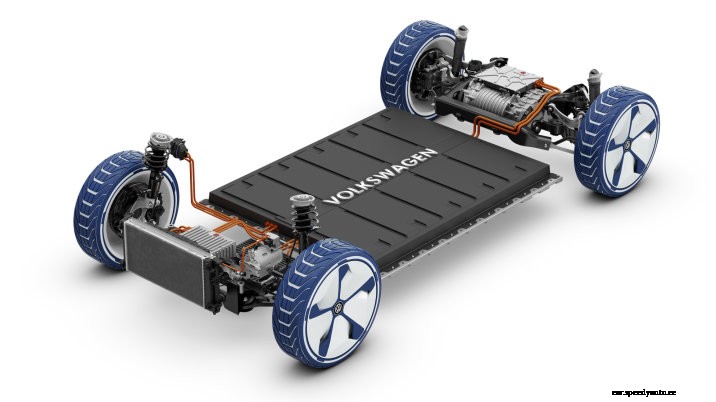
Modular Electrification Toolkit (MEB) in the Volkswagen I.D. Concept
Given that the next generation Volkswagen electric cars with the MEB platform won’t arrive before 2020, Volkswagen really needs to use the already available 60 Ah battery cells, to milk the current platform. The TINA strategy is no longer working and Volkswagen needs to step up its game.
It’s now possible for Volkswagen to sell the e-up with a 44,88 kWh battery or the e-Golf with a 58,1 kWh battery. The Volkswagen e-Golf would get a realistic EPA range of roughly 208 miles (335 km), just enough to make it modern in current standards. How long will it take for Volkswagen to do it? I don’t know, but I suspect it depends on the sales of the Tesla Model 3. I really hope that Tesla manages to increase production to its goal of 40.000 monthly units already in early 2018. That would finally get German automakers worried and moving…
Anyways, I suspect that as rumored, the next – and probably only – upgrade will be to 50 and not 60 Ah cells. It’s not very likely that Volkswagen will decide to jump right into 60 Ah when the new Samsung SDI battery cell plant starts operating in Hungary next year. Otherwise, it would make their electric cars viable alternatives to the ICE cars, and this would destroy the TINA narrative.
What do you think? Will Volkswagen upgrade the batteries in the current platform, or will it keep writing tons of press releases saying that the technology isn’t ready yet, while waiting for 2020 and the new MEB platform?!
