
You’re under the hood checking fluid levels when you notice your coolant is low. You’ve got a bottle of coolant to top it up, but as you open the coolant reservoir, you realize the antifreeze colors don’t match. Should you go ahead and pour in the antifreeze?
Mixing antifreeze is never a good idea. To differentiate between chemical compositions, manufacturers intentionally choose specific colors. Mixing the chemicals can cause a chemical reaction that can turn the antifreeze into acid.
To give you a better understanding of the subject, I’ll explain the differences between antifreeze types, their significance, and why mixing antifreeze is not a good idea.
The conventional antifreeze we can still use today became available in 1926 as an ethylene glycol solution. It’s the most toxic and corrosive mixture that is stabilized by additives. In an enclosed coolant system with no leaks, the antifreeze can last forever, but the additives fade, and the antifreeze can corrode components.
This wasn’t the problem at the time because radiators were copper plated, but those made out of aluminum needed to be regularly flushed. As newer vehicles have aluminum radiators and the notion of regularly replacing antifreeze doesn’t exist, you can really damage your car by using older types of antifreeze.
Some people will tell you that blue color is used for ethylene glycol, green is for propylene glycol and red is for organic acid-based antifreeze, and while there is some truth to it, it’s far from a reliable way of telling what the antifreeze is made of.
The reality is that antifreeze is colored to make it more visible inside the coolant reservoir and make spills easier to identify. When you’re buying antifreeze, the color can narrow down your search, but you should really check the chemical composition to be certain it’s the right one for your vehicle.
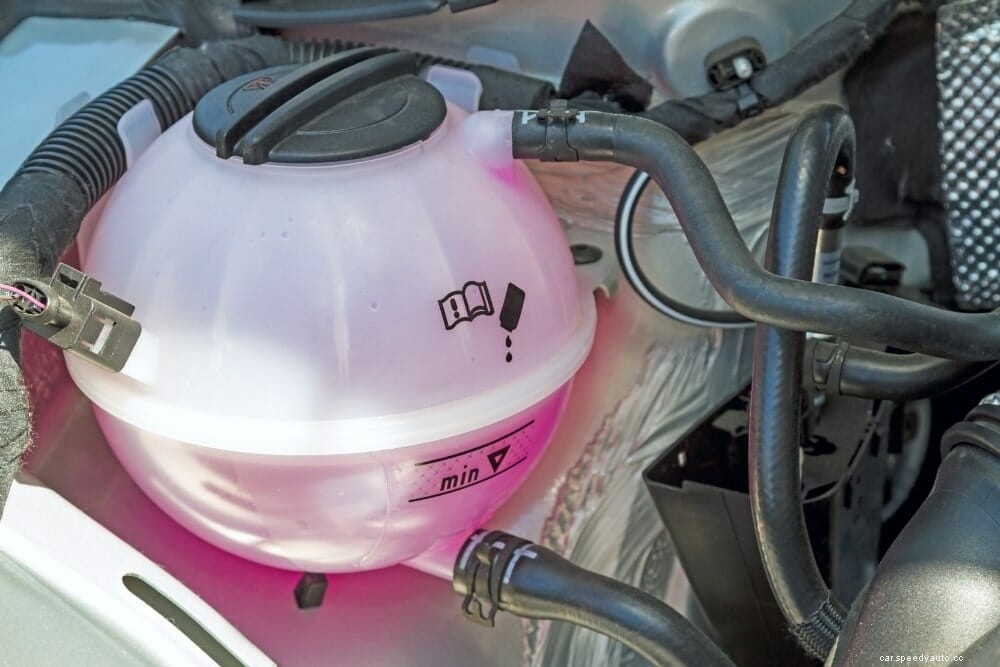
Antifreeze comes in diluted and undiluted variants for convenience. An undiluted solution requires you to add about 50% distilled water in the mix, but it’s easier to carry and cheaper to ship, while a diluted solution can be poured directly into the car, which is especially handy when you have to top up while you’re on the road.
IAT stands for Inorganic Acid Technology, an abbreviation that can quickly tell you whether the antifreeze is compatible with your vehicle, as manufacturers indicate what antifreeze you should use.
The three most prominent IAT antifreeze bases are MEG (mono ethylene glycol), MPG (mono propylene glycol), and propylene glycol methyl ether. MPG is primarily used in food processing because of its low toxicity, MEG in for most car antifreeze solutions, while propylene glycol methyl ether is used for heavy-duty diesel engines and is the most volatile.
Commonly known as the ‘original green’ ethylene glycol solution is made out of distilled water, MEG, and additives that stabilize the highly toxic and corrosive substance. The original green has been used for a very long time, but manufacturers began to phase them out in the ’90s in favor of less toxic options.
The IAT antifreeze should be bright green, but manufacturers also used different shades of green and blue to color their solutions. Heavy-duty diesel solutions tend to be colored blue, but you can also find them in red.
While IAT solutions typically use some form of phosphate or silicate to stabilize the ethylene glycol, OAT (Organic Acid Technology) solutions generally do not use any, making them far safer to use in modern engines.
The OAT solutions are generally red, but you may also find them in orange, blue, and dark green. When buying OAT antifreeze, always check whether it has phosphates or silicates in it which can indicate that it’s a hybrid solution.
It’s difficult to determine what exactly classifies as HOAT antifreeze, but from what I can tell it’s the use of phosphates, silicates, or benzoate as the solution inhibitor. It’s a hybrid because it takes the inhibitors (additives) from the IAT antifreeze and mixes them with OAT antifreeze.
In terms of colors, HOAT antifreeze is distinguishable when bright yellow, but it can also be light or dark blue, pink or even purple.
Dex-cool is a proprietary antifreeze solution made by GM for vehicles 1995 and newer but is also used in some Ford and Chrysler vehicles. It’s essentially a HOAT solution that supposedly has a longer service life.
Dex-cool has sparked a lot of controversies when it was determined that it causes manifold gasket failures and acts as a plasticizer, ruining nylon and silicone rubber. In 2007-2008, GM settled in the class action lawsuits and had to compensate owners for the damage, but the 2009 bankruptcy made the payout more complicated.
Since then, the Dex-Cool solution has been altered and improved, and most importantly it’s now manufactured by reputable brands. While other antifreeze solutions vary in color, Dex-cool is always bright orange.
I know I’ve given you quite a chemistry lesson in the previous sections, but it’s important for understanding why different antifreeze colors simply do not mix together.
Even if you manage to match the chemical basis, it’s highly unlikely that the other antifreeze has the same stabilizers, especially if it’s a different color. When combined, different additives can neutralize, letting the coolant become corrosive, or turn into a much thicker substance.
I would even go as far as to say that even the same antifreeze color isn’t a guarantee you’re getting the right mixture. In the past, that might have been the case as the supply was limited, but in the abundance of options we have now, it’s unlikely that the two bottles of red antifreeze have the same chemical composition.
My advice is to first check what your vehicle’s manufacturer recommends in terms of antifreeze type or even brand, then stick with it for as long as you own the vehicle. Always buy an extra bottle to keep in your trunk should you have to top up, and it’ll act as a good reminder of what antifreeze to buy when you have to flush the system.
We’ve discussed how to flush and clean a clogged radiator in the article titled “How To Flush Your Radiator With Vinegar or Baking Soda (Is It Safe?)” so make sure to check it out!
| Title | Price | Buy | |
|---|---|---|---|
 Top
Top | Pro-LifT F-2315PE Grey Hydraulic Trolley Jack Car Lift with Blow Molded Case-3000 LBS Capacity | Buy Now | |
 Top
Top | Capri Tools CP21023 Portable Oil Drain Pan, Anti-Freeze, Green | Buy Now | |
 Top
Top | Klein Tools 600-6 5/16-Inch Keystone Screwdriver 6-Inch Square Shank | Buy Now | |
 Top
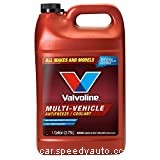
Top | MaxLife Valvoline Multi-Vehicle Concentrate Antifreeze/Coolant 1 GA | Buy Now |
Replacing antifreeze is a very simple job and you probably have most of the tools necessary to do it. Some vehicles have skid plates that cover the coolant drainage plug, so you’ll have to take it off. To do this, you’ll have to raise the vehicle with the car jack, and I’d advise placing a pair of jack stands underneath, just in case.
You need to pour in as much antifreeze as you bleed out, so check the volume levels in the drainage pan and compare it to what’s left in your antifreeze bottle. If you managed to fill the coolant system to MAX without spending all of the antifreeze, it means there’s an air bubble in the system. To get rid of it, do the following:
When winter is right around the corner, it’s not a bad idea to check the antifreeze concentration in your system. This is a very simple task that requires just one very inexpensive tool.
If your coolant will not survive a cold winter, there are only two ways to go around it. Either bleed some of the coolant and add undiluted antifreeze into the reservoir or change the coolant completely. I suggest changing it completely, as it’s not that expensive and keeps you from wondering.
A fluctuating temperature gauge is not a good sign and the cause has to be fixed quickly to avoid damage to the engine. A bad thermostat, failing water pump, and low coolant level are the most likely causes.
As we’ve discussed in this article, the color of the antifreeze doesn’t have to mean it has a different chemical composition, but in most cases, there’s a huge difference between the two. The green color is typically used for inorganic acid technology antifreeze, a type of coolant used in the past, while red is more commonly used for organic acid technology antifreeze or hybrids.
As a part of General Motors, Chevrolet most likely uses Dex-Cool. You can easily check this by opening the coolant cap and looking at the color of the liquid – Dex-Cool is almost always orange. To be safe, you should confirm by consulting the owner’s manual.
This is not the case 100% of the time, but green antifreeze is usually made using inorganic acid technology and silicate or phosphate additives. Green antifreeze is primarily used for vehicles from the early ’90s or older.
Antifreeze is colored to make it easier to identify leaks and check coolant levels, not to differentiate between the chemical composition. As there are no standardized coloring rules, antifreeze manufacturers can color their antifreeze into whatever color they like, usually to create variety in their product lineup. That’s why we can find antifreeze in orange, blue, purple, pink, dark green, and other colors.
Switching from one coolant type to another can be just as bad as mixing them together. Coolant comes in contact with aluminum, steel, plastic, rubber, silicone, and other materials on its way through the system. An incompatible type of coolant can eat through some of those materials, harden rubber, and cause a number of issues that can be very expensive to repair.
You can top up the old coolant with new if your levels are low, but you should always completely drain the system when you’re replacing it.
Whether you have to top up or replace your antifreeze, always go with the same type, and never mix colors. Doing so can seriously harm the engine, and considering that the price of all types of antifreeze is about the same, there’s no real reason to do it.
If you’re caught on the road with low coolant and the gas station doesn’t have your type of antifreeze, just buy some distilled water instead. It will dilute your coolant mixture and make it less resistant to boiling and freezing, but it will get you home where you can flush the system or top up with 100% antifreeze to compensate.
Check out some of these related topics:
Is Coolant And Antifreeze The Same Thing?
How To Put Coolant In A Car: Adding Antifreeze The Right Way
How Much Coolant Loss is Normal?
