
Discussing bad motor mounts is an interesting subject. It makes perfect sense to replace any part that’s broken, but maintaining a vehicle in perfect condition would be too costly and unsustainable. That’s why we all look for corners to cut, and issues to avoid or postpone – as we all know, as soon as the old part is replaced, the new part starts to wear out.
So how long can you drive with broken motor mounts? It depends entirely on how severely they’re damaged.
If you’re experiencing only minor symptoms of bad motor mounts, it’s safe to continue driving. You can cross thousands of miles before more serious symptoms appear, and that’s when you have to replace the mounts or risk damage to the powertrain.
Motor mounts, also known as engine mounts provide a link between the engine and the body of the car.
Engines are really heavy. V8 engines can weigh as much as 700 pounds. When you combine that with the amount of energy created through internal combustion and the rotation of the crankshaft, there’s a lot of force to reign in.
Welding the engine in place is an option, but that creates other problems. The secured engine will still generate vibrations, which would travel through the chassis and make the ride unbearable. Not only that, but those same vibrations would wear out engine parts and cause it to self-destruct.
Rubber or fluid-filled mounts create a link between the chassis and the engine. They absorb vibrations of the engine and prevent it from transferring to the chassis, but also absorb the movement of the vehicle and keep the engine stable.
A four-wheel vehicle has four suspension points, one for each wheel. To get another perspective on the motor mounts, consider them to be the fifth suspension point.
The sturdier a component is, the longer it will last. But some components cannot be made out of steel alloys, and require much softer materials. The primary material of motor mounts is the same as that of control arm bushings and ball joints – rubber.
The hardened rubber used to make these parts is currently the best material available – it absorbs vibrations while being durable enough to endure tens of thousands of miles. When they do fail, replacement parts are not expensive, and usually, the labor costs more than the parts. It’s a balance between durability and costs.
The early sign of worn motor mounts is a clunking noise coming from the engine bay. It’s a weird occurrence – it seemingly happens at random, accompanied by a distinct clunk or a dull impact sound. It actually happens when the vehicle’s point of mass shifts.
The easiest way to test motor mounts is to apply gas, and then quickly lift your foot off. The acceleration “pulled” the engine backward, but as you lift your foot, the force disappears and the engine swings forward like a pendulum until it settles back in place.
If you hear a noise just as you release the pedal, that’s a clear sign that the motor mounts are worn out. You can do a more stressful test by switching from accelerating to braking at low speeds. The braking amplifies the forward movement and exposes mount weaknesses.

Vibrations are a more serious symptom. If you can feel the car vibrating through the pedals, steering wheel, and the seat itself, you shouldn’t postpone repairs for long. Vibrations rapidly increase component deterioration throughout the system. Even if the mounts can hold, letting the car vibrate will quickly cause other failures.
Leave the vehicle running in parked gear and lift up the hood. If the position of the engine seems misaligned, you need to change the engine mounts immediately. The same applies to engine movement that looks like something you’d see on a decades-old farm machine.
It’s normal for the engine to vibrate as it tries to balance out the explosions happening inside it, but excessive movement means that the motor mounts aren’t holding it in place.
The first thing I should say is that if you plan on driving with bad motor mounts, you’re doing so at your own risk. If you take the range of time provided in this article without properly identifying the condition of your mounts, you could end up with serious engine and transmission problems.
Clunking noise is the only motor mount symptom I would consider safe to ignore. That’s coming from personal experience, as motor mounts in my daily driver have been clunking for over a year and 10,000 miles. Just a few weeks ago, I went on a 1200 mile trip without any issues.
However, as soon as I find some free time or I start experiencing vibrations, I’m going to replace the motor mounts. They’re a problem you can postpone, but not one you can forget about.
Replacing motor mounts involves a lot of steps that are unique to your vehicle. Half the battle is just getting to the motor mount, which can be particularly challenging in a tight engine bay.
The job isn’t all that challenging, and as long as you work carefully and check vehicle-specific guides on how to remove certain components that get in the way, you should be just fine.
| Title | Price | Buy | |
|---|---|---|---|
 Top
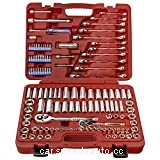
Top | EPAuto Mechanics Tool Set Drive Socket Wrench Ratchets, SAE/Metric, 122-Piece | ||
 Top
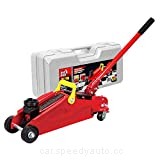
Top | BIG RED T82012 Torin Hydraulic Trolley Service/Floor Jack with Blow Mold Carrying Storage Case, 2 Ton (4,000 lb) Capacity, Red | ||
 Top
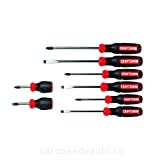
Top | CRAFTSMAN Screwdriver Set, Assorted, 8-Piece (CMHT65075) | ||
 Top
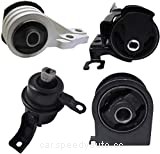
Top | ENA Front Rear Left Engine Motor and Tran Mount Set of 4 |
The wide range of basic mechanic’s tools: sockets, wrenches, and screwdrivers are there to cover all the possibilities, but depending on your vehicle, you may get away with just the socket set and a Philips head screwdriver.
Some motor mounts are only accessible from underneath the vehicle. If that’s how your vehicle is designed, it’s best that you take your vehicle to a mechanic.
When you’re working from the top, the car jack is holding the engine in place. Even if you make a mistake and improperly secure the engine, at least there’s no risk of injury. To replace mounts from underneath, you need to gain enough access and work with the risk of the engine falling on your arms or head. It doesn’t help that the task is much more complicated, to begin with.
Mechanics have car lifts to raise the vehicle to the optimal working height, and use heavy-duty engine stands that will keep it in place when the motor mount is removed. Now that I think about it, my car has this type of motor mount, so even I will have to leave the job for someone else.
Motor mounts cost between $20-50 apiece, which isn’t all that bad, but it’s the cost of labor that makes the mount replacement expensive. Generally, you’re looking at labor costs between $80 and $400 depending on the complexity and number of mounts required and a total cost between $200 and $600.
The time it takes to replace motor mounts depends on the complexity of the job. Two top-mounted motor mounts can be replaced in an hour, but the upper limit is 8 hours for the more complex designs.
As we’ve previously discussed, the position of the motor mounts dictates the difficulty of the job. A rule of thumb is that if the motor mounts can be accessed from the top, you can replace them at home, otherwise, it’s a job for a mechanic with professional tools and machinery.
Once one motor mount starts to wear out, it’ll increase the load on all other mounts and make them wear out more quickly, which is why it’s a good practice to replace all motor mounts at the same time.
Bad motor mounts will result in greater vibrations that will transfer into the transmission, which is definitely not good. On top of that, the separate transmission mount will also start to wear out. It’s generally much more durable than motor mounts, but it’s also more expensive to repair, so it’s important to prevent unnecessary wear.
Minor symptoms of bad motor mounts can be neglected for a while, but when vibrations and engine rattling start, you should get the replacement parts and swap out the mounts. Car vibrations have a number of potential causes, so take a look at this article to learn more. We also have an article on bad control arm bushings, and whether you should drive once they’ve worn out.
More interesting topics are below:
How To Rev a Car Engine Without Moving – Automatic and Manual
How To Bypass Reduced Engine Power?
How To Start A Car With A Bad Fuel Pump
