
Nothing can handle knee-deep snow and ice better than snow chains. Even an offroad 4WD SUV could struggle with snow without snow chains. If you own a car and need to move through snow, you have no other choice but to use snow chains. Obviously, snow chains slow you down, but to what extent. How fast can you drive with snow chains?
Snowchains are a series of chains that are wrapped around the tire to handle snow or ice with ease. Even with snow chains, driving through snow and ice could be grueling. But they do provide that extra grip that is required to drive through harsh weather.
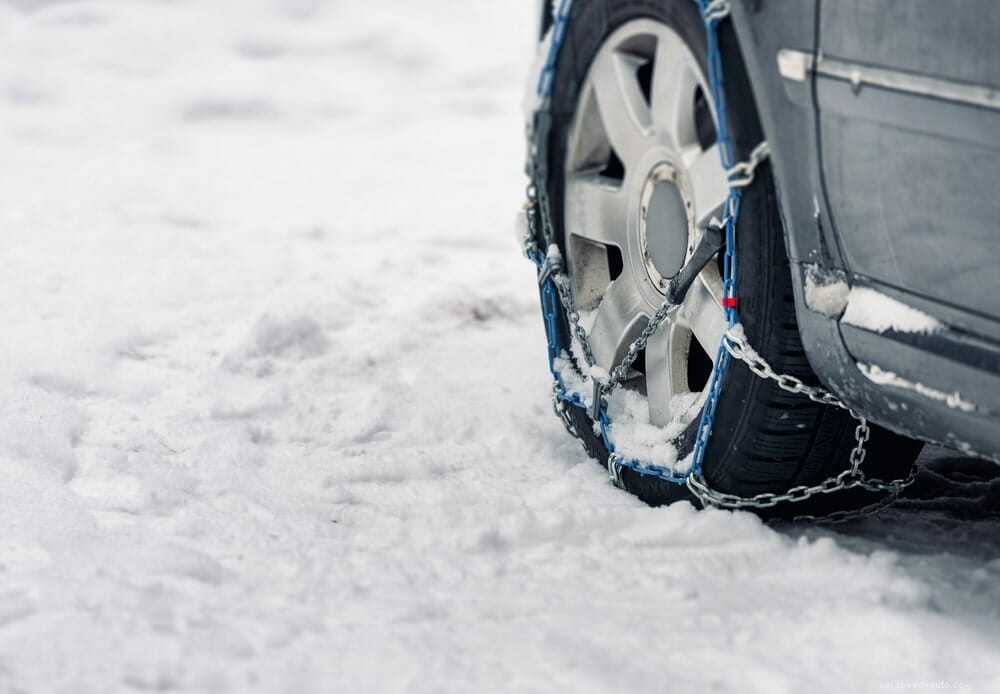
The chains are wrapped around the tire with the help of several hooks, that provide a tight fit. As it is securely attached to the tire, the chains act as an extension of the grooves in the tire.
Snow chains reduce the area of contact between the tire and the road. This allows it to create more friction between them. This also means that you should only use them when it is absolutely necessary. If there is no ice or only a thin layer of snow, snow chains could do more harm than good. It could damage the vehicle as well as the road.
When you use snow chains, you cannot drive at the speeds you are used to. You should plan while considering the excess time that’ll take due to snow chains. On average you’d be able to cruise around at 20 mph. At the most, you will be able to travel up to 30 mph. Anything more than this would be a risk.
We already discussed that you shouldn’t use snow chains unless necessary because of the damage that you’ll incur. Other than these driving with snow chains will also affect the fuel economy of the car.
So keep in mind, by using snow chains you are running the risk of damaging your car, you won’t be able to drive at high speeds, and it will reduce your fuel economy. So you should only use snow chains when it is absolutely necessary.
Some states that are frequently subjected to heavy snow, have laws regarding the use of snow chains. They make it mandatory to use snow chains in situations when they face heavy snowfalls. Just like the rule to use snow chains, they also have a speed limit. That speed limit is often 30 mph.
When you look at the top speed you can get with snow chains on, you have to also look at the factors that affect the speed. 30 mph is the highest you can go. The weather might already be bad, but if it’s worse you might have to slow down from that 30 mph cap.
Here are a few factors that will decide how fast you can drive with snow chains.
You should never drive fast when the visibility is low. This is especially true when you are wearing snow chains and there is a layer of snow and ice on the road. If you are experiencing heavy snowfall, chances are you do not have great visibility at the moment. In cases like this, you should try to drive as slow as possible.
You should keep in mind that even though you have a snow chain you are not invincible. You can easily lose control in the snow. You should be more aware of this if your chain is old. If it has been sitting for a while, there is a chance that it could be rusted.
If it is used heavily in the past, it would definitely have some wear and tear. The point is, with time the structural integrity of the chain is going to drop. While driving you should keep this in mind.
No matter how new your chain is, if it doesn’t fit your tire like a glove, you should take that into consideration while driving. Driving fast puts extra pressure on the chain. If it is not secured to the wheel it could come loose.
Therefore depending on the age of the chain and how it is fastened to the car, you should slow down accordingly.
If you are new to the entire snow chain topic, you should drive slowly until you get a hang of it. As you gain experience and confidence, you can slowly build up your speed.
We already talked about how the weather could affect visibility. It also affects the condition of the road. Ice has less friction than snow.
So if you are driving through a patch of ice, you should slow down. A fresh coat of snow also has less than ideal friction, even if you are using snow chains. Ultimately, you need to assess the road conditions before you stomp on the accelerator.
There is a lot of factors that could determine how fast you drive with snow chains. Even though the law allows you to go up to 30 mph, if you are facing adversities you should slow down. The optimal speed no matter the conditions would be 20 to 25 mph.
Before you decide how to secure the chains to your tire, you need to decide which tire to fit them to. Do you go for the rear wheels or the front wheels?
Which tire you install the snow chains on depends on the type of car you drive. If it is a rear-wheel-drive car, you should install them on your rear wheels. If it is a front-wheel-drive car, you should install them on the front wheels. What about 4WD cars. For 4WD cars, you need snow chains for all four wheels.
Fastening the chains to the tire is not that complicated. But you should purchase a tire chain that fits your tire. Anything smaller or larger than your tire size is not going to fit.
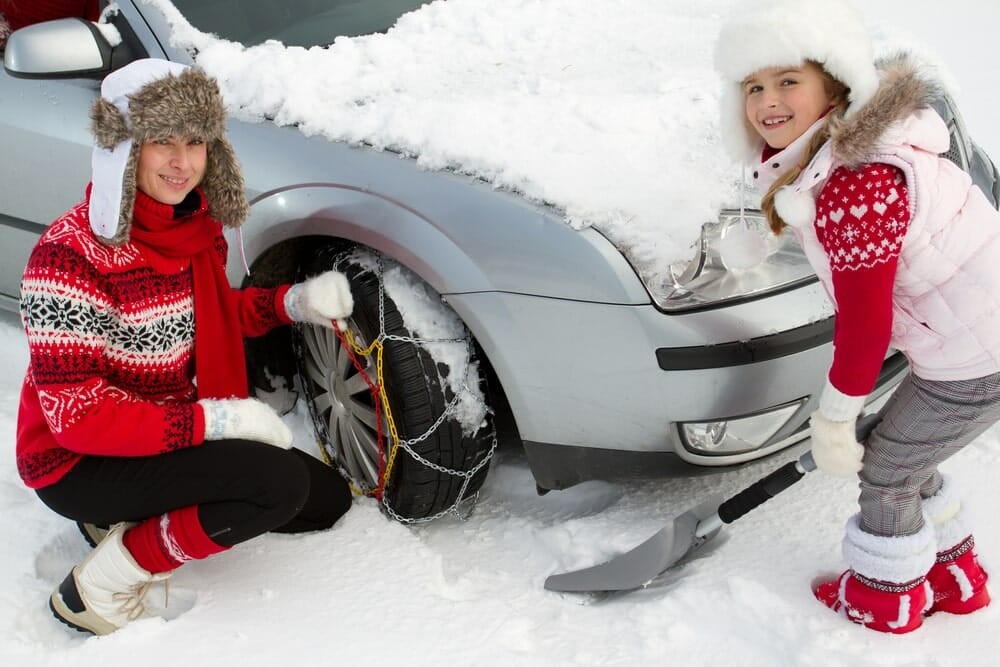
The best way to do this is to lay them on the road or driveway untangled and stretched out. Place your wheels above the chains as close to the center as possible. Now all you have to do is wrap the chains around the tire.
Now use the hooks or rings that come with it to attach each end. You should be able to cover the upper half of the tire with ease. Now move your car slightly forward, and finish up the rest of the hooks.
Pretty easy right? The process of installing the chains is easy as long as you are prepared. If you do it in your driveway or on a clear street it should be fine. But if you drive without the snow chains and decide to install them when you get stuck, then the situation could get messy.
Know the road conditions and be prepared before you start your journey.
If you don’t like to use snow chains, and there are plenty of good reasons to hate them, there are alternatives. Here are some options.
These are pretty much the same as snow socks. They wrap around the tire. Instead of being made of metal, these are made of chains. They are made out of fabric. The fabric is modified to give the best possible grip while driving.
It has a number of advantages over regular snow chains. They whey less than snow chains and it takes less room to store. Since they are light, they offer better control than snow chains. They are easy to set up. One of the main advantages is that it does no damage to the tire or the road.
But it is not all good news. They are prone to tearing if the conditions get tough. If you are worried about the speed limit of snow chains, snow socks are even worse. The maximum speed of snow socks is around 25 mph. According to some laws, they cannot replace the mandatory snow chains.
Spider spikes are a more modern alternative to snow chains. They are made of metal, and they are easily attached to the side of the wheels. They are easy to move and quick to set up.
The main disadvantage is the price. These cost $350 and upwards. Looking at the speed, these don’t provide an advantage compared to snow chains.
Tire straps are often referred to as plastic snow chains. They are made out of plastic and they are attached to the wheel using straps. Installing these is much easier than snow chains, and it does little to no damage to the wheels.
These are a pretty good alternative for snow spikes. The grip they offer is slightly less, but you can get similar speeds. They tend to be slightly more expensive, other than that they are a perfect replacement.
Tire wraps are similar to snow socks, but instead of fabric, they have a fishnet design. The process of attaching these to the tires is also similar to attaching snow socks. Even though they look ineffective, surprisingly they can handle snow conditions well.
One of the biggest issues with this is the wear. If you drive through a dry patch, it could easily be damaged. As long as you drive it through snow and ice, they are a decent alternative.
When it comes to snow tires, there are 2 types. One is studded tires and the other is non-studded. The studded tires work best but it has their own problems.
Both types offer great traction. The studded tires are often better though. You can even drive through dry patches without any issues. But the studded tires are known to damage roads when driving through dry patches.
Therefore they are illegal in a few states. They are costly, and if you don’t use them regularly, it doesn’t make sense to invest in them. Another issue is changing the tires. Fixing snow tires to your car is not the same as fixing regular tires. So it requires professional help to install them.
One of the main advantages you get by using snow tires is excellent traction. They can handle the most treacherous roads covered with snow and ice. Due to these capabilities, they are faster than snow chains or any other alternative. You can go up to 40 mph with snow tires.
Taking all these into consideration, all these alternatives are useful. But the conditions will eventually decide which is best. Snow tires would be a great investment if the area you live in is constantly bombarded with heavy snow. If not they are not worth the price tag.
If it is the speed and traction that you are looking for, snow chains are by far one of the best solutions. They are a bit tedious to install but the time spent is worth it.
If you do not want to spend a lot of time setting up your defense against snow, the other alternatives should be okay to use.
Winter is coming. The streets are going to be dressed with snow and ice. For an experienced driver, it is going to be just another day. If you are new to driving in these conditions, snow chains aren’t going to be enough to protect you.
They might give some added protection, but to safely navigate frictionless streets, you need to follow some other practices as well. Here are some tips to safely navigate through snow and ice.
This is probably the most important practice to safely drive in these conditions. You might think 30 mph with snow chains is already slow enough, but you should try to keep it at around 20 mph or less if you are inexperienced.
Unlike sunny days even if you slam the brakes it will take a while to come to a stop. If you are going fast even by a fractional amount, the stopping distance increases drastically.
If you feel like you are swaying a lot, or seem to be drifting while taking a turn, that is an indicator that you are driving too fast. Easing off the gas pedal is the safest way to drive through adverse weather. Even if you are an experienced driver, try to keep it under 30 mph when you are using snow chains.
This is one of the common rookie mistakes that you can make. Never slam your brakes even if you are tempted to do so. It will cause the car to slide and you will lose control. This doesn’t mean you shouldn’t use your brakes when necessary. Ease into it and decrease the velocity of the vehicle slowly.
You already know the braking distance increases exceptionally in ice and snow. And you cannot use the brake as you do on dry roads. If you are too close to the tailgate of the vehicle in front, you will crash into them if they slow down.
Never overtake the car unless they are driving really slowly. If you are trying to overtake a car driving above 15 mph, you are taking a huge risk.
No matter how cautious you are, things could go sideways in an instant. In these conditions, the car will literally turn sideways and you’ll be in a slide. Reasons for being in a slide are either driving too fast or slamming the brakes.
You might be a safe driver but know how to deal with a slide. The basic technique is to turn the wheels in the direction you want to go. There is a lot more behind this, make sure to look it up.
After we drive for a while, we adjust to that style of driving. Sometimes your subconscious might take over. Snowy conditions are completely different from sunny highways. You constantly remind yourself of the conditions you are in and never let your subconscious take over. Be aware of your surroundings and slow down if necessary.
Driving through snow and ice is never going to be 100% safe. By following these tips and using a snow chain or any other alternative you can vastly reduce the risk.
Here are some of the most common questions regarding snow chains.
There is a wide variety of snow chains in the market. The most basic economical snow chains cost around $30. If you want a high-end snow chain with additional features you could end up paying $300 or more. The price tag depends a lot on the size of the tire. Larger truck tires could cost a hefty sum.
There is only one way to drive using snow chains, that is slowly. Try to keep the car under 25 mph. As long as you properly fasten the snow chains to your tire, driving around with them will not prove to be a major challenge.
Yes, there is a possibility of snow chains damaging the tires if you are not careful. As long as you use it as it is intended, that is through ice and snow you should be fine. If you constantly drive through dry patches it could damage your tires and the road. Improper installation could also damage your tires.
It depends, if you are planning to drive through ice and snow, you definitely need to use snow chains. But if not you should never use snow chains. Sometimes you are bound by the law to wear snow chains. It depends on the season, weather conditions, and the road you are going to drive through.
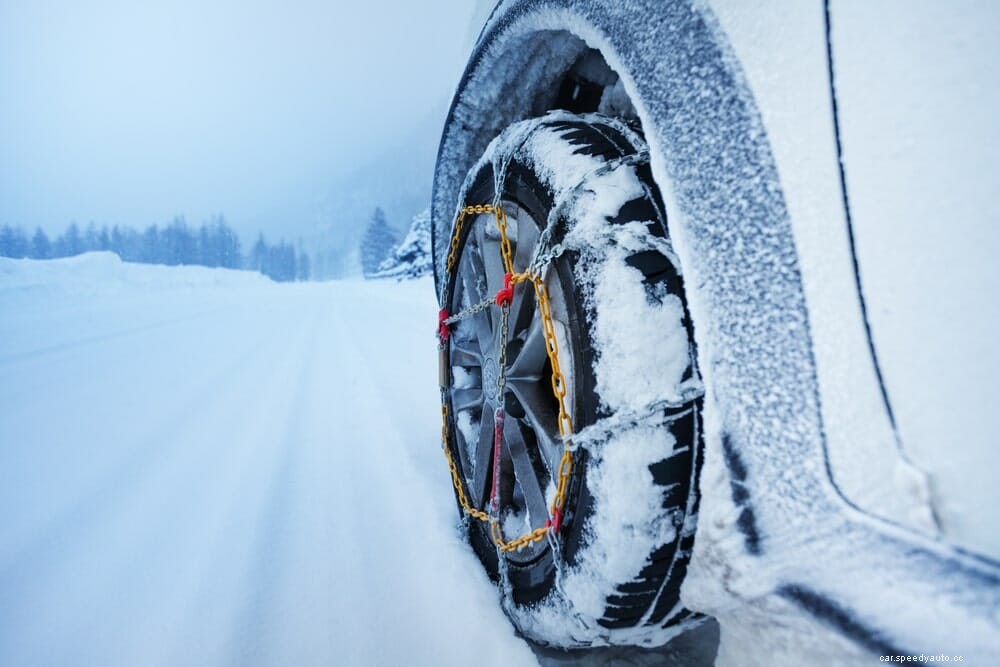
You should not drive faster than 30 mph when you are on snow chains. If you over the speed you could lose control, or bust your tire. The speed limits are there for a reason, it is to ensure your safety and everyone else on the road.
Other than the dangers of overspeeding, in most states, you will be breaking the law. So you will be fined if you Overspeed with snow chains.
There are plenty of different options if you don’t want to use snow chains. Each has its own pros and cons. The option that comes close to snow chains would be tire straps. Tire socks and tire wraps are also decent options.
Snow chains are a piece of essential equipment to navigate through snow. But using them provides a new set of challenges. It poses a measly speed limit of 30 mph. This speed limit might be frustrating, but that is the maximum speed you can drive during such conditions.
Even though there are a few other alternatives to snow chains, most of them are not going to increase your maximum speed.
Attaching snow chains to the wheels is not easy. You should be prepared if you do not want to get stuck in the snow. Attaching the chains to the wheels in the open exposes you to the harsh weather. So when needed, make sure to attach them before driving into the sunset.
Driving through snow and ice is definitely risky. By using equipment like the snow chain or another alternative, you can reduce the risk. The best method to ensure maximum safety is to take it slow on the gas pedal.
