
One of the most underappreciated yet very important mechanical parts hiding under our vehicles is the stabilizer bar bushing. The anti-roll bar, located on the vehicle’s chassis, is designed to reduce road noise, absorb road bumps and cracks, and provide a smoother ride.
The anti-roll bar is supported by rubber bushings that prevent the body from rolling when cornering. With proper lubrication and maintenance, the stabilizer bar bushings can provide optimum driving conditions for years to come.
But with time, they do tend to wear. So you need to keep an eye out for symptoms of bad stabilizer bar bushing.
A stabilizer bar or more commonly known as a sway bar is a component that attaches each of the vehicle’s wheel struts. A sway bar is not found on every car and there are some variations of the sway bar. So, the sway bar on one car will not be identical to another.
All sway bars are not necessarily ‘U’ shaped and some may be hollow while others are not. The exterior looks and features may not look the same in every vehicle but they all serve the same purpose. They are in charge of enhancing the stability of the vehicle.
For example, when one wheel moves lower or higher than the other, such as when cornering, and weight is transferred from one side of the vehicle to the other, the sway bar counters the twisting forces on the wheels.
The sway bar tries to make the wheel as level as possible while still providing resistance. The sway bar is attached to the suspension arm and connects the vehicle’s suspension components. This is connected from one side to another.
It is important to note that the anti-roll bar can only rotate through the hub and does not move up and down. This shifts the weight to the left and right when turning.
When you turn right, the car rolls to the right. As the wheels rise towards the body, the sway bar rotates to transfer the weight back to the other side of the car. As a result of this movement, the car begins to level out, reducing the number of rollovers when cornering.
Apart from this, there are other factors such as different chassis components and the engineer’s goals in setting up driving and steering characteristics. Usually, the stiffness of the front and rear swings will vary.
It’s important to know what your sway bar is doing as most automakers strive to strike a balance between comfort and performance. If the stabilizer is too stiff, and the car encounters a bump in the road the car will feel too stiff and uncomfortable as the wheel will try to resist the vertical movement of the wheel on impact.
Depending on how you adjust the rest of the suspension, your car will most likely bounce off the bump.
When you notice symptoms of bad stabilizer bar bushing, you need to work on fixing the problem. During repairs, you need to locate the sway bar bushings, so you need to know the types of stabilizer bars.
There are 4 types they are hollow sway bars solid sway bars, splined stabilizer bars, and an active anti-roll system.
The most used types of sway bars on today’s vehicles. These sway bars work by connecting to both of your wheel’s assemblies and twist when necessary to keep the car stable these sway bars are ‘U’ shaped and even though they are the more used type of sway bar, these solid sway bars are quite heavy.
Hollow sway bars are pretty identical to solid sway bars except they are hollow. This provides a number of performance advantages and also hollow sway bars are longer lasting than solid sway bars. But, they are a bit more expensive than solid sway bars.
Installing hollow sway bars can provide a vehicle with better performance. So they are popular with performance rides.
The only sway bar that doesn’t have the ‘U’ shape. This sway bar is shaped like a straight line allowing it to spin directly into the connecting arms. In race cars and high-performance cars, this kind of sway bar is prevalent.
Because the sway bar can be simply changed and you can customize the sway bar according to the race track.
While hollow and splined sway bars are widely used in high-performance vehicles and race cars, there is another type of sway bar technology that outperforms the two. This is the active anti-roll system. This is an electronic system controlled by the ECU in your car.
When you make a turn, the computer works with sensors and actuators to adjust your car’s suspension.
Your car eliminates the need for a standard swing by lowering one side of the car to accommodate the shifting motion. This means you carry less weight, which greatly improves your performance. This system, on the other hand, will only be found in luxury vehicles.
As a driver, it is very important to be aware of any problems that may take place in your vehicle. Thus being aware of the symptoms of bad stabilizer bar bushings is very important. You get to reduce the cost of repairs by doing precautionary measures and you’d also save your car from any more damage that can be caused by small problems.
When your sway bar bushing squeak from under your feet it’s a critical sign that your car’s stabilizer bar bushings may be wearing off. Although noises do occur due to a number of other faulty components, rattling and clanking noises are more frequent.
Therefore a squeaky noise is a bit more unique and gives an advantage when looking for symptoms of bad stabilizer bar bushing. But remember if you see booming noises even on level roads you should probably go see a mechanic because this could mean a heavily damaged stabilizer bar.
If the stabilizer bar bushings are damaged, you might find it difficult to cut corners with your vehicle due to the lack of control. Since the tires of your vehicle can’t get enough grip, the sway bar links are loose. This will make it hard to take your usual turn.
As you turn the steering wheel you’ll find that it takes much more effort to make your car turn, this issue can also be due to sway bar links but is more usually caused by eroding sway bar bushings. Thus, this is another common symptom of bad stabilizer bar bushing.
Since the sway bar bushings are not working properly, you will encounter a feeling that the car is not turning properly and having a hard time keeping its balance.
Hit a small bump in the road and you will feel as though the car is rocking from side to side and you may feel that the car is gently ever so slowly turning left and right leaving you out of control. This is a significant symptom that could mean you have worn or eroded stabilizer bar bushings.
You must be familiar with the handling and operation of your vehicle on the road. One way to tell if you have a stabilizer bar bushing problem is to notice that your car is slow or slow to respond, especially when you steer the vehicle while driving.
If you notice that your car becomes unstable when cornering on its wheels, this is a sign that your bushings are damaged and need to be replaced as soon as possible.
You should know that your car’s anti-roll bar bushings wear out quickly. So, ignoring any of the symptoms can lead to several adverse consequences, which are very dangerous. This is one error that you need to pay attention to.
If you notice a discrepancy in your car’s controls, be sure to check for the cause. If you can’t find the real cause, have your car serviced to diagnose your car.

If the stabilizer bar bushing is damaged, you will find that the car body rolls under acceleration. Your car starts rocking every time you try to go more than 25 mph to 30 mph. A bad anti-roll bar bushing will shake the anti-roll bar, which will cause your car to become unstable.
Many drivers experience this from time to time and most are unsure of the cause, but now you know how this happens so you can be cautious. Poor sway bar bushings cause vibration while driving. However, this effect may not be noticeable when driving at low speeds.
Even traveling at constant velocity might not be a huge challenge. This phenomenon will be much more visible when you are accelerating.
Usually, signs aren’t enough to convince someone to go to the mechanic. So when you see symptoms of bad stabilizer bushings, you need proof. What better proof than a physical inspection. So, how do you inspect the stabilizer bar bushing?
This is the simple way of checking your stabilizer bar bushings. You should always be cautious when you do this make sure to wear your safety gear and make sure that your tools are always at arms reach or have someone there to help you.
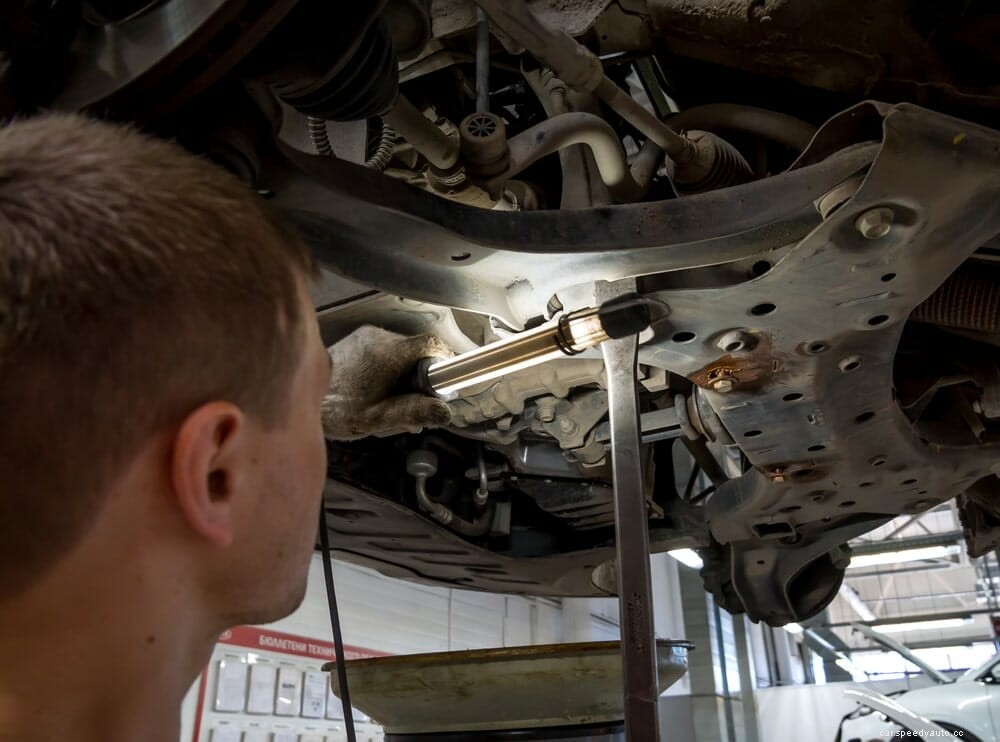
First, to check your stabilizer bar bushings, you first need to gain access to it. It should be located right above your vehicle’s undercarriage, so to access the stabilizer bar bushings you first need to remove the vehicle’s undercarriage.
To do this, you must first raise your vehicle off the ground using a jack or a hydraulic lift. Again, we cannot emphasize this enough. Please be cautious and follow all safety measures when you do this.
However, if you’re using a jack on one side of the car, it may cause stress on the bar bushings, which is not good. You must keep the suspension of both sides equal, so most prefer doing this with a hydraulic car lift.
Once you have successfully got to your stabilizer bar bushings, it’s a pretty easy job, because the rest can be done in a few minutes.
All you have to do is take a screwdriver or a pry bar then place it between your stabilizer bar near the bushings. Then you should apply force on it to strain the stabilizer bar bushings, if it does not show any movement that’s a good sign.
Check stabilizer bar bushings for damage. If there is wear, you may see oval cracks on the surface with visible spaces at the bottom or top where the sway bar passes through the bushing.
In addition, if you notice noise from the suspension or a noticeable deviation from the applied load, then you should immediately replace the bushings. Checking your stabilizer bushing will also tell you what caused the stabilizer damage. Now do the same check process on the other side of your car.
Once you notice symptoms of bad stabilizer bar bushing, you need to take steps towards getting it fixed. Replacing a damaged stabilizer bar bushing is the only way to repair your car’s bushings. Stabilizer bushings are designed to break after a while, although they are very durable.
The level of difficulty in replacing bushings mainly depends on the type of vehicle and the position of the bushings. However, here is the process on how to repair your damaged bushings.
First, park your vehicle on a flat level surface and then continue by placing a stopper behind your vehicle. Next open your vehicle’s bonnet, letting in air through the engine area and to your workspace, which would make finding the stabilizer bar bushings much easier.
Next, you should wear all your safety equipment. You should wear goggles, gloves, and coveralls at all times during this kind of repair. This will help protect from dangers that could occur while doing this kind of thing. And you must make sure that you have your tools well within your reach.
As stated earlier, you need to raise your car up using a car jack or a hydraulic car lift. By the way, when using this equipment, you should follow precautions and know how to use this equipment.
You should keep the car level as you raise the car to avoid lifting one side of the car first because this could cause stress on your stabilizer bar.
Then, you need to quickly find the location of your sway bar bushings. The sway bar is usually behind your front tires and in front of your back tires. All you have to do is find the sway bar and trail it to where the bushings are attached.
You may need to remove the heat shield or bracket to remove the stabilizer bracket. It depends on the car construction. Remove all obstructions carefully to gain access to the socket. The brackets can be easily removed.
They are usually fixed with one or two mounting screws. In some cases, bolts are inserted into your car chassis with nut or threaded holes. Using a wrench, socket wrench, and ratchet, carefully loosen the bolts. Stabilizer bracket bolts have hinges on the bottom or top that you can remove if you remove one bolt.
Once you know the exact location of your bushing, move it along the stabilizer rod to a point where it can be easily removed from the bar.
Using a lever or a certain type of screwdriver, press firmly into the hole in the bushing to release it from the stabilizer rod. Stabilizer bar bushings are usually covered with rubber, so removing them is not easy.
Install your new stabilizer bushing the same way you removed the old bushing. Since the bushing is new, it is even more stubborn to repair. Place the new bushing in place and secure it with your tool.
Once you are done you can close the bonnet, and lower your car back to ground level. This is not exactly a detailed guide on the process, and it will change drastically, depending on the car you own. But this is enough to give you a general idea of how the repair is supposed to go.
Now, you can decide whether you have the skill set to do this job yourself. By doing it yourself, you should be able to save a good chunk of the money when it comes to replacing stabilizer bar bushings.
Here are some of the most common questions regarding symptoms of bad stabilizer bar bushings.
Though it is not advisable, if you must, you can drive. But you must be very careful because you can easily lose control if you have faulty or bad stabilizer bar bushings.
The situation is a little less controversial if you have a broken rear stabilizer bar. If the sway bar ends are damaged, you can still drive the car. The only problem is that you experience unnecessary body rollover when trying to corner at over 35 mph or more.
This will make your car unstable. You will need to follow the instructions above to repair the stabilizer rod bushings or you can take your car to a mechanic.
If the bushing of the car is damaged, the stabilizer bar will become unstable, causing your car to make a loud noise when driving. These sounds are best described as squeaking, rattling, or clunking. The noise gets louder while driving, especially when driving on rough roads.
When you are changing lanes and turning, the rattling sound is increased. It would sound like a noisy door hinge. You might be able to feel the front of your car vibrate. Driving on paved or gravel roads with worn bushings can cause bumps and noise, as well as on sharp turns these noises are amplified.
At the hands of an automotive workshop, you should expect to spend upto$450, depending on your car. Usually, it is much less. By doing it yourself, you should be able to decrease the cost drastically.
If you are doing it yourself, the process could take 2 hours or more. But a professional will be able to get the job done in around an hour.
Usually, whenever moving components are involved, it needs lubrication. So you may wonder if this is another part that requires some sort of oil.
Sway bars are lubricated by grease. This is applied whenever a repair or replacement is done. And replacing the grease at intervals is unnecessary.
There are many factors that could affect the life span of sway bar bushings. There is not a lot you can control though. Keep in mind that these bushings are meant to last a lifetime. But if your car has been on the road for a long period, there is a possibility. On average sway bar bushing lasts around 14 years.
As you may have already figured out by now, the stabilizer bar is an important component in your steering system. And whenever the steering system is involved, the importance of maintaining the component and keeping it functional rises.
This is because the steering wheel is the only component that allows you to control the car. The stabilizer bushing keeps the bar functional. Thus without it, you’d be in trouble. This is exactly why you need to know the symptoms of bad stabilizer bar bushing.
If you are capable of identifying the symptoms of bad stabilizer bar bushing, you should be able to avert danger and stay safe.
There are plenty of symptoms of bad stabilizer bar bushings that you need to be aware of. Once you notice them, a physical inspection should confirm your doubts. If they are faulty, you need to get them repaired immediately.
