
I was the one who was dragging a roller bag to a parking lot at midnight and touching the unlock button as if it were the magic button. The flight was fine. The trip was great.
After which your car then thinks it is time to stop playing. One click. Dim dash. Nothing. And all next second you are jet-lagged, you are hungry, you are troubleshooting in the dark.
This is the reality of the traveler: one week is enough and small issues almost become actual problems. One of the batteries which had just been clinging on finally descends below the starting point.
A small electric draw continues sucking up power throughout the week. A rusty terminal that you never had a problem with on an ordinary everyday day becomes no-crank the very first time the time comes when you need it most.
Let’s make this practical. We will start with the symptoms, since that is how individuals spend the money.
When a person mentions that his car would not start, I always say: Ok- so what happens when you explore?
The latter answer normally provides 80 percent of the diagnosis.
That just about always comes through power delivery.
Consider battery charge, terminals, cables and ground.
And this is the traditional weak under load moment.
Nevertheless, it remains the battery, but starter circuits begin to appear here, as well.
Now we have reached into fuel/spark/immobilizer land.
Different world. Different checks
In case your radio and dash are alive and the engine will just not crank, this internal guide will help you to sort that particular combo. The car won’t start, but the radio works.
Travel note: this is why I’m a fan of removing variables before you leave. Pre-booking parking helps your schedule, sure, but it doesn’t protect your battery from a week of slow drain.
If you’re flying out of Seattle, I’d still check SEA off-site parking prices and lot options early then spend two minutes on the car-prep stuff so you’re not the person calling a rideshare from the back of a long-term lot.
Modern cars don’t fully sleep. They nap.
The car remains alert even in the parking lot: security, keyless entry, module memory, clock, and even cellular connection. That’s normal.
This is a problem of reserve capacity. A battery will bring up the dash, and yet not crank, as a big spurt of current is required to start.
One of the industry facts that is surprising to people and may die quickly is that batteries do not normally die in a dramatic style. They fade.
I have seen too many of them. It was fine yesterday, batteries proved satisfactory when at rest, but then failed miserably when real current is called for by the starter.
If you want a simple explanation for why this happens (without turning it into an electrical engineering lecture), this internal piece breaks down how many amps it takes to start a car and why voltage under load matters more than “my lights work.”
 Modern cars don’t fully sleep. They nap. (Photo: RAC)
Bright and steady? Better sign. Dim or fading? The battery is likely low.
Rapid clicking is generally of low voltage. When it is cold, the battery or thick oil may be used as a slow, lazy crank.
In case you are able to twist a terminal by hand, it is loose. When you have white/green corrosion also, it makes it harder and harder, and difficult to resist takes away the very power your starter requires.
Short trips matter too. You could have driven five minutes to the store all week, parked to travel, and not have replenished the battery fully at all first, and in cold weather, when the batteries are less efficient, and the engines require more to start.
If you jump-start the car, drive it, and it starts fine… then it’s dead again after sitting, you’re usually looking at one of two stories:
I learned this the annoying way with a glove box light.
It looked “closed,” but the switch was failing, and that tiny bulb quietly drained the battery during a weekend trip. The car started fine when I left. It didn’t when I came back.
I replaced the battery first (because I was tired), then found the real culprit later. Not my proudest diagnostic moment.
Here is a Marse-dallent casse-check, which you may make tonight:
Park, close down, lock the car and look inside the windows.
Is there any inner light shining? Any weird LED staying on? That’s not “character.” That’s a drain.
In case it can die after a few days, then the drain must be small, or the battery may be weak.
When it goes dead at night you should consider bigger drain or one battery which really is on last legs.
A reasonable parasitic draw test would be rather an affair with a multimeter, but I am not going to claim that it would be fun. Stores work in a hurry, and it is normally worth the money in case the issue recurs.
This is where people get misled.
A failing starter system can look exactly like a dead battery from the driver’s seat.
If you get a single click and nothing else, that’s often the solenoid/relay trying to engage. The starter motor still has to spin the engine, and it needs:
If the clicking/no-crank pattern keeps happening, compare your symptoms to this internal checklist of bad starter relay symptoms. A relay issue can feel random and infuriating, especially after a car sits.
I will say as a mechanic that has watched too many repeat comebacks, grounds count.
Loose or corroded ground can result in intermittent no starts, dulling lights under load or electronic devices performing bizarre resetting operations when you start the engine.
Trace the negative cable up to the point of bolting it to the metal.
If it looks crusty, clean it. If it’s loose, tighten it. Simple, boring, effective.
Another fact: changes of temperature may aggravate marginal connectivity.
A car parked in front of the door in a week is practically a method of slow heat-cycle experiment, and tenuous associations do not necessarily win the experiment.
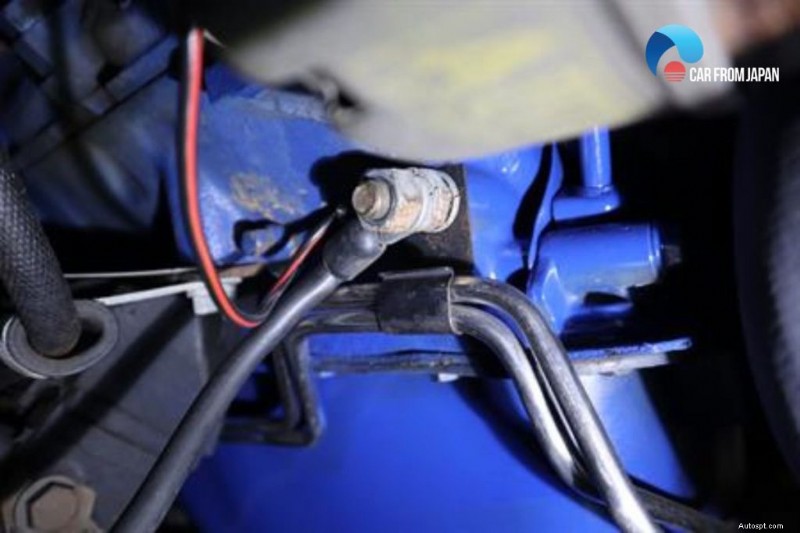 Loose or corroded ground can result in intermittent no starts. (Photo: Speedway Motors)
If the engine cranks at a normal speed strong and consistent but never catches, stop blaming the battery. It’s doing its job.
This is all too easy to hear, but it works sufficiently frequently as to be worth attempting:
Switch the key to ON (not start) 3-5 seconds and OFF. Do that twice, then start.
This assists in building of fuel pressure before cranking in some cars.
As long as that modifies the behavior, then notice. Even when you leave that to someone else, that is good diagnosis information.
In cars with push-button starters, a low-power key fob battery can leave the car in no start mode causing an impression of electrical failure.
Numerous vehicles have a safety measure (such as having the fob near the start button). When your backup key works immediately, then you have just saved yourself a lot of needless battery nonsense.
A basic OBD scan can point you toward crank sensors, immobilizer faults, or fuel-related issues. It won’t solve everything, but it narrows the search fast.
Jump-starting gets you moving. It doesn’t explain why you were stranded.
If you want a clear, step-by-step refresher, AAA’s jump-start instructions are solid and easy to follow. I still glance at a checklist when I’m tired, because tired is when people reverse cables.
Here’s the safety part people hand-wave until they shouldn’t:
Batteries can vent hydrogen gas, and sparks happen at the worst time. NHTSA has documented injuries from battery explosions, including serious eye injuries see this NHTSA research note on battery explosion injuries if you want the “okay, I’ll wear glasses” motivation.
And if you prefer a second reference with clear photos, Car and Driver’s jump-start steps are straightforward.
Let it idle a minute. Then drive 20–30 minutes if you can.
When it comes to highway speed, it is typically the better option as compared to hanging around.
When parking off leave it off and restart.
When it does not go on the first encounter, then it is not a one-time affair.
There are two likely causes of weak battery reserve or parasitic drain, in case it begins to run fine now, but dies again after sitting. Both are fixable. Both can be carried at home without a problem as compared to a parking lot with luggage.
It is not so much of a mystery when your car will not start after a week it is just being honest.
Diagnostic diagnosis is first, since changes in click vs crank vs crank-no-fire are everything, then on battery reserve, connections and slow drains, but not on exotic causes.
Enact the tedious inspections, and you will not leave a bad end to the journey: a beautiful journey will have a dead car as its climax.
