
A CV joint is a component that can be seen in all 4-wheel-drive vehicles. Though CV joints are more common in all-wheel-drive and front-wheel-drive vehicles, some rear-wheel-drive vehicles also have a CV joint.
A faulty CV joint will start making noises whether you are driving straight or when you are turning. If you notice a CV joint noise when driving straight, you are going to need to know the possible causes and fixes for the problem.
Before going deeper into the topic of CV joint noise when driving straight and possible causes and fixes, we need to look at what a CV joint is. CV stands for constant velocity, thus this is a constant velocity joint. They are referred to as CV axle or CV half-axle as well.
The CV joint is placed at both ends of the drive shaft. It comes in 2 parts, the inner CV joint, and the outer CV joint. The inner CV joint is connected to the transmission while the outer CV joint is closer to the wheel.
If you have a CV joint in a rear-wheel-drive car, the system is slightly different. The inner joint sits closer to the wheels. And the outer joint is actually positioned close to your car’s differential.
CV joints are essential to keep your car functional. Just like any other part in your car, they too wear out. When they age and show signs of wear, that is when you start to notice a CV joint noise when driving straight.
The actual design of CV joints is actually centuries old. Since then it has had many updates which led to better and better performance throughout the years. In most modern vehicles, we use something called Rzeppa joints. These were invented by Alfred H.Rzeppa in 1926.
The structure and function of CV joints are pretty simple. On one side of your car’s axle, you’d be able to see a hemispherical groove. Within these groves, there will be slots that could fit 6 balls. This is covered by a shell made of rubber which is known as the CV boot.
Within those 6 grooves in the hemisphere, sits 6 steel balls. This is then fit into a housing, to keep the entire component nice and tight. This design allows the CV joint to be extremely versatile and be able to move around without disturbing the comfort of the drive.
The CV axle is extremely important as it transfers the torque produced in the transaxle or differential to the wheels. The CV joints allow the wheel and axle to move independently of the body. So if you go through a pothole, the wheels will go up and down while the body sits fairly still.
The introduction of CV axles has made vehicles much more comfortable and maneuverable.
There aren’t many factors that could cause your CV joints to fail.
The only reason why your CV joint might fail prematurely is due to external factors. The CV joints are at the bottom of the vehicle. If you do not drive carefully you could damage your CV joint.
Other external factors that could cause your CV joints to fail are grime, oil, salt, or any other impurities that could cause damage. When these find their way inside the CV joint it causes the joint to wear out prematurely. This is why your CV boot is an important part of the system.
Apart from these, age is the greatest rival for CV joints. As they move around a million times, they start to wear. As your CV joints wear they will start to emit symptoms and eventually fail.
If you use low-quality CV joints, they can rust. Most manufacturers make sure that this doesn’t happen. But sometimes they do rust and deteriorate.
Rust and wear can cause the CV joints to loosen. This will reduce the comfort of your drive.
Whether you hear CV joint noise when you driving straight or taking turns, it could be an indicator that your CV joint is failing. It doesn’t indicate that your CV joints are totally broken and unusable, but that is what is going to happen in the long run.
Here are some reasons why you hear CV joint noise when driving straight.
The CV boots are what keep the entire unit contained. That includes the joint and the lubrication that is used on it. CV joints are usually lubricated with grease to keep the motion smooth, reduce friction, and increase the lifespan of the CV joint.
CV boots not only act as a vessel for whatever is inside, but they also keep unwanted stuff outside. The CV boots make sure that dirt, grime, or even sand is kept outside of the car. Since the CV joint is actually at the bottom of your car, it is close to the dirt and debris that is on the streets. Without the CV boot to act as a shield, these impurities find their way inside the CV joint.
CV boots are made of rubber. So they are not as strong as most people think. With age they tend to become brittle, so they can crack and fall apart. Even if it comes in contact with a sharp object such as a sharp rock, the rubber could rip. So these are really fragile parts and can fail pretty easily.
Once dirt sand or any other impurities enter the CV joint, they will damage it. They could cause the joint to wear out fast. Apart from that, the grease will also drip down from the joint. The lack of lubricant will increase the friction of the CV joint. Thus it will further increase the rate at which the CV joint deteriorates.
The dripping or leaking grease gives another clue. Apart from the symptoms of a failing CV joint, you will also see grease stains under your car. This could mean that the CV boot is damaged and the grease inside is leaking. It is worth checking the CV joint if you see grease where you parked your car, or in or around your rims.
The friction is what creates the noise when the CV boot fails. Though impurities enter the CV joint, they do not contribute to the noise. Since the friction rises as you drive faster, the noise will also increase as you increase your velocity.
Whenever metal on metal contact is present, lubrication is necessary. Lubrication makes sure that the contact is as smooth as possible. By doing so it provides a ton of other benefits. And one of those benefits is the reduction of friction.
Friction between metal components generates a squeaking sound. This sound is reduced when the friction is reduced.
Inside the CV joint, the lubricant used is grease. This grease reduces the friction thus reducing the sound produced. When there is no grease inside, the friction build-up and as the metal components rub against each other, they contribute to the CV joint noise when driving straight.
This could happen if you do a repair on your CV joint or replace your CV joint and do not apply enough grease. Every time you operate on your CV joint, you need to close the job after adding grease.
As mentioned above the other way you can lose grease is through a torn or damaged CV boot. Another way where you could lose grease that has been applied on your CV joint is discussed next.
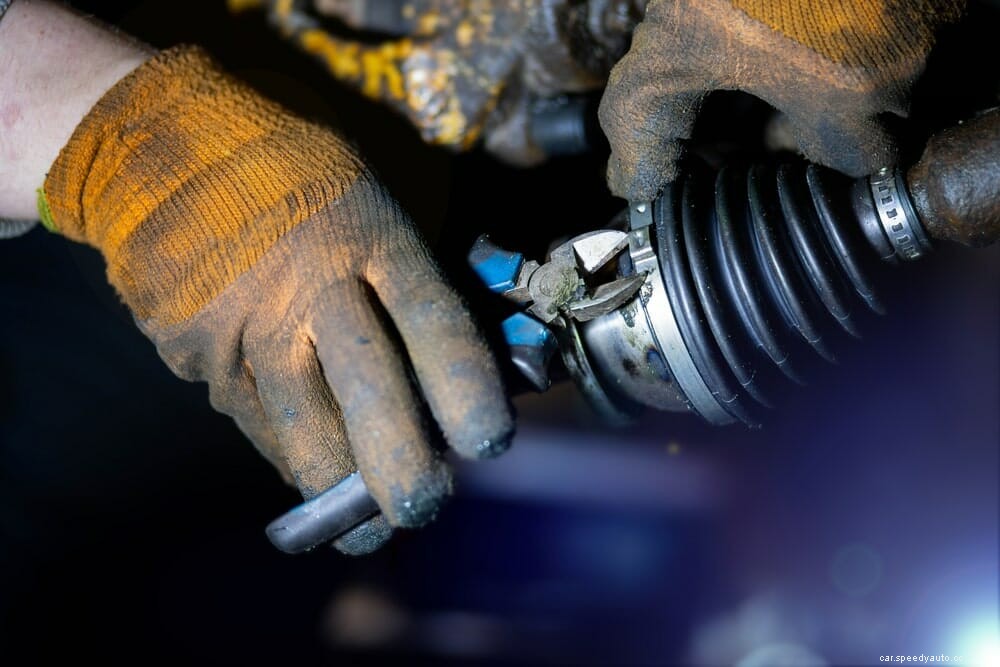
As mentioned earlier, the CV boot seals the CV joint and the grease applied to it. This CV boot is not pasted or welded in position. What seals the boots and keeps them in position are the Boot clamps.
These clams should be tightly fit to protect the CV joint. If the CV joint is damaged, corroded, or not tightened properly to start with, it will loosen the CV boot.
As the boot loosens, it allows the dirt and sand from the road to get hitch a ride into your CV joint. This causes an inner CV joint clunk. And this is what generates the noise that you hear from the CV joint while driving.
This loose connection or the broken seal will also allow the grease inside to gradually fall out. This will result in a lack of lubricant and you will see another reason why you hear CV joint noise while driving straight.
Like every other component in your car, CV joints tend to wear out with time. No matter how enthusiastic you are about maintenance, you can only protect parts in your car for so long. After the time comes they need to be replaced.
The CV joint and all its components form a snug fit when it is in perfect condition. When the metal parts wear out, the fit between these components will not be as tight as it used to be.
So when they wear out, they get some room to move around. This will result in clunking sounds as metal bashes on another metal. This will be more evident when you are driving fast or taking turns.
Just to emphasize, the lack of grease or letting impurities inside the CV joint will only accelerate the process of deterioration. So to get the most out of your CV joints, make sure to properly maintain them.
Other than the sounds there aren’t a lot of other symptoms that you could use to diagnose a faulty CV joint. Identifying these symptoms early could save you a lot of money on repairs.
As mentioned a few times earlier, grease is the substance used to lubricate the CV joint. When the CV boot is damaged, the grease inside leaks out. A grease leak will be completely different from other fluid leaks in your car. Usually, when a fluid leaks, it forms a puddle below the leaked spot. Grease from your CV joints don’t do that.
The grease inside the CV joint is a lot less than the other fluid in your cars such as engine oil, transmission oil, or coolant. Due to this will not form a puddle under your car.
Another factor is viscosity. Grease is a highly dense liquid so it does not flow like other liquids in your car. Sometimes grease is considered a semi-solid rather than a liquid. So grease leaks are completely different from other fluid leaks.
When grease leaks it will form stains on your wheel and rim. This will appear as a black thick fluid.
A faulty differential will also leak grease. So you cannot conclude that the CV joint is faulty just because you found a grease stain. But you need to get it checked.
The CV axle is a component that is a major component that determines the comfort of a ride. So when your CV joint fails, it will no longer be able to balance the body of the car. This causes the entire body to vibrate and shake while driving.
This poses a safety hazard as well. Vibrations in this case will not only affect the comfort but your ability to control the car as well.
Again a vibrating car alone cannot dictate that your CV joints are faulty. Bad wheel bearings or unbalanced tires will also cause the same effects. So wait till you notice a couple more symptoms of a failing CV joint along with the excessive vibrations to conclude that the problem in your car is caused by a faulty CV joint.
These are the symptoms that are followed by a CV joint that makes noise when driving straight. Whenever these symptoms are noticed along with CV joint noise when driving straight, you need to take action towards fixing the issue.
The way you should deal with a CV joint when you hear CV joint noise while driving, depends on the cause of damage.
In most cases, CV joints are damaged due to a ripped or cracked CV boot. CV boot is just a piece of rubber that covers the CV joint. So, you might expect that you could get away with a cheap bill by replacing the piece of rubber. But is it actually possible?
It depends on how soon you are able to identify a problematic CV boot. Once a CV boot is damaged, your CV joints are constantly bombarded with particles that could accelerate the rate of wear. So if you notice a failed CV boot before the CV joint is heavily damaged, you can consider repairing the CV boot.
A CV boot repair kit costs less than $25. If your CV boot is damaged you can buy a CV boot repair kit and repair it yourself. The process is really simple. Replacement CV boots are available for as low as $10.
But if the problem lingers for a long period you would have to replace your entire CV joint. Even if your CV joint gives out due to its age, you don’t have any other option but to replace the entire CV joint.
Just like every other component in your car, CV joint replacement costs will vary a lot depending on the car you drive.
Thankfully, replacing a CV joint is not going to be a costly venture. CV joint replacement costs between $190 to $600. The price increases if you own a luxury car. In some luxury cars, CV joint replacements could cost upwards of $1000.
Since a CV joint is a part of your car that contributes to the safety of a drive, no matter the cost you should get it fixed.
Here are some of the most common questions regarding CV joint noise while driving straight – possible causes and fixes.
CV joints also known as constant velocity joints are the components that connect the transmission to the wheels. It is a part of the drive shaft in a vehicle. They are mostly seen in vehicles with front-wheel drive and four-wheel-drive vehicles. But they are also seen in some rear-wheel-drive vehicles.
The car will still be capable of accelerating if that is what you are asking. Is it drivable? Not exactly, a bad CV joint will cause your car to vigorously vibrate and shake. This makes them harder to control and unpredictable to drive.
Though you might be able to drive the car, it is no longer safe to do so. If you keep on driving with a bad CV joint, eventually the CV joint will completely fail and your car will no longer be functional.
A bad CV joint will make knocking noises as you drive it. Even at low speeds, you will notice these sounds. The frequency of the knocks and the loudness will increase as you increase the speed.
Apart from the knocking sound, you will also hear popping or clicking sounds. You rarely hear these when you are driving slowly. If you are driving at high speeds or taking turns, you will be able to hear these noises.
If you are replacing CV joints due to the wear they’ve suffered due to age, it is better to replace both the CV joints. Both CV joints suffer almost the same amount of wear. Even if only one has failed, it will soon be followed by the other.
On the other hand, if you are replacing the CV joint because it has suffered damage due to impurities or a lack of lubricant, in that case, you will be fine replacing only the damaged CV joint.
These are components that easily wear out. As long as your CV boot is properly fitted, and you do all your maintenance correctly, they tend to last a really long time.
On average, they could last at least 100,000 miles. Though they last even longer on some occasions.
So when do you need to consider replacing CV joints? There is no need to replace your CV joints on a schedule. They could last much longer than your engine, so you only need to replace them when needed.
This is why you need to know the symptoms that come with a faulty CV joint. This will indicate exactly when you need to replace the CV joint. So if you notice symptoms of a failing CV joint, that is when you need to replace your CV joint.
CV joints are important components in your car and they make your ride safe and comfortable. It is responsible for transferring the power to the wheels while balancing the body of your car.
If you hear CV joint noise when driving straight, that would indicate that something is wrong with your CV joint, and it is going to fail if you did not get it checked. But noises aren’t the only symptoms of a failing CV joint. Often when you hear CV joint noise when driving straight, you will see other symptoms such as grease stains and a car that is vibrating while driving.
There aren’t many options for you when it comes to fixes for the problem. These problems are caused by wear or lack of lubricant.
If the CV boot is the part that is damaged, you can replace the boot and lubricate the joint with grease. If the issue is caused by wear, you have no option but to replace the CV joint.
You should never postpone repairs regarding the CV joint. If you notice the symptoms early you could save a lot of trouble by scheduling maintenance immediately.
